
On this page
A Kalshi price difference is a candidate to investigate, not a guaranteed profit. Before calling a cross-platform position hedged, prove that the selected contracts produce the assumed combined payout under every applicable outcome and that both legs can actually be acquired within your cost budget.
This guide was checked October 6, 2026. It focuses on the Kalshi leg of a comparison, with hypothetical arithmetic. It does not report a live opportunity, place an order or demonstrate an atomic trade across venues.
Start with the exact Kalshi contract
Record the ticker, selected Yes or No side, event definition, observation period, threshold, resolution source and payout rules. Then create the same record for the other venue. Matching a team, candidate or meeting name does not establish equivalence.
Use the contract-pair checklist to document differences. In particular, “at least” and “above” can describe different outcomes at a boundary value. A canceled event or unusual settlement provision also belongs in the payoff comparison.
A sell instruction is not automatically interchangeable with buying a complementary position. Identify what you already hold, what each proposed order acquires or disposes of, and the collateral required. Do not reconstruct the economics from a screenshot of two Yes prices alone.
Use executable prices for the intended quantity
Kalshi's current limit-order guide says a price limit does not guarantee a fill; an order can partially fill, with remaining quantity resting. Inspect actual fills and open orders separately.
The Polymarket US spread guide distinguishes market buys at asks from market sales at bids and notes available size. That documentation concerns the US product; international Polymarket has its own access and contract rules.
For each leg, record quote time, intended size, available opposing size and estimated total cost. A last transaction or midpoint is a reference value, not proof of the price your order can receive. Use the slippage calculator to explore weighted fills from hypothetical levels.
A complete-pair calculation
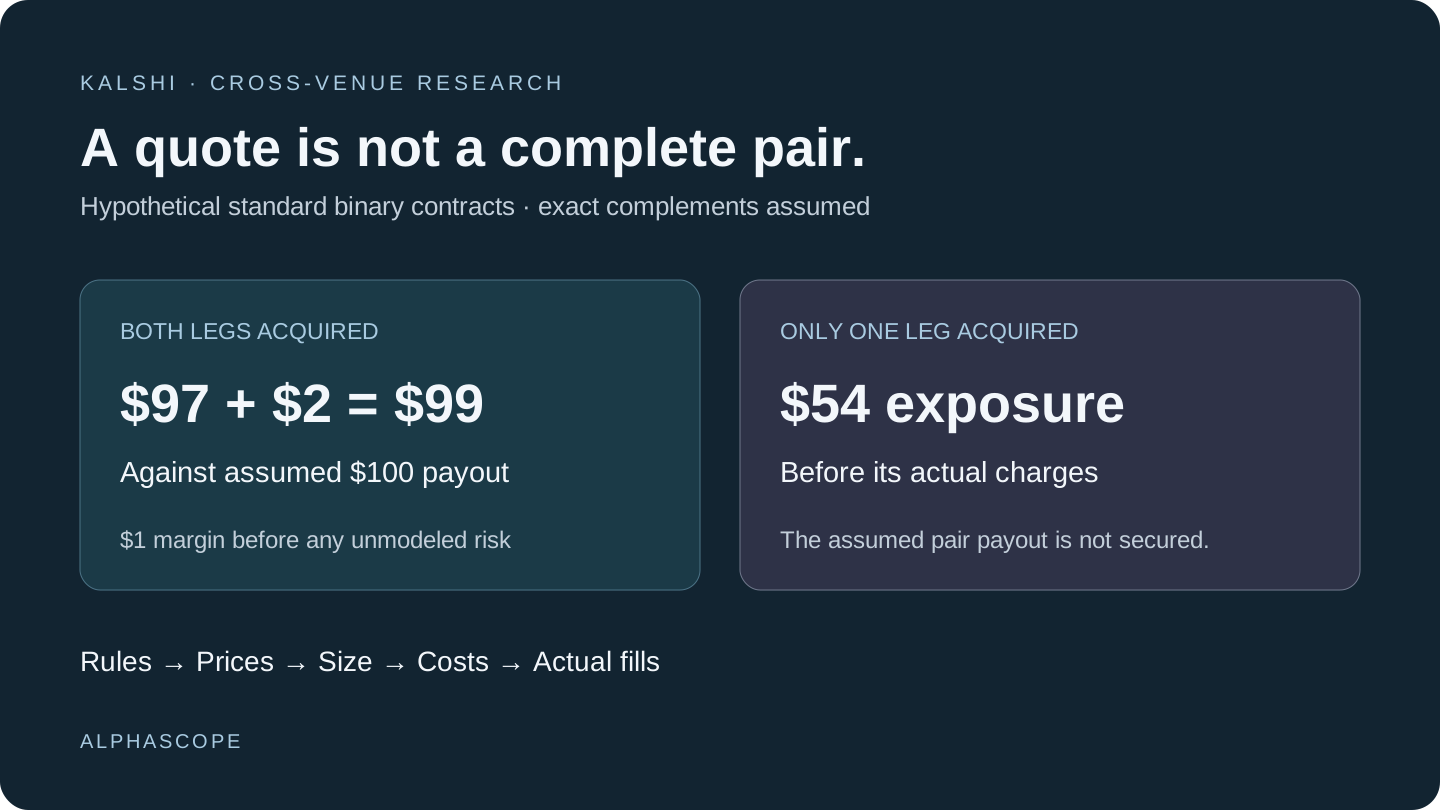
Suppose two invented standard binary contracts are exact complements and each qualifying outcome pays $1 on exactly one leg. Buying 100 Yes units at $0.54 and 100 complementary No units at $0.43 costs $97. With $2 in hypothetical total extra costs, combined spend is $99 against an assumed $100 payout: $1 of arithmetic margin.
| Scenario | Combined spend | Difference against assumed $100 payout |
|---|---|---|
| Both legs fill at $0.54/$0.43; $2 extra costs | $99 | +$1 |
| Second leg instead costs $0.49; same extra costs | $105 | −$5 |
The $100 payout is an assumption that must be proved from the actual rules. The $2 cost is invented, not a Kalshi fee quote. This example does not cover every contract type, later exit, currency conversion or settlement exception.
What if only the Kalshi leg fills?
If only the 100 Yes units at $0.54 fill, $54 has bought directional exposure before its actual charges. The assumed combined $100 payout has not been secured. A pending second order does not complete the hedge.
Review the acquired position, remaining orders and current opposing quotes. Assess the cost and maximum loss of keeping, completing or unwinding the position under the venue's actual rules. Define acceptable unmatched exposure before submitting orders; do not improvise it from the original headline spread.
Fees and funds availability require separate checks
Read the Kalshi fee guide alongside the current venue schedule and order quote. Include all applicable charges for the selected market and execution method. An order described as “limit” is not automatically a fee-free result.
Trading profit, contract settlement and transferable cash are separate records. The Kalshi settlement guide and portfolio-versus-cash guide explain why the event result does not by itself establish immediately available funds.
Keep a reproducible candidate record
- Both full contract definitions and selected sides.
- Payoff comparison for every relevant outcome.
- Quote times, quantities, depth and final fills.
- Actual charges and uncertain cost assumptions.
- Unmatched-leg exposure and exit assumptions.
Reject a candidate when contract equivalence is unresolved, executable size is insufficient or the all-in difference is nonpositive. If the arithmetic remains positive, that still does not test execution, platform access or eventual settlement.
For the general mechanism, read prediction-market arbitrage payout math. For the product distinction, use Polymarket vs Kalshi. Alphascope supports research and does not coordinate these orders across venues.