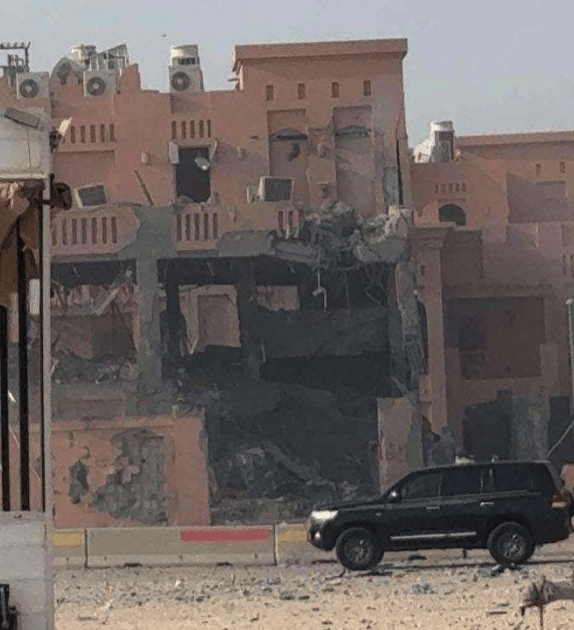
Iran has launched a barrage of retaliatory missiles aimed at Israel and US bases across the region, denouncing the two countries’ airstrikes as a breach of the UN charter and an act of flagrant aggression designed to end any possibility of a diplomatic resolution.
Iran’s foreign ministry called on Muslim and non-aligned states to demand an urgent meeting of the UN security council, pointing out that the US-Israeli strikes on Saturday were the second such attack in a year while Iran was in the middle of sensitive negotiations over its nuclear programme.
The talks were designed to set up a verifiable process whereby Iran could not acquire the materials for a nuclear bomb. The chief mediator in the talks, Oman’s foreign minister, Badr Albusaidi, had said on Friday that he believed peace was in reach.
After the first wave of Israeli attacks in Tehran on Saturday morning, officials insisted the leadership, including the supreme leader, Ayatollah Ali Khamenei, and President Masoud Pezeshkian, were safe, despite an attempt to assassinate them in the bombings. Khamenei’s office in the capital looked to be a charred ruin, according to satellite images.
Despite rumours that the commander-in-chief of the army, Maj Gen, Amir Hatami, had been killed, it did not initially appear that the attacks had managed to target its leadership on the same scale as it did last June. But the fate of the Revolutionary Guards commander, Mohammad Pakpour, was in doubt, and the home of the leading reformist and former prime minister Mir Hossein Mousavi was badly damaged.
Forty schoolchildren in a girl’s elementary school in Minab Hormozgan province were reportedly killed and 48 injured. Ambulances were seen taking injured people to hospital in central Tehran.
Pictures showed numerous Revolutionary Guards weapons warehouses had been hit, as well as missile sites.
The foreign ministry issued a statement, saying the country “will not hesitate” in its response. In a statement posted on X, the ministry said: “The time has come to defend the homeland and confront the enemy’s military assault.”
The national security council called on the public to relocate away from cities under attack, and the government information council insisted “people should not worry about shortages or deficiencies”.
The instruction to leave Tehran and other cities may reflect a desire to prevent the accumulation of protesting crowds, and was the opposite of the message being issued by Reza Pahlavi, the son of the shah who ruled Iran before the revolution that brought in it current theocracy. Pahlavi said he would soon be asking for the protesters to return to the streets.
Donald Trump addressed Iranian civilians in his speech announcing the US attack: “Bombs will fall everywhere. When we finish our work take control of your government,” he said.
It is unclear whether the Iranian security apparatus will be in any position to suppress any renewed street protests, or whether the attacks will reforge a sense of national cohesion, which had been lost amid the unprecedented state repression and economic malaise.
The supreme national security council claimed: “Essential goods and fuel and medicine are abundantly available in the country. 24-hour medical services, centres and pharmacies will continue. Today is a test of national resistance for Iranians and despite all complaints and grievances we are united and in unison against foreign aggression,”
Pezeshkian’s son, Youssef, said on Telegram: “As far as I know this time the assassination attempts were unsuccessful and other officials are also safe. We will probably have a longer conflict and it will be a war of attrition. Endurance and patience are essential to get though these days.”
A senior spokesperson for the armed forces warned: “We will give a lesson to [Israel and the US] that they have never experienced in their history. Any base in the entire region that helps Israel will be a target of the sacred system of the Islamic republic and we will show no leniency.”
The Iranian military confirmed that it had sent drones and fired short-range missiles at al-Udeid airbase in Qatar, the Ali al-Salem base in Kuwait,al-Dhafra airbase in the United Arab Emirates, the Prince Sultain airbase in Riyadh, the US base in Erbil, northern Iraq, the Muwaffaq Salti airbase in Jordan, and the US Fifth fleet base in Bahrain. Saudi Arabia and the UAE issued statements condemning Iranian violation of their sovereignty, and warning of their right to take reprisals.
Iran’s foreign minister, Abbas Araghchi, in a call with his counterparts from Saudi Arabia, UAE, Qatar, Kuwait, Bahrain and Iraq, sought to justify Iran’s actions by saying the Gulf states had a responsibility to try to stop the US from using their bases to mount an illegal attack on Iran.
Reza Nasri, a lawyer close to the foreign ministry, said in a message to the American people: “This is not your war. But you will pay for it with your soldiers’ lives, your national interests and your standing as Americans around the world .You will pay for it through the rise of anti-American sentiment globally, the tarnishing of your name, your flag and the hostile world your children will inherit.”