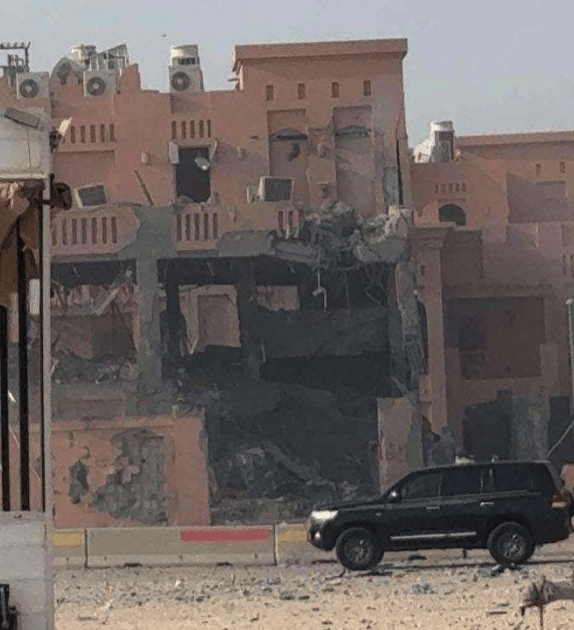
Iranian strike hits near Israeli nuclear facility
As a reminder, an Iranian missile strike hit the town of Dimona in southern Israel on Saturday, approximately 13km (8 miles) from a nuclear research facility.
Though the International Atomic Energy Agency (IAEA) has said it was not aware of any damage to the facility following the attack, the director general has warned that the "maximum military restraint should be observed, in particular in the vicinity of nuclear facilities".
The Shimon Peres Negev Nuclear Research Center - located in the Negev desert - is often referred to colloquially as the "Dimona reactor". It is long accepted as holding Israel's undeclared arsenal of nuclear weapons.
Officially, the site is said to focus solely on research. But for around six decades, it has been an open secret that Israel developed a nuclear bomb there, even if each succeeding government has maintained a position of ambiguity over this.
It has meant that Israel is the only nuclear power in the Middle East. So, any indication that it is being targeted is taken with the utmost seriousness by Israel.
Iranian state TV said the strike was in response to a reported attack on Iran's Natanz nuclear facility earlier on Saturday.
Read more about the impact of the strikes on Israel here.
'Nothing worse than being forced from home', Iranians tell BBC
Ghoncheh Habibiazad
Senior reporter, BBC Persian
Iranians inside the country have been speaking with BBC Persian about their experiences during the war.
One woman in Tehran has said that, in her view, "nothing is worse than being forced to leave your home". She says that she hasn't had to leave for now, but "I am still afraid, I won’t pretend I’m not, but at least I have my own belongings around me".
She says her thoughts are with those who had to leave: "For those who have lost their homes and become displaced, that is terrible. ... Honestly, I hope everyone who has been forced from their homes anywhere in the world can one day return. Losing your home is worse than the war itself."
One man tells the BBC that Iranians are "waiting for the day when we can celebrate freedom in our own homeland". He adds: "We believe that, after years of resistance and struggle, that day will mark the end of the evil king’s corrupt rule", referring to Iran's supreme leader.
BBC Persian is the Persian language service of BBC News, used by 24 million people around the world - the majority in Iran - despite being blocked and routinely jammed by Iranian authorities.
Attempted strike on Diego Garcia happened late on Thursday night into Friday morning, BBC understands
Damian Grammaticas
Political correspondent
Missiles targeting the joint UK-US base on Diego Garcia were fired by Iran sometime during the period late on Thursday night into Friday morning, the BBC understands.
Initial information had been limited only to the fact the incident had happened before Friday afternoon when UK government ministers met in London to discuss the war.
At that meeting ministers agreed the US could use UK airbases to carry out missions protecting shipping in the Strait of Hormuz as part of defensive actions against Iranian attacks.
Before then US use of British bases had been restricted to preventing Iranian missile attacks on UK interests and allies in the Middle East.
Strait of Hormuz - why is it significant?
As a reminder, Iran has effectively blocked the Strait of Hormuz, one of the world's busiest oil shipping channels, since the US and Israel attacked the country on 28 February.
Bounded to the north by Iran and to the south by Oman and the United Arab Emirates (UAE), the waterway - only about 50km (31 miles) wide at its entrance and exit, and about 33km wide at its narrowest point - connects the Gulf with the Arabian Sea.
About 20% of the world's oil and liquefied natural gas (LNG) usually passes through the strait, with oil coming not only from Iran but other Gulf states such as Iraq, Kuwait, Qatar, Saudi Arabia and the UAE.
What is the impact of closing the strait?
About 3,000 ships usually sail through the strait each month but this has dramatically decreased recently, with Iran threatening to attack tankers and other ships.
At least 21 vessels have been hit or targeted, or have reported attacks, since the start of the war, according to an AFP news agency tally on 18 March.
Global fuel prices have soared in the wake of the war. Crude oil has risen above $100 a barrel - up almost 70% this year and nearly 50% from a year ago.
You can read more about why the Strait of Hormuz matters so much here.
Trump's new 48-hour deadline for Iran: What we know
President Donald Trump issued Iran with a 48-hour deadline to re-open the Strait of Hormuz, after which he says the US will "obliterate" Iranian power plants.
In peacetime, around 20% of the world's oil and liquefied natural gas (LNG) shipments passes through the strait, making it critical for global energy supplies.
Trump posted on his Truth Social platform at 23:44 GMT on 21 March, meaning Iran has until 23:44 GMT on 23 March (03:14 in Tehran on 24 March), to meet the US president's demand.
He posted: "If Iran doesn’t FULLY OPEN, WITHOUT THREAT, the Strait of Hormuz, within 48 HOURS from this exact point in time, the United States of America will hit and obliterate their various POWER PLANTS, STARTING WITH THE BIGGEST ONE FIRST!"
Tehran says it will target US-linked energy sites across the Gulf region if it is attacked, according to Iranian state media.
Iran's blockade and attacks on ships in the Strait has seen oil prices soar over recent weeks.