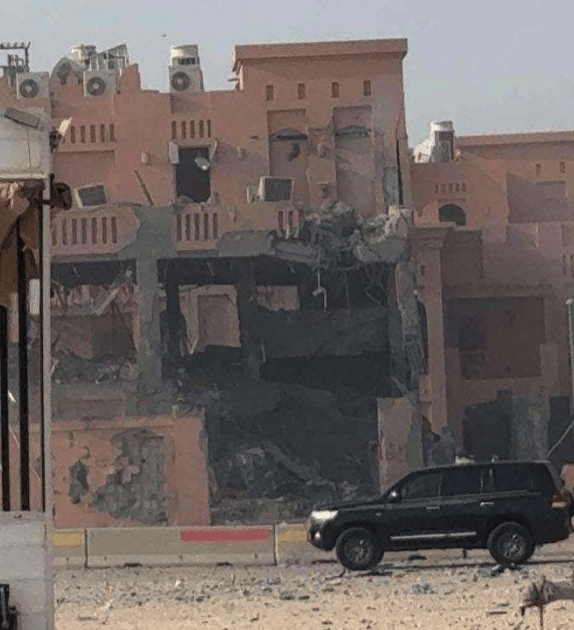
Strikes have hit nuclear-related facilities and sites in Tehran, while Iran has launched hundreds of missiles and drones in retaliation.
Share
The United States and Israel have continued to carry out strikes on Iran, bombing government, military and civilian infrastructure as the conflict spreads to Lebanon, where Israel has been carrying out an intense bombardment.
A fire broke out near the US consulate in Dubai on Tuesday as Iranian retaliatory strikes continued in the Gulf, escalating tensions in the Middle East.
Recommended Stories
list of 1 item
list 1 of 1US senators fear ‘boots on the ground’ after Iran war briefing
end of list
Iran has launched hundreds of missiles and drones as it expanded its attacks to energy infrastructure and diplomatic compounds.
The conflict, which entered its fifth day on Wednesday, has also sparked political debate in the US, with the opposition Democrats questioning Trump’s decision to attack Iran.
Here is what we know:
In Iran
Nuclear facilities: The Natanz nuclear facility was struck during the military operations, though Iranian media reports that no radioactive leakage has been recorded.
Iranian retaliation: According to US Admiral Brad Cooper, Iran has launched more than 500 ballistic missiles and 2,000 drones in retaliation.
These attacks have hit the US embassy in Saudi Arabia and struck near the US consulate in Dubai in the United Arab Emirates.
Ongoing operations: Israeli Prime Minister Benjamin Netanyahu confirmed that Israeli pilots are flying over Iran and Tehran, stating that Israel will continue to strike the country “with force”.
Rising death toll: After four days of fighting, Iran’s Foundation of Martyrs and Veterans Affairs reported that 1,045 people have been killed in US-Israeli attacks.
In Gulf nations and Turkiye
Advertisement
Regional security and infrastructure threats: Iran has launched strikes on energy infrastructure across the Gulf and warned that it will target “all economic centres in the region” if US-Israeli attacks continue.
Qatar: Qatari air defence systems intercepted projectiles in the skies over Doha, causing loud bangs.
The Gulf country has also said it has arrested 10 suspected spies operating for the Islamic Revolutionary Guard Corps (IRGC).
Saudi Arabia: Saudi authorities reported that two drones struck the US embassy in Riyadh, which caused a limited fire and minor damage.
Oman: Citing “ongoing activity,” the US embassy in Muscat instructed its staff and all American citizens in Oman to shelter in place and find secure locations until further notice.
Vessel Struck off UAE Coast: The British maritime security tracker (UKMTO) reported that a vessel was hit by an unknown projectile 7 nautical miles east of Fujairah, United Arab Emirates. Separately, a drone struck near the US consulate in Dubai.
China: Foreign Minister Wang Yi told his Saudi Arabian and UAE counterparts that Beijing will send a special envoy to the Middle East for mediation purposes.
Turkiye: An Iranian ballistic missile that was fired from Iran and heading into Turkish territory was downed by NATO air defence systems, the Turkish Ministry of National Defence said.
In Israel:
Attacks inside Israel: The Lebanese armed group Hezbollah claims to have fired rockets at Israeli forces in the northern town of Metula.
Additionally, the Iran-aligned Hezbollah announced that it has carried out a missile attack on a naval base in Haifa.
Israeli military operations: Israel is a primary actor in the continuing multi-front conflict, actively bombarding targets in both Iran and Lebanon. In Lebanon, Israeli air attacks have killed at least 50 people and wounded 335.
Israel’s military announced that two soldiers were “moderately injured due to anti-tank fire in southern Lebanon.
Air strikes on Hezbollah: The Israeli military has struck approximately 60 Hezbollah targets in southern Lebanon, hitting weapons storage facilities, command centres and missile launchers.
In the United States
US political stance: Trump stated that “the big scale hitting goes now,” promising that Iran is “in for a lot of hurt”.
Despite the heavy military action, Trump maintains that a US-led regime change is not the primary goal, suggesting instead that “someone from within” the current Iranian government might be the best choice to take power once the war concludes.
General Dan Caine, chairman of the Joint Chiefs of Staff, told a news briefing that Iran was now firing fewer missiles than at the start of the war and that the US will “expand inland striking progressively deeper into Iranian territory”.
Defense Secretary Pete Hegseth told reporters the US was winning the war and confirmed that the military sank an Iranian warship off the coast of Sri Lanka.
At least 80 people were killed in the US submarine strike on the Iranian vessel in the Indian Ocean, Sri Lanka’s Deputy Foreign Minister said in a statement to local television.
Political fallout: Domestically, the war has led to intense political debate due to shifting justifications from the Trump administration. Trump stated he ordered the attacks because he believed Tehran was preparing to strike first.
The US Senate is scheduled to vote on the War Powers Act in an attempt to test whether President Trump has the authorisation to wage these military operations.
US-UK diplomatic rift: Trump heavily criticised UK Prime Minister Sir Keir Starmer, stating, “This is not Winston Churchill we’re dealing with.” This comes after Starmer refused to support the military operation or allow the US to launch attacks from the joint UK-US base at Diego Garcia.
Lawmakers warn of a ground war: Following a three-hour briefing by Secretary of State Marco Rubio, Democratic lawmakers are sounding the alarm that the US could be drawn into a prolonged ground war.
Death toll: The US identified four American soldiers who were killed during an Iranian retaliatory strike on a military facility in Kuwait, bringing the total confirmed US deaths to six.
In Lebanon, Iraq and Jordan
Advertisement
Lebanese government stance: The Lebanese government officially banned Hezbollah’s military activities on Monday and demanded that the group hand over its weapons to the state.
Officials in Lebanon said at least 50 people have been killed since Israel began attacks on the country on Monday.
Pressure from Israel: Israel’s ambassador to the UN, Danny Danon, agreed with the calls for Hezbollah to disarm, but urged the Lebanese government to “act now,” emphasising that “statements do not dismantle rockets… only action does.”
Iraq: Airstrikes have targeted sites used by pro-Iran armed groups, including Kataib Hezbollah and Asa’ib Ahl al-Haq, in western and northeastern Iraq.
Czech Evacuations: The first Czech government evacuation plane, a military Airbus carrying about 40 passengers, flew out of Jordan and successfully landed in Prague.
Slovak Evacuations: Similarly, the first two evacuation flights organised by the Slovak government flew out of Jordan and landed in Bratislava, bringing 127 people to safety.
aj-logo
aj-logo
aj-logo
Advertisement