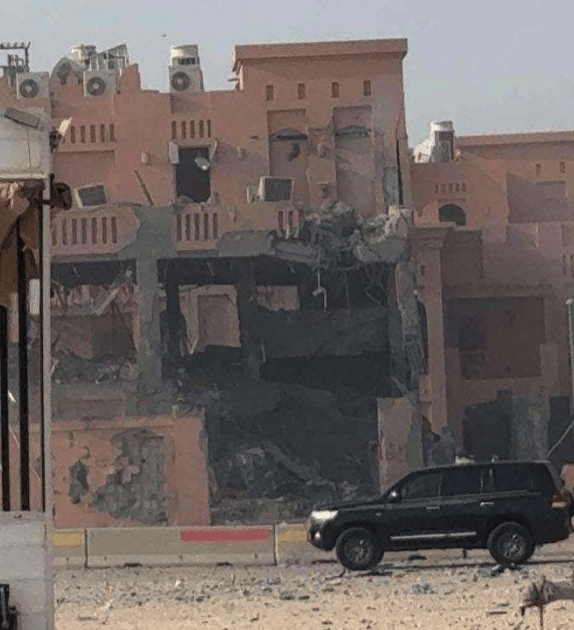
Fifteen people were injured on Sunday, one of them seriously, when an Iranian ballistic missile dropped cluster munitions in central Israel, paramedics said, in the Islamic Republic’s fourth ballistic missile attack since midnight.
The missile spread bomblets over a wide area in Tel Aviv and nearby cities.
Tel Aviv Sourasky Medical Center-Ichilov said seven people who were injured in the attack were brought to the hospital, four of them in moderate condition.
The Magen David Adom ambulance service said the most serious injuries it treated were sustained by a 53-year-old man.
Damage was caused to several homes and roads by the impacts.
In Jaffa, a projectile struck a residential building, and an impact in Petah Tikva started a fire in a residential area, but no one was seriously injured in those locations.
The first missile attack of the day — around 7 a.m., following an eight-hour lull — was also assessed to have contained a cluster bomb warhead. A bomblet impact damaged a road, but there were no reports of direct injuries from the attack.
Four additional attacks — two targeting central Israel, and two targeting southern Israel — set off sirens and sent hundreds of thousands of people to bomb shelters, but did not result in any reported damage or direct injuries.
36 still hospitalized from impacts in south on Saturday
Sunday’s salvos, six total by 2 p.m., came after two direct hits the previous evening in the cities of Dimona and Arad in the south injured hundreds of people and sent dozens to the hospital.
As of Sunday morning, five people wounded in the Dimona impact were still hospitalized, including a 12-year-old boy in serious condition who underwent surgery, and a man in his 20s in moderate condition, Beersheba’s Soroka Medical Center said.
From the strike in Arad, 31 people remained hospitalized at Soroka, including 18 children.
Two of the people lightly wounded in the strikes were taken to Sheba Medical Center and were continuing their treatment there, the hospital said.
A total of 4,564 people have been taken to hospitals since the start of the war with Iran, as a result of the conflict, according to the Health Ministry.
The ministry did not give a breakdown of the causes of injuries, many of which were sustained by people trying to reach shelters rather than as a direct result of missile fire.
Since the war began on February 28, 15 civilians and foreign nationals have been killed in Israel in Iranian missile attacks, along with four Palestinians in the West Bank. Farmer Ofer Moskovitz, who was killed Sunday, and two soldiers have been killed in Hezbollah attacks.
Most of those wounded in Dimona, Arad weren’t in shelters
An investigation by the military’s Home Front Command found that most of those injured in the missile attacks Saturday night were not inside bomb shelters when the impacts occurred.
In Dimona, a missile carrying a conventional warhead of hundreds of kilograms of explosives struck soft ground next to homes. The shockwave caused extensive damage to surrounding buildings and injured some 30 people, including the young boy.
There are bomb shelters in the area, however, and those who were inside them were largely unharmed by the blast, according to the Israel Defense Forces.
Similarly, in Arad, the missile — also carrying a conventional warhead — struck a courtyard between several apartment buildings with basement shelters. The impact caused massive damage to the buildings and injured nearly 90 people, 10 of them seriously. Nearly all of those wounded had not been sheltering, the Home Front Command found.
Air defenses had engaged both projectiles, but the interceptors failed to knock them down.
According to the Israeli Air Force’s probes of the incidents, there was no relation between the errors that led to the two impacts, and the fact that they had occurred in the same area within two hours was entirely coincidental.
The IAF said the Iranian missiles were likely from the Ghadr family of projectiles, and were a known threat.
Two earlier missile attacks on the same area in southern Israel were successfully intercepted using the same air defense systems, according to the IAF, stressing that there is no “systemic failure” in Israel’s air defenses.
Netanyahu, in Arad: If you’re in a shelter, you’re protected
Prime Minister Benjamin Netanyahu, visiting the site of the impact in Arad, said it was a “miracle” that no one was killed and urged residents to shelter when they hear a warning siren.
“We don’t want to rely on miracles. There was a full ten minutes from the [early cellphone] warning until the missile’s impact. If everyone had gone to protected areas in time, to the shelters that are there under every home, no one would have been wounded,” the premier insisted.
He noted that of all 15 people who have been killed by missile attacks since the start of the war, there was only one incident — in Beit Shemesh — in which the missile directly hit the protected area, and that in all other cases, no one in a shelter had been seriously hurt. “If you’re in a shelter, you’re protected,” he said.
Netanyahu also responded to Iran’s long-range ballistic missile attack on the UK-US Indian Ocean military base at Diego Garcia over the weekend, saying the Islamic Republic has “the capacity to reach deep into Europe” and is “putting everyone in their sights.”
The premier condemned recent Iranian attacks that have resulted in shrapnel falling near holy sites in Jerusalem.
“They fired on Jerusalem, right next to the holy sites of the three monotheistic faiths: the Western Wall, the Church of the Holy Sepulchre, and the Al-Aqsa Mosque. By dint of a miracle, none of them were hurt, but they were targeting the holy sites of the three major monotheistic religions,” Netanyahu asserted.
Asked by a Fox News reporter what his response will be to Iran’s incessant attacks on Israeli civilians, the premier responded: “We’re responding with great force, but not on civilians. We’re going after the regime. We’re going after the IRGC, this criminal gang, and we’re going after them personally, their leaders, their installations, their economic assets. We’re going after them very strongly.”
Lapid: Israel must finish off Iran’s ballistic missile capabilities
Visiting the same site, Opposition Leader Yair Lapid insisted that Israel not halt the war until it achieves “the elimination of all of Iran’s ballistic capabilities.”
Lapid noted that Beersheba’s Soroka hospital, where many of those wounded in the attack were sent for treatment, is still operating at a reduced capacity following an Iranian ballistic missile strike on its surgical ward last June.
More than 400 ballistic missiles have been launched from Iran at Israel since the start of the war, with the IAF reporting an interception rate of 92 percent of attacks heading for populated areas and key infrastructure.
In all, five missiles carrying conventional warheads with hundreds of kilograms of explosives have struck populated areas in Israel, causing extensive damage in four cases. There have also been more than two dozen incidents of missiles carrying cluster bomb warheads hitting populated areas, with over 100 separate impact sites.
Sam Sokol and Times of Israel staff contributed to this report.