
On this page
The Kalshi GOVTSHUTDOWN contract inspected here asks whether the federal government is at least partially shut down because of an appropriations lapse at 10:00 AM ET on its named date. A shutdown that happened earlier and ended before the checkpoint is a different proposition.
Sources reviewed October 13, 2026. The linked December contract is a dated rule example; this guide is not a live odds feed, an account-eligibility check or a guarantee that any market remains open. Read the current full terms before relying on the example for another contract.
The dated contract: December 12, 2026
The official Government shutdown on Dec 12, 2026? page identifies KXGOVTSHUTDOWN-26DEC12 as its market ticker and lists the 10:00 AM ET checkpoint. Its named sources include OMB and OPM. The page’s example of a technical funding lapse with an OMB direction to continue standard operations would not satisfy Yes.
Write down the date and clock time together. “December 12” alone omits information that can change what the contract asks. A headline about negotiations overnight does not establish the status at 10 AM, and a news article’s publication time is not necessarily the time of the condition it describes.
On a date is different from by a deadline
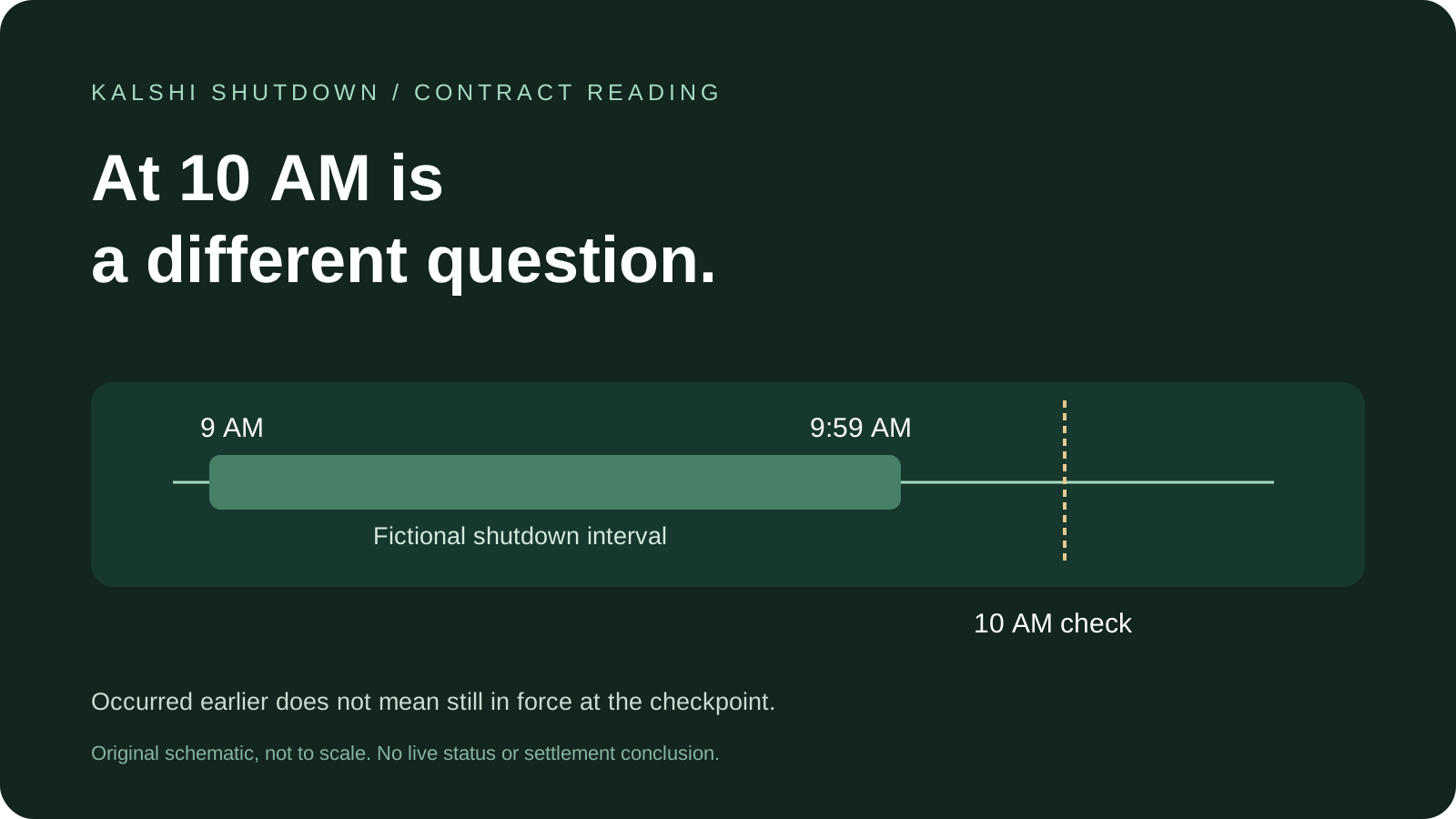
Use an original fictional timeline: a qualifying shutdown starts at 9:00 AM and ends at 9:59 AM on the named date. A question asking whether a shutdown happened by 10 AM could be satisfied. A question asking whether the government is shut down at 10 AM asks for a different fact. This is a reading example, not a report of an actual shutdown or a settlement decision.
Now imagine a shutdown continuing through the checkpoint. The relevant fact for a status-at-time question is the condition at the checkpoint, even if it began days earlier. The full GOVTSHUTDOWN rules explicitly allow the named date to fall within a continuing shutdown period.
| Question wording | Fact to establish | What is insufficient |
|---|---|---|
| Shut down at 10 AM on a date | Status at the specified checkpoint | Only knowing a shutdown happened earlier |
| Shutdown occurs by a deadline | Occurrence within the defined window | Applying a different contract’s status checkpoint |
| Shutdown ends by a deadline | Qualifying end under that contract’s rule | Confusing reopening, announcement and publication times |
| Shutdown lasts a number of days | Defined start, end and day-count convention | One status observation on one date |
A technical funding lapse is not enough in this example
The inspected market page distinguishes an appropriations lapse from the qualifying shutdown condition. It describes suspension of non-excepted agency work when funding is unavailable, usually accompanied by furloughs. It also excludes holiday, weather and unrelated emergency closures unless accompanied by the qualifying appropriations-related shutdown.
Do not reduce this to “any funding gap is Yes” or “a furlough count is the only test.” Use the definition and source evidence together. If a document says an agency is closed, inspect the reason, effective time and work affected before treating it as evidence for a specific event contract.
How the source hierarchy works
The full rules name OMB and OPM as primary sources and list secondary news sources. Secondary evidence may be used when primary guidance is untimely or conflicting. In that case, a headline saying the government shut down is insufficient without reporting consistent with the defined suspension of operations or furloughs. A reopening headline alone is likewise insufficient without relevant operational or funding detail.
Keep the source document, publication timestamp and effective timestamp separately. A later report can describe an earlier condition; a statement can also announce a future change. Those are reasons to preserve the evidence trail rather than equate every timestamp with the contract checkpoint.
What about Kalshi government shutdown length?
A checkpoint contract does not directly measure how long a shutdown lasts. Before using a separate length contract, identify its start, end and counting convention. Does it count calendar days, completed 24-hour periods, or another quantity? Verify those fields in that contract’s own rules.
Several status-at-time contracts can all be Yes if a shutdown continues through several checkpoints. They are not automatically mutually exclusive outcomes. Nor are later status checks necessarily nested in earlier ones: a shutdown can end and another can begin. Do not apply cumulative end-by arithmetic to every date-labelled status market.
For comparison, our Polymarket shutdown guide includes a fictional cumulative end-by lesson. That calculation assumes one consistent event definition and ordered deadlines. Its assumptions should be established before reusing its formula.
Read the quote separately from the rule
Once you know the event, record the quote type and time. A displayed probability based on recent transactions is different from the price available to buy or sell your quantity. Inspect the order book, spread, depth and fees. Our prediction-market odds guide provides broader context.
For an original fictional ordinary binary Yes contract bought at 40 cents, a $1 winning payout gives 60 cents of gross profit; a losing outcome gives a 40-cent loss, before fees. That arithmetic is a payoff example, not a claim that the true probability is 40% or that this is a recommended trade. Use the profit calculator to inspect hypothetical entry-cost scenarios.
A difference between two platforms’ prices is not proof of arbitrage. Their condition, date, timezone and source requirements must match, and both quotes must be executable for the assumed quantity. Do not infer matching settlement rules from matching headlines.
Checkpoint, expiration and payout are separate times
The full rules specify a latest expiration one day after the named date to accommodate reporting delays, with provisions for earlier expiration. They also allow outcome review and associated settlement contingencies. Treat a projected payout on the event page as a projection, not a promise that review cannot affect timing.
Your research record should therefore separate the time being observed, the trading close, expiration and the payout state. A condition may already have occurred while an outcome is still being determined. Conversely, a displayed result does not tell you when a particular account’s funds are available to withdraw.
Read our Kalshi settlement timing guide for the distinction between close, determination and cash credit. Use the official account screen for your individual balance.
A worksheet for comparing shutdown contracts
Download the checkpoint worksheet. Record the ticker, named date, exact time, trigger, source hierarchy, exceptions, quote timestamp and settlement timeline. Use a second copy for a comparison contract so a changed condition is visible.
For a status claim, ask: what was true at the checkpoint, and which permitted source establishes it? For a duration claim, ask: what are the endpoints and counting rule? For a price claim, ask: which quote and what size? Those three questions can prevent a technically correct number from being attached to the wrong proposition.
Evaluate forecasting claims with a record
This article does not establish that shutdown markets systematically overprice risk or that a deadline-trading strategy has been profitable. Such claims need timestamped forecasts, resolved outcomes, a stated sample-selection rule and execution costs. A few remembered price swings are not that record.
Our Brier score calculator and log-loss calculator explain how to score recorded binary probabilities. Those scores assess the entered forecast sample; they do not establish profits from buying at market prices.
Alphascope helps organize prediction-market research. The useful starting point here is a precise contract and evidence trail, not an assumed universal shutdown definition or an unsupported historical trading edge.