
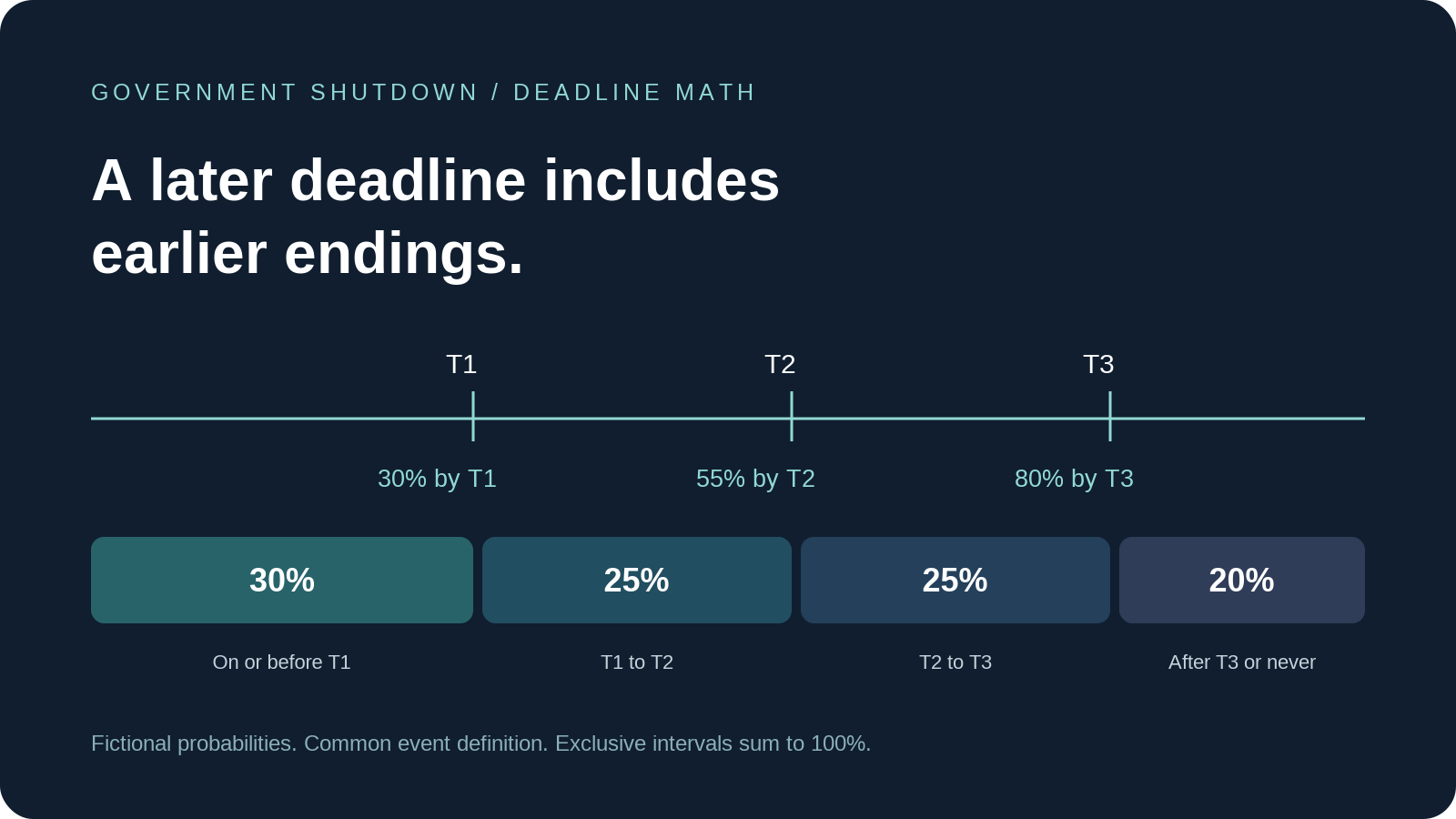
Later deadlines include earlier ones.
Enter fictional cumulative probabilities that the same shutdown ends on or before three ordered deadlines. T1, T2 and T3 are illustrative labels, not current dates or market odds. Assume one common definition of ending and one consistent forecast.
Implied mutually exclusive intervals
- On or before T1
- 30.00%
- After T1, on or before T2
- 25.00%
- After T2, on or before T3
- 25.00%
- After T3 or never
- 20.00%
Intervals sum to 100%. A deadline exactly T1 is in the first interval; exactly T2 is in the second; exactly T3 is in the third.
Differences describe this assumed probability model. Subtracting unrelated market prices does not establish an executable interval price or an arbitrage opportunity. Rules, quote times, spreads and fees must be checked separately.
On this page
Polymarket government-shutdown odds describe a particular contract, not one universal probability of a shutdown. Check the trigger, deadline, timezone and resolution source before comparing two prices. A funding-lapse contract can have a different condition from a contract asking when a shutdown ends.
This guide was reviewed October 13, 2026. The official contracts linked below are historical rule examples, not a live odds feed or a claim that a particular market is open today. The interactive lesson above uses fictional probabilities.
Where to check government shutdown odds on Polymarket
Open the official event page for the deadline you mean. Read its full year and rules, then check whether the market is active, closed, awaiting resolution or resolved. Record the time when you read a price. An old chart or resolved result is not a forecast of the next funding deadline.
For example, the official Government shutdown by October 1? page lists an October 1, 2026 end date. That date is already past at this review. Its displayed price should not be carried forward as the probability of a later shutdown.
A search snippet can look fresh while the contract is old. A page title containing the current year is also weaker evidence than the actual contract dates and resolution status. Save the event link and market identifier with any odds you share.
A funding lapse and a shutdown need not be the same contract
The official Federal Appropriations Lapse on October 1? rules specify October 1, 2026 at 12:00 AM ET. They cover a partial or full federal appropriations lapse of any duration, even without operational impact; a subsequent shutdown is not required. The rule names official government information, including Congress.gov, with credible reporting also permitted. Its final outcome was displayed as No when inspected October 13.
That is one contract’s rule, not a definition to apply to every shutdown market. Do not replace the actual condition with “a politician said shutdown” or “an office was closed.” Read exclusions and clarification notices as carefully as the headline.
| Question shape | What to inspect | Common mistaken comparison |
|---|---|---|
| Shutdown by a deadline | Trigger, scope and exact cutoff | Treating every funding lapse as the same outcome |
| Appropriations lapse at a time | Whether any duration or partial lapse counts | Requiring operational disruption when the rule does not |
| Shutdown ends by a date | Who announces the end and which timezone applies | Adding nested deadline probabilities as if they were exclusive |
| Shutdown lasts a number of days | Starting point, day-count convention and endpoint | Converting an end date into duration without a defined start |
When will the government shutdown end?
An end-by question differs from an exact ending-date question. The older Will the Government shutdown end by...? example opened in October 2025. Its rule uses an OPM announcement that the federal government is no longer shut down due to an appropriations lapse by the listed date in ET. Partial shutdowns count; holiday or weather closures do not. The named source is OPM’s Operating Status page.
The historical page also displays a clarification that the OPM announcement date determines the end, even if the reopening date it announces is later. That is a concrete reason to inspect clarification notices rather than infer an end time from a news headline.
Those historical rules demonstrate why several deadline contracts can be Yes together. If the qualifying end occurs before an early deadline, it is also before later deadlines. A list of date-labelled Yes contracts is therefore not necessarily a set of mutually exclusive outcomes.
Check whether your event instead uses non-overlapping date ranges. “By Friday” and “during Saturday through Sunday” answer different questions. Before reading an event as a probability distribution, write down what each row actually covers.
Use cumulative probabilities carefully
Try the fictional deadline lesson above. If the same event has cumulative probabilities of 30% by T1, 55% by T2 and 80% by T3, the implied exclusive intervals are 30%, 25%, 25% and 20%. The 25% between T1 and T2 is 55 minus 30 percentage points, not 55% of 30%.
The final 20% means after T3 or never under this model. It is not a forecast that the shutdown definitely ends after T3. The distinction matters when there is a possibility that the question’s qualifying event never occurs.
The lesson assumes one consistent definition and ordered deadlines. Decreasing cumulative inputs are rejected. In real market comparisons, apparent decreases can come from different rules, stale quotes or spreads. The arithmetic alone cannot identify which explanation applies and does not establish a tradable arbitrage.
How long will a government shutdown last?
A duration forecast needs a starting point as well as an ending condition. If one contract counts calendar days and another counts completed 24-hour periods, an event ending at the same instant could fit different buckets. Treat those conventions as part of the contract, not a footnote to add after the result.
Use an original fictional example: a lapse starts shortly before midnight and funding resumes shortly after midnight. That spans two calendar dates but lasts only minutes. Whether it qualifies as a shutdown, and how many days it counts, depends on the rules you selected. This example describes a reading problem; it is not a report of an actual funding lapse.
Displayed probability is not a guaranteed fill
Record whether a number is a last trade, a displayed probability, a best bid or a best ask. Then check size, spread and quote time. The number you can execute for your quantity can differ from a chart label.
For a fictional simple Yes share purchased at 55 cents, a $1 winning payout gives 45 cents of gross profit and a losing outcome gives a 55-cent loss, before fees. Those payoff amounts do not establish the true event probability. Our profit calculator helps separate entry cost from payout, while the order-book guide explains executable quotes.
For a different question type, our Kalshi shutdown checkpoint guide explains a dated 10 AM ET example and why status-at-time is not the same as an earlier occurrence.
Do not infer a safe cross-platform comparison from two similar titles. The trigger, date, timezone and source must align before prices can answer the same question. Different wording can create different outcomes even when a headline groups them together.
A contract-reading worksheet
Download the shutdown-market worksheet. Record the platform, event link, market identifier, status, cutoff, trigger, exclusions, source and quote type. Use a separate copy for each contract rather than overwriting one description with another.
For news, distinguish a proposed agreement, a passed bill, a signed funding measure and a source announcement required by a contract. A news headline may help you research a forecast; it does not replace the settlement rule. Check the underlying document before changing your interpretation of the event.
Government shutdown is different from platform shutdown
This page covers federal-government event contracts. A question about Polymarket’s service being unavailable, an account restriction or a legal proceeding has a different scope. Do not use a government-shutdown probability to answer whether a platform is operating in a particular place.
The linked Polymarket.com examples are from the international product. Its current page directs US users to the separate US product. For product and account-access questions, use our Polymarket access guide. Alphascope supports prediction-market research; this article does not guarantee current market availability, a trading fill or a political outcome.