
How to Bet on Bitcoin: Kalshi & Polymarket Contract Rules
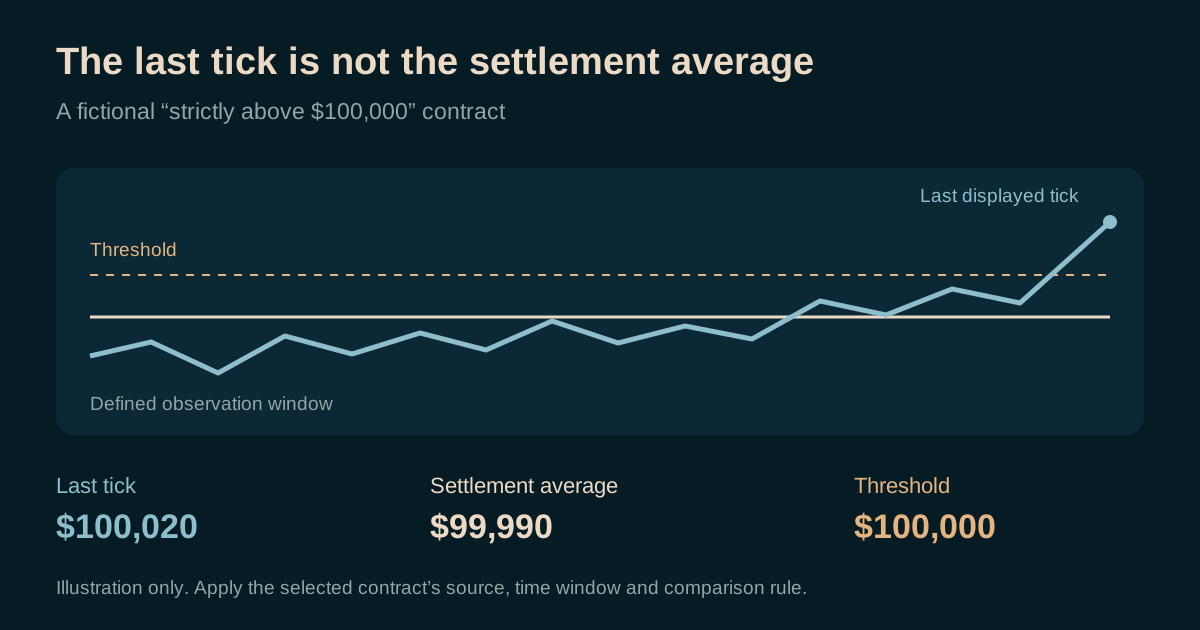
Betting on Bitcoin through a prediction market means buying a contract on a defined outcome. It does not mean buying BTC. A price target, a price range and an Up/Down window can give different results even when Bitcoin follows the same path. Start with the contract's rules, then compare its executable price with your own probability estimate.
Reviewed October 6, 2026. The examples below are fictional. Market availability, account eligibility, fees and individual rules can change; check the selected venue and contract before funding or trading.
Choose the Bitcoin question first
| Question type | What decides it | What to check |
|---|---|---|
| Above a threshold at a deadline | The specified observation at the stated time | Index, averaging window, time zone and strict versus inclusive comparison |
| Touches a level before a deadline | A qualifying observation within the allowed interval | What counts as a touch and which source records it |
| Ends in a price range | The final defined observation falls within the selected band | Whether each endpoint is included |
| Up or Down over a short window | The comparison between the contract's defined starting and ending measures | Reference values, window, price source and tie rule |
A move from $90,000 to $99,000 is a rise, but it does not satisfy a hypothetical “above $100,000 at the deadline” contract. A brief touch of $100,100 followed by a fall can satisfy a touch condition while failing a deadline condition. These questions are different exposures.
How Kalshi Bitcoin markets settle
Kalshi's crypto-market help page describes settlement using the relevant CF Benchmarks Real-Time Index and an average of sixty one-second observations during the final minute before expiration. That differs from checking a single exchange's last trade.
For a selected BTC contract, read the complete rule for the relevant index, observation time, comparison and contingencies. The help article gives context; the individual contract supplies the exact question. A chart, another exchange's price or a screenshot from a different window cannot replace that rule.
Fictional example: a strict “above $100,000” condition uses a defined final-minute average of $99,990. A final displayed tick of $100,020 does not change that average into a winning observation. If the rule uses a different method, apply that method instead.
Open the official Kalshi site for current listings. Distinguish binary event contracts from spot BTC and from perpetual futures; a product mentioning Bitcoin does not by itself identify its payout or loss structure.
For the two-reference comparison and equality rule in a dated short-window example, read the Kalshi 15-minute Bitcoin guide.
How Polymarket Bitcoin rules can differ
Read the resolution rules for the actual Polymarket event. An October 6, 2026 five-minute BTC contract, now closed, names a Chainlink BTC/USD TWAP stream and resolves Up when its specified TWAP measure is greater than or equal to the starting reference. It is an example of rules to inspect, not a live opportunity or a rule for every BTC market.
The same page contains a simplified price-at-end summary. Use the complete Rules section to identify the observation method rather than substituting that summary for the TWAP wording. See our Bitcoin Up/Down settlement guide for the source and timing checklist, or the broader Polymarket Bitcoin guide for other contract types.
Compare equivalent questions before comparing odds across venues. Matching asset names are insufficient: different windows, sources, averaging methods or tie rules can make two contracts resolve differently.
Calculate the contract payout, not the BTC return
Suppose a normal binary Yes contract pays $1 if Yes wins and $0 if it loses. Buying 100 contracts at an executable 42¢ price costs $42 before fees. A winning settlement pays $100, leaving $58 gross profit before costs; a losing settlement pays zero, losing the $42 purchase cost plus applicable fees. The payout does not grow because Bitcoin exceeds the target by more dollars.
If your estimated chance is 50%, expected gross payout is $50 for those 100 contracts. Subtracting the $42 purchase cost gives $8 expected value before costs. That depends on your probability being well founded; it is not guaranteed profit. Use the expected-value calculator with fees and the profit calculator for settlement profit and maximum loss.
Selling before settlement uses the available bid and depth, not the eventual $1 payout. A displayed price is not proof that your full order can fill there. Check the spread, price levels, order size and current fee quote; the slippage calculator helps illustrate execution cost using values you enter.
A practical workflow before placing a trade
- Confirm access at the venue. Check account eligibility and current product availability before depositing. Polymarket's international platform and Polymarket US are separate contexts; do not assume their contracts or accounts are interchangeable.
- Save the question and rules. Record the threshold or band, date, time zone, named source, observation window, tie rule and any cancellation or exceptional-settlement terms.
- Separate the two prices. The BTC reference helps decide the event. The contract price is what you pay for its outcome. A 42¢ contract is not 42¢ worth of Bitcoin.
- Estimate the exact event. “BTC seems bullish” is not a probability estimate for a particular threshold at a particular time. Note what information supports your estimate and what would change it.
- Check an executable order. Review the ask or bid for your intended size, fees, available depth and time remaining. A limit order may remain unfilled or partially fill.
- Account for related exposure. Several BTC positions can lose on the same move. Do not treat separate market pages as evidence of independent outcomes.
- Reconcile after trading. Keep the fill price, quantity, fees and applicable rules. After resolution, compare the official observation and payout with the contract you actually held.
Research Bitcoin markets with Alphascope
Use the Bitcoin odds page, forecast research and market news to investigate a candidate contract. Coverage can be incomplete or delayed, so verify the current venue listing, rule and executable quote before acting. An educational example or forecast does not establish a trading advantage.
For short windows, verify data timestamps and the settlement measure before trying to react faster. A fresh spot print is still the wrong signal if it does not measure the event your contract resolves on.