
On this page
Kalshi 15 min BTC markets ask whether a defined Bitcoin reference rises over a short window. The key detail is what “rises” means in the selected contract. The October 6 contract reviewed here compares two 60-second averages of CF Benchmarks' Bitcoin Real-Time Index, rather than two arbitrary spot-price ticks. Its comparison includes equality.
Reviewed October 6, 2026. This is a guide to the contract mechanics, not a live quote or a trading signal. Open the official Kalshi platform for current listings, eligibility and the complete rules of the window you select.
What decides a Kalshi 15-minute Bitcoin contract?
The dated market record for KXBTC15M-26OCT062030-30 specifies a Yes outcome when the BRTI average from the minute before 8:30 PM EDT is at least the BRTI average from the minute before 8:15 PM EDT on October 6, 2026. That reviewed market is now finalized; it is not an open opportunity.
The record's secondary rules describe sixty one-second index observations before expiration and rounding the final average to two decimal places. Preserve the complete rules of your own contract, including any additional contingencies. Do not add a rounding step or substitute a price source that the rules do not specify.
Kalshi's crypto-market help article explains the broader CF Benchmarks averaging approach. An external exchange quote can help with context while still differing from the reference that determines settlement.
The window has two reference measurements
- Beginning reference: read the averaging window stated for the initial BRTI reference. In the reviewed example, it is the minute before 8:15 PM EDT.
- Trading interval: the contract concerns the following 15-minute period. A price crossing during that period is not, by itself, the final comparison.
- Ending reference: apply the specified average before expiration, including the stated final-value precision.
- Comparison: use the contract's exact operator. The reviewed record uses a greater-than-or-equal comparison.
Save the window's date and time zone. Kalshi Pro's chart documentation says displayed chart times are local, so do not silently mix a local display with an EDT time in a dated rule. A different window is a different contract.
What happens if the two values are equal?
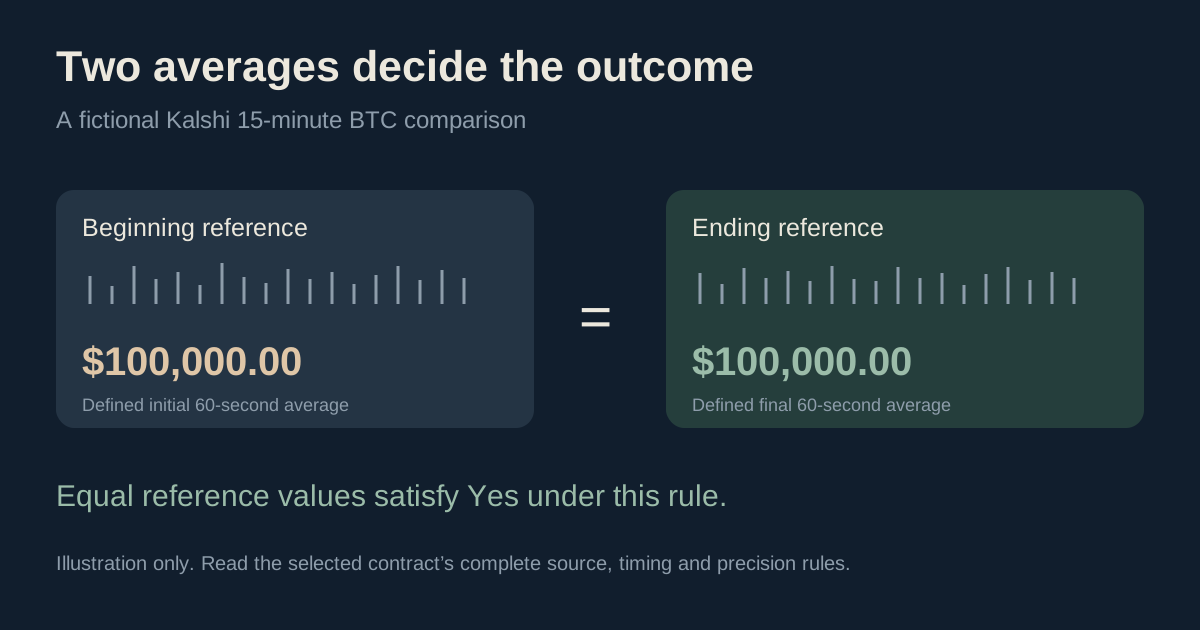
For the reviewed greater-than-or-equal rule, an equal defined ending value satisfies Yes. Do not infer a push, refund or No outcome from the everyday meaning of “up.” The following values are fictional and already represent the contract's defined references.
| Beginning reference | Ending reference | Comparison | Result under this rule |
|---|---|---|---|
| $100,000.00 | $100,001.00 | Ending is higher | Yes |
| $100,000.00 | $100,000.00 | Values are equal | Yes |
| $100,000.00 | $99,999.00 | Ending is lower | No |
A last displayed tick of $100,020 can coexist with a final defined average below a $100,000 reference. One tick does not replace the average. Our cross-venue Bitcoin contract guide illustrates that distinction and compares threshold, touch, range and Up/Down questions.
Bitcoin's price and the contract's price are different
The underlying Bitcoin reference is measured in dollars per BTC. The binary contract price is what you pay for exposure to the outcome. A 60¢ Yes contract does not mean purchasing 60¢ worth of Bitcoin.
The Kalshi Pro chart guide distinguishes the underlying-asset view used for short-duration crypto from the standard contract-price chart. Identify which one you are reading. A distance from target or countdown can describe the current situation without providing an independently justified probability of settlement.
Worked payout and expected-value example
Assume a normal binary contract pays $1 for the winning side and $0 for the losing side. Buying 100 Yes contracts at an executable 60¢ price costs $60 before fees. If Yes wins, settlement pays $100 and gross profit is $40 before costs. If Yes loses, payout is zero and the $60 purchase cost is lost, plus applicable fees.
If your estimated chance of Yes is 65%, expected gross payout is $65 for those contracts. Subtracting $60 gives $5 expected value before costs. If total costs were a fictional $3, net expected value would be $2. That $3 is an illustration, not a Kalshi fee quote. A poorly founded probability can erase the apparent advantage.
Use the expected-value calculator with your actual estimate and costs, and the profit calculator for winning profit and maximum loss. Neither tool predicts the next Bitcoin window.
Fees, spreads and short-window execution
Kalshi's fee help page says charges can differ by market and some markets have maker fees. Those maker fees apply when the resting order executes; canceling a resting order does not itself incur that fee. Check the selected order's quote and current schedule rather than assuming a universal rate or that a limit order is free.
Review available size at each price. A displayed probability is not proof that 100 contracts will fill there. A resting order can remain unfilled, partially fill or execute after the information you relied on has changed. If you exit before settlement, your proceeds depend on the available bid and depth, not the winning $1 payout.
The slippage calculator can illustrate depth and cost from entered values. It does not verify a live Kalshi book. Short windows also leave less time to notice stale data, a delayed order or a mistaken reference.
Polymarket 15-minute Bitcoin: compare rules before odds
A closed October 4, 2026 Polymarket 15-minute BTC page names a Chainlink BTC/USD TWAP stream in its resolution-source field. That is a different named reference from the Kalshi BRTI example. The title alone does not establish that the two venues measure the same event.
Read the complete rules for the actual Polymarket interval, including the starting reference, ending measure, observation window and comparison. Do not automatically transfer the Kalshi tie or precision rule. Our Polymarket Bitcoin Up/Down guide explains why a simplified price-at-end summary may leave out important TWAP details.
Polymarket's international platform and Polymarket US are separate contexts. Check eligibility and current product listings at the applicable venue; a historical international contract is not evidence that the same window is available to a US account. Compare executable prices only after confirming that the conditions, sources and timing are equivalent.
A checklist for a 15-minute BTC strategy
- Record the exact window, ticker and complete resolution rules.
- Distinguish the initial average, current reference display and final settlement observation.
- Check timestamps and whether the data source actually measures the contract's condition.
- Estimate the defined event rather than relying only on a bullish or bearish BTC view.
- Inspect executable price, depth, fees, time remaining and possible partial fills.
- Account for related BTC positions: separate windows can still share exposure to the same move.
- Keep fills and rules so you can reconcile the official settlement afterward.
No chart pattern, bot or faster refresh guarantees profitable execution. For context, use Bitcoin odds and market news, then verify the venue's current contract and order book. For the different rules used in a dated Polymarket example, read the Polymarket Bitcoin Up/Down guide.