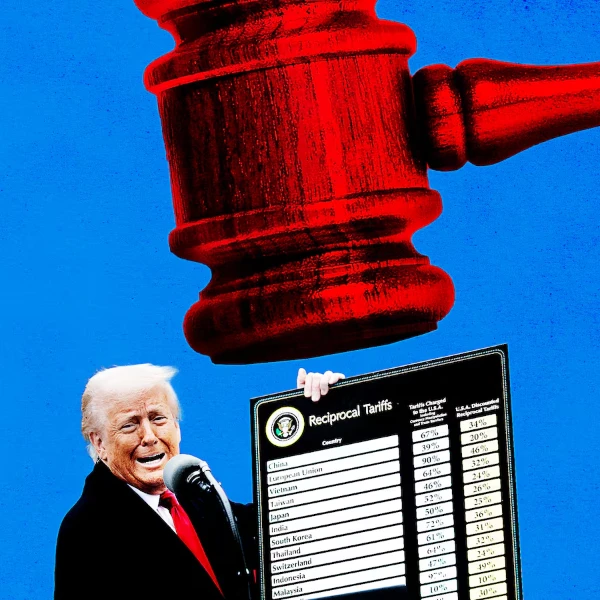
A split ruling from the Court of International Trade on Thursday delivered President Trump another setback in his tariff agenda and could provide some businesses with new options to get a break from tariffs — at least for the coming months.
The full scope of the ruling across different businesses and states wasn't immediately clear — and an immediate cessation of tariffs might be delayed by 30 days. But the ruling puts the president’s effort to impose a 10% tariff on goods from around the globe on thin ice.
The trade court, in a 2-to-1 ruling, also suggested in the 53-page decision that if the decision stands up to all but certain Trump appeals, the illegally collected tariffs “shall be refunded with interest as provided by law.”
The ruling added that the law Trump invoked — Section 122 of the Trade Act of 1974 — didn’t satisfy the criteria for when import surcharges are allowed.
The Trump administration misinterpreted the law, two deciding justices wrote, and as a result, Trump’s move “is invalid, and the tariffs imposed on Plaintiffs are unauthorized by law.”
Capital Economics said the ruling might “not have any immediate implications for the US effective tariff rate, but it raises the risk that the Treasury will soon be on the hook for another round of tariff refunds” and also highlights the judicial pushback Trump may face when he tries to implement permanent tariffs this summer.
The decision creates a different calculation for many import businesses, which often face timelines of weeks, if not months, between import decisions and paying tariffs.
In February, these companies saw the Supreme Court invalidate Trump’s “Liberation Day” tariffs imposed under different emergency economic powers.
Within hours, the president replaced many of them under a different authority that has now been declared illegal.
’Clarity and stability for companies’
The business community is used to operating in uncharted territory and has grown adept at boosting imports when it can avoid tariffs.
In the four-month window between Trump's election and his liberation day announcement in April 2025, importers brought in goods at record levels, pushing the March 2025 trade deficit to the largest in US history.
The latest ruling may result in another period for businesses to act before further trade restrictions are imposed. Trump and his team had a plan in place to replace the temporary 10% duties with permanent tariffs under Section 301 of the Trade Act of 1974 and Section 232 of the Trade Expansion Act of 1962. But the lengthy investigation process required before enacting either measure means those tariffs won’t go into effect for weeks or even months.
One of the plaintiffs in Thursday’s decision was a business called Burlap & Barrel. The company immediately celebrated the ruling, calling it “a major victory for small businesses like ours that depend on fair and predictable trade policy.”
Another plaintiff, toymaker Basic Fun!, said the ruling will bring “needed clarity and stability for companies navigating global supply chains.”
The decision also appears set to remove tariffs on China, just as the president is preparing to travel there for a high-stakes visit next week. His visit is set for May 14 and 15, and tariffs are expected to be a major topic on the agenda.
Many tariffs on China and other importers from around the globe, meanwhile, won’t be affected by this ruling.
Sector-specific tariffs on goods such as automobiles, steel, and timber are collected under a different authority that is not under legal challenge.
“The weakening of Trump’s leverage ahead of the meeting will add a new layer of tension,” wrote Ed Mills and Ellen Ehrnrooth of Raymond James, adding that White House now has less maneuvering room with China and other trading partners.
This story has been updated with additional developments.
Ben Werschkul is a Washington correspondent for Yahoo Finance.
Click here for political news related to business and money policies that will shape tomorrow's stock prices
Read the latest financial and business news from Yahoo Finance
Recommended Stories