
On this page
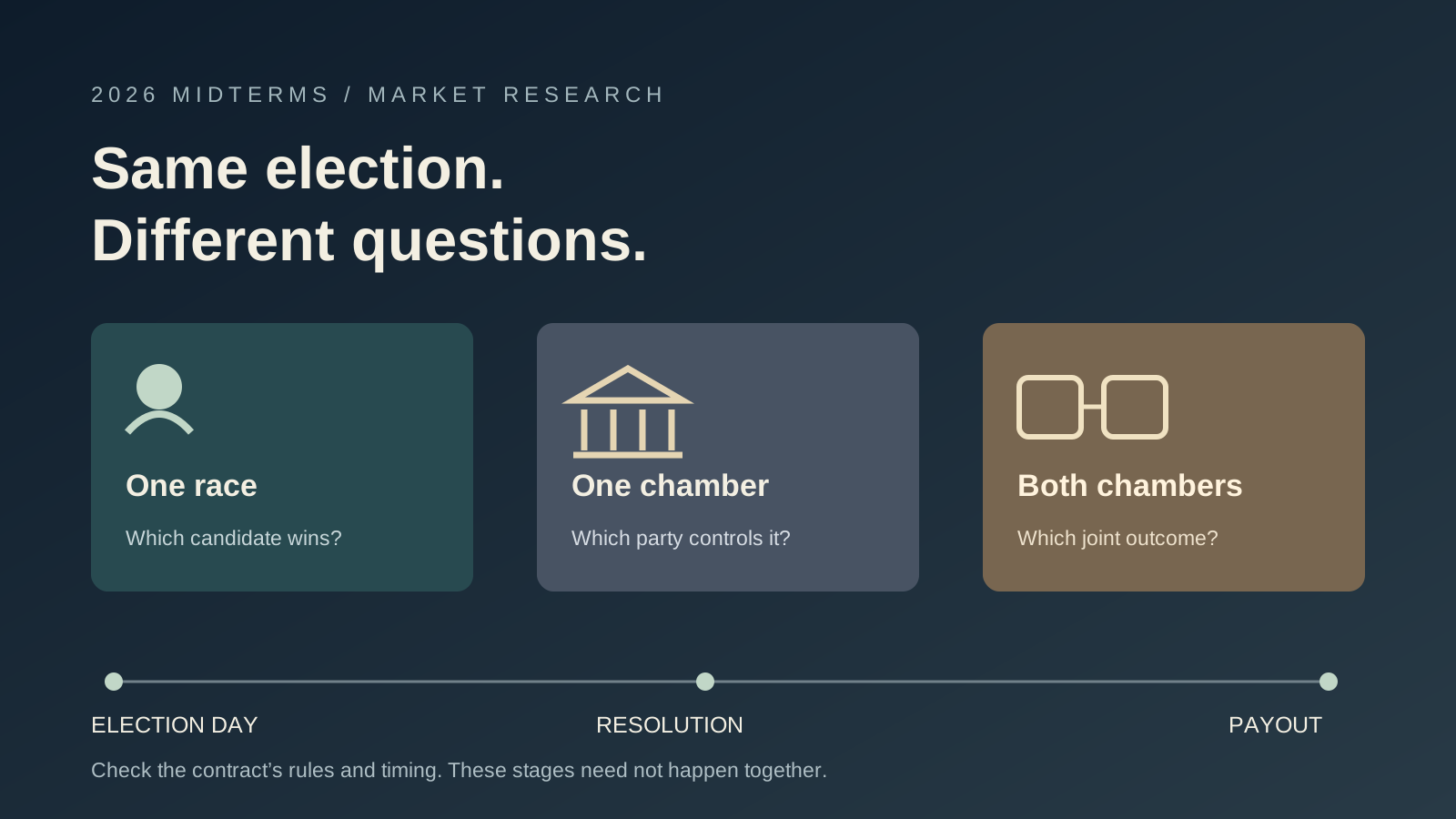
Looking for Polymarket midterms odds? Start with the exact question: one race, control of one chamber, or the combined House-and-Senate outcome. Those markets are related, but they do not pay out on the same condition. Open the official market links below for current prices, then read the selected outcome’s rules.
This guide was checked October 6, 2026. The linked Polymarket pages concern its international prediction platform. Its public page offers view-only access in the US and directs US trading users to the separate Polymarket US platform. Viewing an international market does not establish eligibility to trade it or availability of the same contract on another platform.
Open the official midterm market pages
These links were checked during the review. They lead to venue pages where prices, availability and rules can change. This article explains how to read them; the figures in the worked example below are fictional, not a live odds feed.
| Question | Official page | What to compare |
|---|---|---|
| Which party wins the House? | Polymarket House market | One chamber’s control definition |
| Which party wins the Senate? | Polymarket Senate market | Seat attribution and tie handling |
| Who controls both chambers? | Polymarket balance of power | The selected combined outcome |
| How does another venue frame the joint question? | Kalshi Congress balance of power | Component rules and timeline |
| Where is Kalshi’s standalone House question? | Kalshi House market | Selected party, outcome and full rules |
For an individual Senate or governor race, select the exact candidate, office, state and election year. A primary winner, general-election winner, popular-vote margin and chamber-control contract answer different questions. Save the full market URL and outcome rather than only a short search phrase.
For a closer look at the standalone chamber contract, read the House-control rules and odds guide.
Election Day and market resolution are different dates
The Federal Election Commission lists Tuesday, November 3, 2026, as the next regularly scheduled federal general-election date. It also explains that state election offices certify results and that immediate results are not available from the FEC.
That date does not establish when every contract stops trading, resolves or pays out. Read those fields separately. A contract can need information that is not settled by a televised election-night projection.
The Polymarket balance-of-power rules include runoff results even when the runoff happens after November. They specify treatment of vacancies, elected members’ party attribution and independents’ caucus decisions. Unresolved independent caucus choices can keep this market open until an announcement or its January 4 cutoff.
The same rules define Senate control using a majority of voting seats, then a half-seat count with the Vice Presidency, with a further President Pro Tempore fallback for ambiguity. House control has a Speaker fallback when no party wins a majority. These are this contract’s definitions; check the full current text before applying them elsewhere.
On the reviewed Kalshi combo page, the selected sweep outcome requires both listed components. Its rules allow early No resolution if a component becomes impossible and early Yes resolution if all components are satisfied. Otherwise, its displayed timeline closes by February 1, 2027. That date is not a prediction that the contract must remain open until February.
House odds, Senate odds and sweep odds are distinct
A chamber-control probability describes one event. A sweep describes two events happening together. Multiplying separate percentages assumes independence; it does not establish a joint probability when the outcomes share national conditions, turnout or other influences.
Here is an invented distribution for Party A, used solely to illustrate the arithmetic:
| Fictional outcome | Assigned probability |
|---|---|
| Party A controls House and Senate | 55% |
| Party A controls House only | 15% |
| Party A controls Senate only | 5% |
| Party A controls neither | 25% |
The four mutually exclusive cases sum to 100%. House control is 55% + 15% = 70%; Senate control is 55% + 5% = 60%. The joint probability is 55% in this constructed distribution. Multiplying 70% by 60% gives 42%, which would describe an independence model, not the distribution we entered.
A quoted joint-market price is also not proof that the underlying probabilities are correct. Use the example to distinguish the questions, then inspect actual rules and executable quotes. Do not insert fictional numbers into a current election forecast.
Try your own two-event assumptions in the joint probability calculator. It checks the feasible range and shows the four outcomes from your entered values.
Read the displayed odds and order book separately
Polymarket’s price documentation says the display uses the bid-ask midpoint, with the last traded price substituted when the spread exceeds $0.10. The display need not be the price available for your intended trade size.
For a fictional 60¢ best bid and 64¢ best ask, the midpoint is 62¢. That does not show an available buy at 62¢. Record the observation time, outcome side and price definition when comparing two screens. Check quantity at each level rather than treating lifetime trading volume as an execution quote.
A chart movement can be useful context, but it does not identify its own cause. A polling release, candidate announcement or news story may be relevant evidence; a price move alone cannot establish which report changed participants’ beliefs. Open the underlying source and check its date.
Our order-book guide explains depth and displayed prices. The slippage calculator models entered levels and quantity, without claiming that the same liquidity will be available later.
Compare Kalshi and Polymarket by matching the contract
Before calling two prices different views of the same event, compare the following:
- Question: race winner, chamber control, seat count, vote margin or joint outcome.
- Outcome: selected party or candidate and Yes/No side.
- Definition: included seats, independents, ties, vacancies and runoffs.
- Evidence: designated resolution source and any rule clarification.
- Timing: observation time, trading close, resolution criteria and payout timeline.
- Execution: available prices, quantity, fees and account eligibility.
A shared headline does not establish equivalent payouts. Two contracts with different definitions can legitimately have different prices. An apparent gap also does not prove a risk-free trade or guarantee that both requests can execute at the displayed numbers.
Polymarket’s resolution guide emphasizes that rules define the outcome, including sources and edge cases. Keep a copy of the relevant rule text with your comparison, and revisit any later clarification.
A practical midterms research record
You can follow markets without placing a trade. For each observation, save the contract URL, exact outcome, timestamp, displayed price definition, current best prices, relevant rule and primary evidence link. When updating your view, write down what changed instead of overwriting the earlier observation.
Use official election-office information for results and election administration. For polls, distinguish the fieldwork dates, population and exact question from the publication date. A generic congressional ballot is not a direct probability that a particular candidate wins or a particular chamber changes control.
Review forecast quality over a predefined sample rather than one winning screenshot. Our accuracy evaluation guide and Brier score calculator explain how to keep that assessment separate from trading profit.
Alphascope helps organize market research and forecast context. Open the cited venue page to confirm the current contract, rules and quote before relying on an account action. The purpose of this guide is to make the question and evidence clearer.