
Estimated EV per contract
$0.06
Estimated total EV
$6.00
Break-even probability
54.0%
Maximum loss at settlement, estimated
$54.00
If your forecast is 5 percentage points too high
At 55.0% probability, total expected value becomes $1.00. Winning nets $46.00; losing costs $54.00.
Illustrative stress test. This does not estimate the reliability of your forecast.
Assumes a binary contract pays $1 for a win and $0 for a loss, and entered costs are paid regardless of outcome. Your probability applies to the selected side. The calculator does not fetch a live quote or calculate venue-specific fees. If fees depend on the result, model each outcome separately. A positive EV can still lose the full purchase cost.
On this page
Expected value (EV) is the average profit or loss you would expect if you could make the same decision many times at the same price with a well-calibrated probability estimate. It is a useful filter for a prediction-market trade, but it is not a promise about any one contract. Use the free expected value calculator to run your own numbers as you read.
For a binary Yes contract that pays $1 if the event occurs and $0 otherwise, the simplest per-contract formula is EV = your probability − purchase price. A positive result means your estimate exceeds the cost before fees. A negative result means the offered price is too high for your estimate.
How to calculate expected value
Write your estimated probability as a decimal. Use the price you can actually buy at, not a displayed last trade or midpoint. For 100 Yes contracts:
Expected net profit = 100 × (your probability − all-in cost per contract).
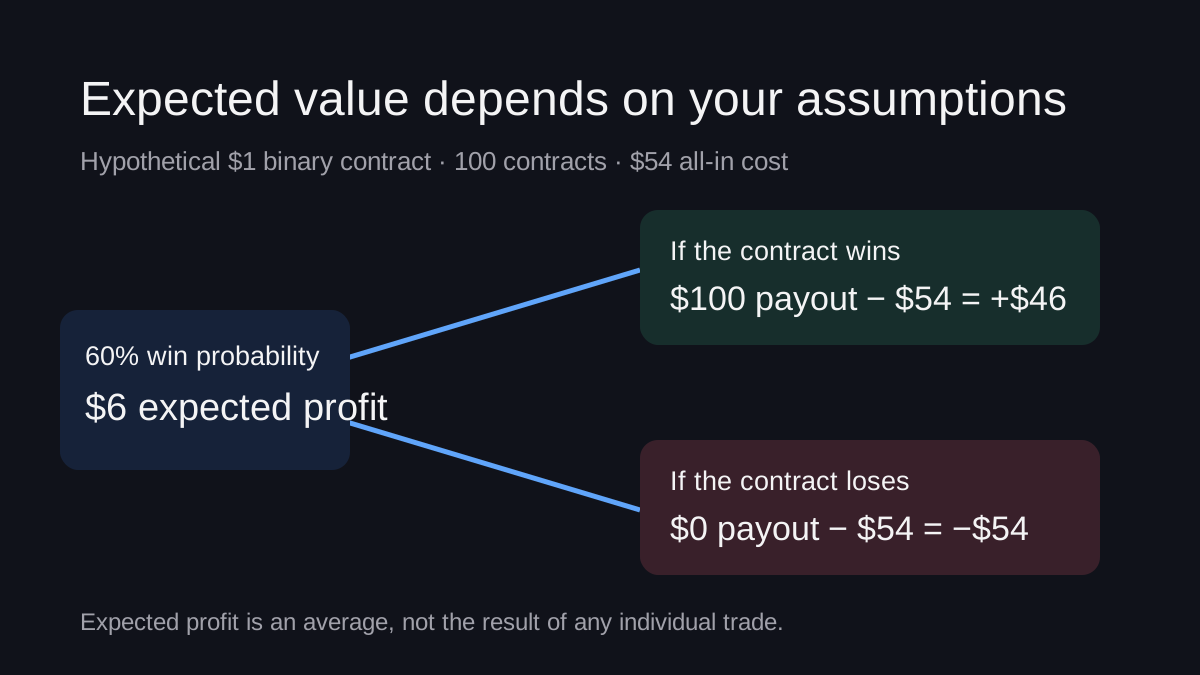
If your estimate is 60% and the executable Yes price is $0.52, gross EV is $0.08 per contract, or $8 for 100 contracts. If fees and slippage cost another $0.02 per contract, estimated net EV is $0.06 per contract, or $6 for 100. If the event loses, however, you lose the full amount paid. EV describes an average across comparable decisions, not a guaranteed $6 return.
For a No contract, replace “your probability” with your estimate that the event does not happen. If your Yes estimate is 60%, your No estimate is 40%. A No price of $0.43 therefore has gross EV of −$0.03 per contract.
Find the break-even probability
Without costs, a Yes purchase at $0.52 needs a true probability above 52% to have positive EV. With $0.02 in total purchase and settlement costs, the break-even estimate rises to 54%. The same principle applies to No contracts: compare the No price with your estimate of the No outcome.
Some venues have variable transaction fees, while others charge through spreads or different order types. Check the current fee schedule and executable quote for the exact venue and size. If you plan to sell before resolution, your exit price and exit costs are uncertain; the simple $1-or-$0 settlement formula is only a starting model.
Payout, ROI, and EV answer different questions
| Measure | Question it answers | 52¢ Yes example |
|---|---|---|
| Maximum profit | What do I gain if Yes wins? | 48¢ before costs |
| Maximum loss | What do I lose if Yes fails? | 52¢ plus costs |
| Gross winning ROI | How large is profit relative to stake if Yes wins? | 48 ÷ 52 ≈ 92.3% |
| Expected value | What is the probability-weighted average profit? | 8¢ if your Yes estimate is 60% |
A contract bought for 10¢ can advertise a 900% winning return and still be a poor trade if the outcome has less than a 10% chance. For payout and maximum-loss math, use our prediction-market profit calculator. For an explanation of the price as probability, read how prediction-market odds work.
Where does your probability come from?
EV is only as reliable as the probability you put into it. Begin with the exact resolution rule, deadline, and source of truth. Gather a base rate for similar events, current evidence, and reasons your view could be wrong. Compare your estimate with live market odds and related contracts. If your estimate differs sharply from the market, investigate the difference before calling it an edge.
Use a range when uncertainty is high. Suppose your defensible Yes range is 50%–62% and the all-in price is 54%. The low end has negative EV; the high end has positive EV. That is a fragile thesis, even though your central estimate might show a gain. A margin for forecast error helps keep small theoretical edges from becoming expensive mistakes.
A practical EV checklist
- Read the exact settlement language and identify the outcome you are pricing.
- Form an independent probability estimate, preferably a range.
- Get the executable ask for your size and add fees and likely slippage.
- Compute EV for both your central and cautious estimates.
- Size the trade for the possibility of a total loss, even when EV is positive.
Alphascope can help you inspect market prices, forecasts, and related news in one research flow. It does not replace your own probability estimate or the venue's final order quote.
Further reading: CFTC's event-contract explainer describes payouts, costs, and contract terms for regulated markets.