
On this page
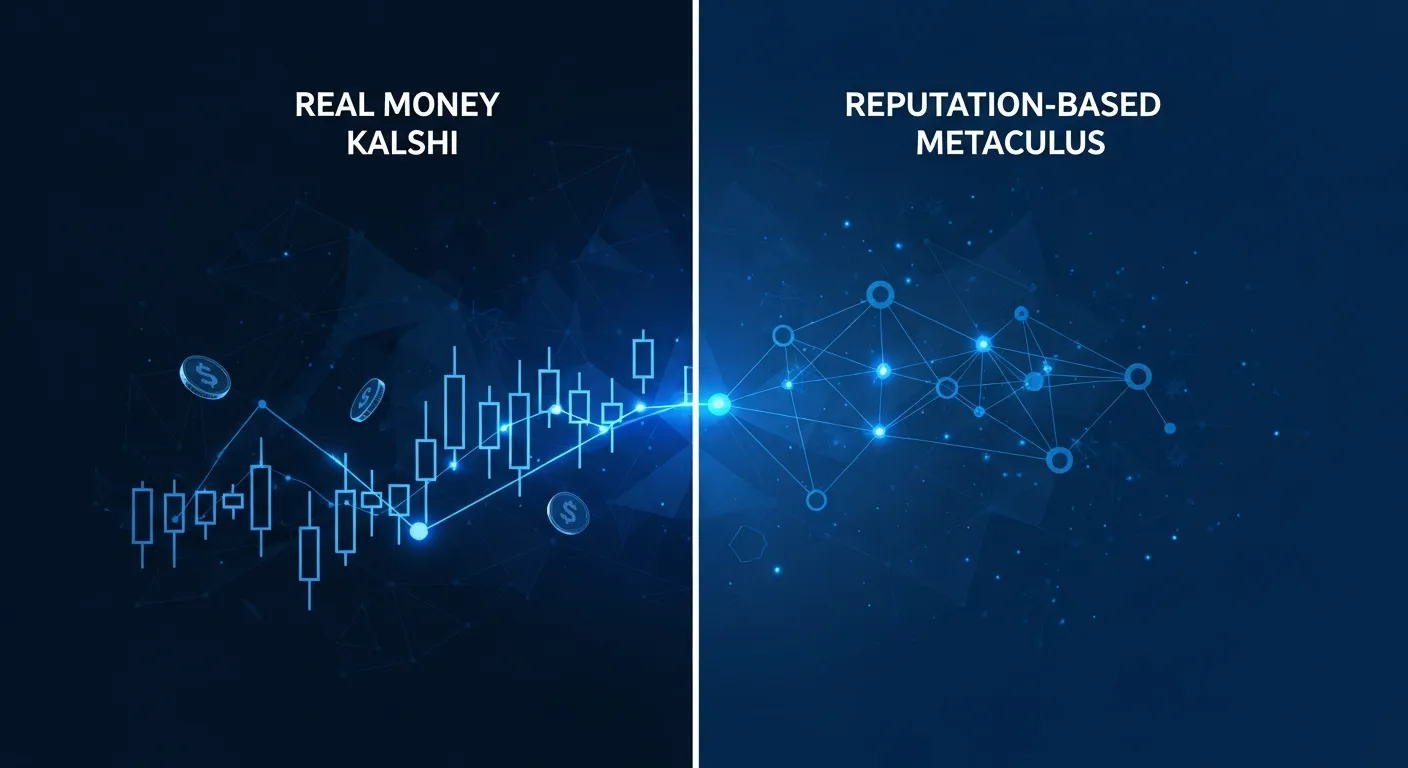
Kalshi and Metaculus are both prediction platforms, but they work very differently. Kalshi is a real-money exchange where you trade contracts. Metaculus is a reputation-based forecasting platform where you submit probability estimates. Here's how they compare and when to use each.
How each platform works
Kalshi:
- Trade binary contracts with real money (USD)
- Prices set by supply and demand on an order book
- CFTC-regulated exchange
- Profit comes from buying low and selling high (or holding to resolution)
- Focus on events with clear, near-term resolution
Metaculus:
- Submit probability estimates (0-100%) for free
- Earn reputation points based on forecast accuracy
- No real money at stake
- Community-driven question creation
- Covers long-term, scientific, and existential risk questions
Accuracy comparison
Both platforms have strong accuracy track records, but measure differently:
- Kalshi: Accuracy is embedded in prices. A market at 70¢ should resolve Yes about 70% of the time. Studies show real-money prediction markets are well-calibrated.
- Metaculus: Tracks calibration explicitly. The community median forecast is historically well-calibrated across thousands of questions. Metaculus publishes its calibration data openly.
Key difference: Kalshi has financial incentives driving accuracy (money on the line). Metaculus has reputation incentives (leaderboard rankings, community status). Both work, but the motivations are different.
Question coverage
Kalshi covers:
- Economics (Fed rates, inflation, jobs)
- Elections and politics
- Sports outcomes
- Weather events
- Current events with near-term resolution
Metaculus covers:
- Everything Kalshi covers, plus:
- Long-term AI development milestones
- Scientific discoveries and breakthroughs
- Existential risk and global catastrophe
- Technology timelines (fusion, space, biotech)
- Questions that resolve years or decades from now
Metaculus is far broader because anyone can create questions and there's no need for CFTC approval or market liquidity.
When to use each platform
Use Kalshi when:
- You want to profit from your predictions with real money
- You're focused on near-term events (days to months)
- You want to hedge portfolio risk against specific events
- You need regulated, trustworthy settlement
Use Metaculus when:
- You want to forecast long-term or speculative questions
- You're interested in scientific, technological, or existential risk questions
- You want to build a forecasting track record without risking money
- You want to contribute to collective intelligence and public knowledge
Use both when: You want to cross-reference probabilities. If Metaculus consensus says 75% but Kalshi prices at 60¢, that divergence might signal a trading opportunity on Kalshi.
Using Metaculus to inform Kalshi trades
Smart traders use Metaculus as a research tool:
- Probability anchor: Check Metaculus community forecasts before trading on Kalshi. Significant divergences may indicate mispricing.
- Long-term context: Metaculus long-term questions provide context for near-term Kalshi markets. If Metaculus forecasts a recession at 40%, it informs how you trade Fed rate markets.
- Expert community: Metaculus attracts professional forecasters, researchers, and domain experts. Their estimates are often well-reasoned and well-calibrated.
Get the best of both with Alphascope
Alphascope aggregates prediction market intelligence from multiple sources:
- Predictions → AI probability estimates that complement both Kalshi prices and Metaculus forecasts.
- News → News analysis that helps contextualize forecasts from any platform.
- Live Odds → Price comparisons across real-money platforms.
FAQ
Is Metaculus more accurate than Kalshi?
Both are well-calibrated. Metaculus publishes calibration data showing strong accuracy. Kalshi's real-money incentives also produce accurate prices. They're different tools for different purposes rather than direct competitors.
Can I make money on Metaculus?
Metaculus doesn't involve real money trading. You earn reputation points and track record. Some forecasting tournaments offer prizes, but the primary reward is reputation and intellectual engagement.
Which platform has more questions?
Metaculus, by far. Anyone can create questions covering any topic with any time horizon. Kalshi is limited to CFTC-approved markets with sufficient commercial interest.