
On this page
Yes, Polymarket can charge trading fees. The amount depends on the product, market and whether your fill takes liquidity. Start by identifying Polymarket US or the international platform. A fee rate copied from the other product can give you the wrong estimate.
This guide was checked October 6, 2026. It separates exchange charges from the price you pay to enter and exit a position. Use the actual order quote and current schedule before trading.
What the official schedules currently say
The international fee documentation describes taker fees on certain markets, applied at matching, with makers uncharged. Its formula is shares × feeRate × price × (1 − price). Parameters vary by category; geopolitical and world-event markets are described as fee-free. It lists no Polymarket USDC deposit or withdrawal fee, while intermediaries may charge.
The separate Polymarket US schedule currently gives a standard taker coefficient of 0.0695 and maker-rebate coefficient of −0.0125, using contracts × coefficient × price × (1 − price). Combos use a different taker curve. The notice announces removal of combo maker rebates and a Table Tennis taker coefficient of 0.10 at midnight ET on October 7, 2026. Check the applicable schedule when you trade.
Neither description supports treating every charge as a fee on winning positions at settlement. A losing trade can still incur trading costs.
Maker or taker: the fill matters
A taker consumes an existing resting order. A maker supplies an order that rests and is later matched. A limit order can do either: if your limit crosses the available opposite quote, it can execute immediately as a taker. “Use a limit order” therefore does not by itself establish a maker fill or zero cost.
For a partially filled order, inspect each fill. Record the execution price, quantity, role and charged fee. Unfilled quantity is not the same as executed quantity, and an estimated order charge can differ from the final fill record.
A worked fee calculation
Suppose you buy 100 contracts at 50¢ on a standard US taker fill, using the coefficient above. The unrounded fee is 100 × 0.0695 × 0.50 × 0.50 = $1.7375. The contract purchase itself costs $50. The fee is an additional cost; 0.0695 is a formula coefficient, not a flat 6.95% charge on that $50.
For an illustrative international market whose applicable rate is 0.05, the same quantity and price produce 100 × 0.05 × 0.50 × 0.50 = $1.25. Confirm the market parameter instead of assuming this rate applies to every contract. These examples isolate the trading fee and omit rounding adjustments, rebates, funding costs and later transactions.
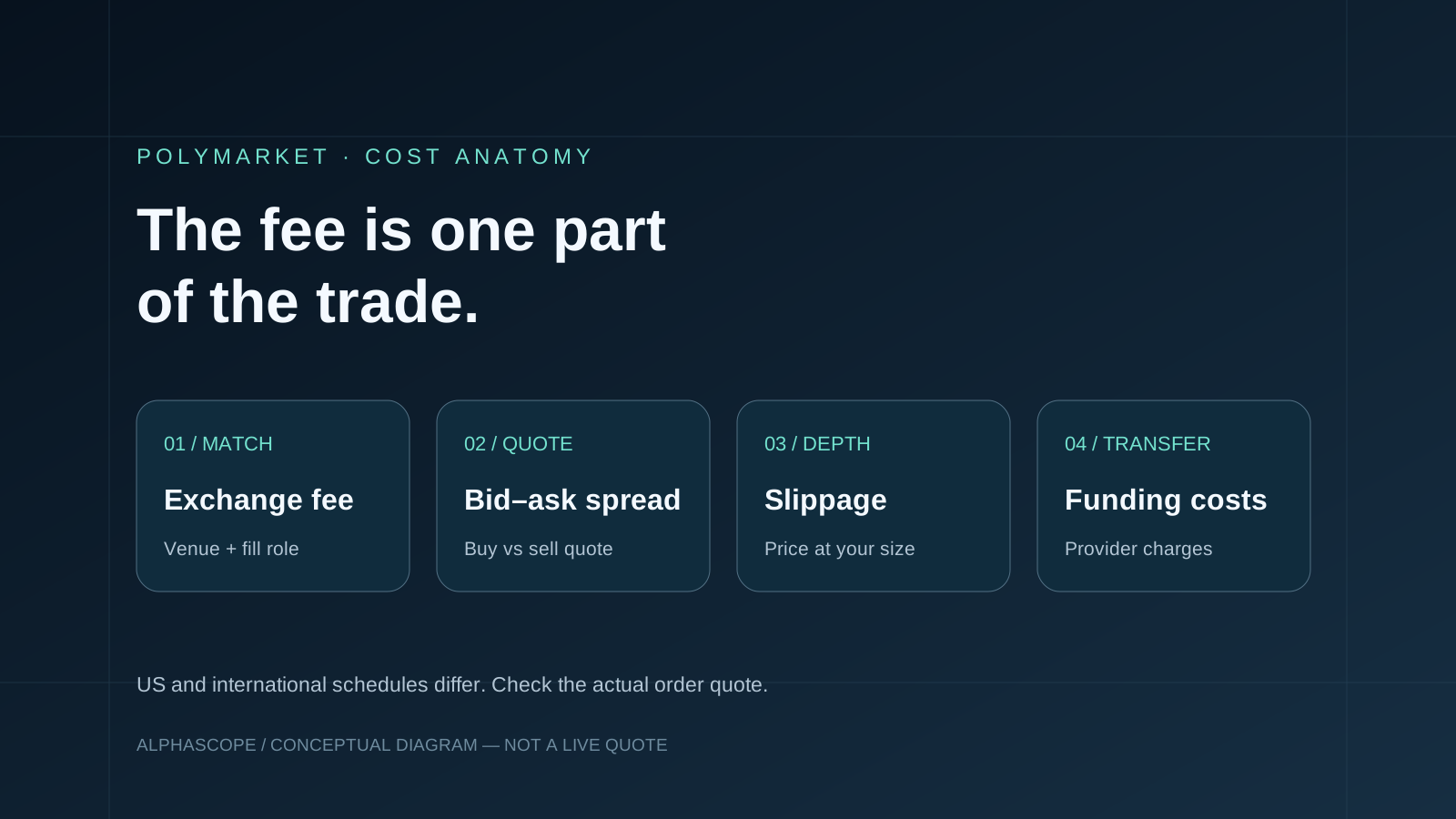
Zero exchange fee does not mean zero trading cost
| Cost | What to inspect |
|---|---|
| Exchange fee | The market's applicable schedule and your fill role |
| Bid–ask spread | The difference between executable buy and sell quotes |
| Slippage | How the average execution price changes as your size consumes depth |
| Funding and transfers | Charges shown by the payment, bridge or withdrawal provider |
Imagine a 48¢ bid and 52¢ ask with enough depth for 100 contracts. Buying at the ask costs $52. Immediately selling at the unchanged bid returns $48, a $4 loss before fees. This is an illustrative spread example, not a claim about typical Polymarket quotes.
Likewise, 20 contracts available at 52¢ do not mean 100 can all execute there. Inspect depth and use our slippage calculator to model several price levels. A displayed last-traded price is not a guarantee of an executable quote for your size.
Calculate the whole position
Write down entry cost, entry fee, possible exit proceeds, exit fee and any separate transfer costs. If you plan to hold to resolution, use the exact contract payout and rules. If you plan to sell early, use an executable exit quote rather than a hoped-for price.
For example, a hypothetical 100-contract position bought for $52 with $1.25 of entry costs needs more than $53.25 of gross sale proceeds to break even if an exit also incurs charges. A rebate should enter the calculation only when the account and activity meet its requirements; an advertised maximum is not an earned rebate.
Our prediction-market profit calculator lets you compare a stated cost assumption with potential payout. Read the odds guide for the distinction between price, implied probability and profit.
Before relying on an old fee guide
Check the venue, effective date, market and order type. Save the final quote and review the fills after execution. If a charge differs from your estimate, compare those records first; don't assume that a maker rebate, a different market category or an older schedule applies.
Alphascope supports market research. The venue's current order quote and account records determine the actual transaction charges.