
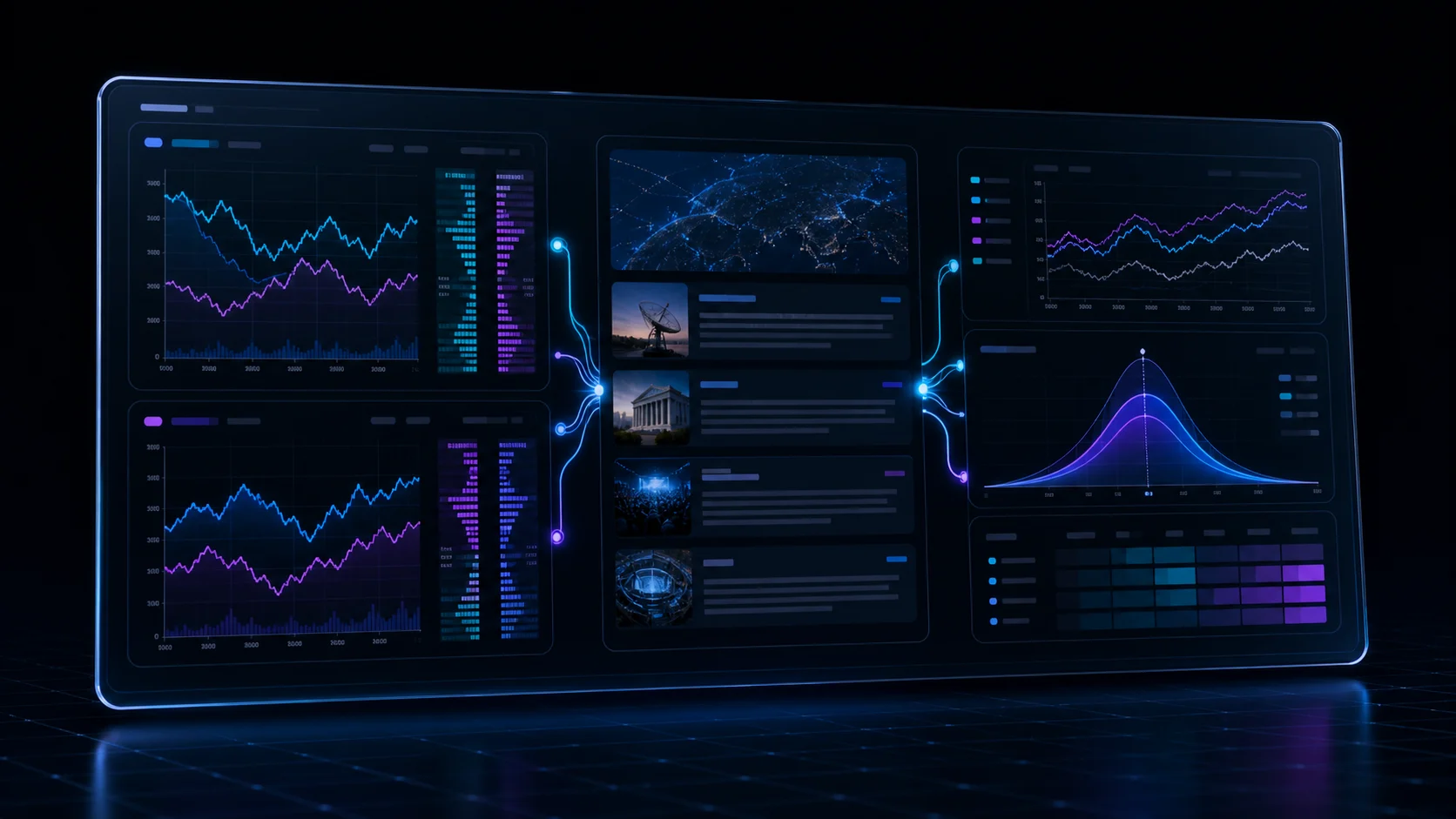
A prediction market terminal should replace a messy research workflow, not simply put more charts on one screen. The useful product connects live Polymarket and Kalshi odds with executable prices, contract rules, current evidence, forecasts, alerts, and position context.
The category is still young. Products use labels such as terminal, dashboard, intelligence platform, scanner, research tool, and command center for overlapping features. This guide gives you a practical way to evaluate them without being distracted by the label.
What is a prediction market terminal?
A prediction market terminal is a research interface that brings several parts of the event-contract workflow together. A complete terminal may include:
- live markets from Polymarket, Kalshi, or other venues;
- bid, ask, spread, depth, volume, and price history;
- cross-platform matching for similar contracts;
- news and evidence connected to the market question;
- AI forecasts or structured bull and bear cases;
- wallet, holder, or portfolio context;
- alerts for price, volume, news, and large-trade changes;
- resolution-rule and liquidity checks before execution.
A dashboard mostly displays. A terminal should help the user move from discovery to a defensible decision. Alphascope's prediction market intelligence platform is built around that research progression while leaving execution with the underlying venue.
The seven layers of a useful terminal
1. Market discovery
The first layer answers what deserves attention now. Useful filters include category, venue, volume, probability, expiration, price movement, and recent news. A long unranked market list is inventory, not intelligence.
Use Alphascope odds to browse active topics and individual market pages rather than opening both exchanges and repeating the same search.
2. Executable price and liquidity
A terminal must distinguish the number shown on a market card from the price a user can obtain. Polymarket's official documentation notes that its displayed price can be the midpoint of the bid-ask spread, while buying occurs at the ask and selling at the bid. Kalshi's order-book guide similarly explains the resting quantity available at each bid and ask.
Without spread and depth, a probability comparison can be visually correct and financially useless. The terminal should also disclose when a price or book was refreshed.
3. Cross-platform contract matching
Putting a Polymarket price beside a Kalshi price is only helpful when the outcomes are actually comparable. A strong terminal preserves each contract's deadline, resolution source, wording, fees, and access restrictions.
Use the Polymarket vs Kalshi comparison for platform-level differences and the live odds board to discover candidate gaps. Then verify both rulebooks before calling a gap actionable.
4. Current evidence and news
Prices tell you what the market believes. They do not explain why it changed. A research terminal should connect a market with the evidence capable of moving it: official releases, election updates, economic data, injury news, court decisions, company announcements, or other category-specific sources.
Alphascope news links developments with affected prediction markets so users can begin with the catalyst instead of manually guessing which contracts a headline changes.
5. Independent forecast context
An AI estimate is useful only when its assumptions are visible and it is compared with the current executable market. A single confident percentage without sources, timing, uncertainty, or a falsifiable thesis is decoration.
Use AI predictions or the Polymarket AI analyzer as a second opinion. The objective is not to obey the model; it is to identify why the model and market disagree and whether the difference survives a critical review.
6. Wallet and position context
Wallet activity can show concentration, conviction, entry timing, or unusual flow. Portfolio data can show exposure and PnL. Neither reveals a complete thesis. A market maker, hedged trader, and directional bettor can create similar onchain activity for different reasons.
Use the Polymarket wallet tracker to research an address, then return to price, evidence, and rules before deciding whether the move matters.
7. Decision and risk checks
The final layer should slow the user down at the right moment. Before execution, a terminal should make it easy to check:
- the exact settlement source and deadline;
- the current bid, ask, spread, and depth at the intended size;
- whether the evidence is newer than the latest price move;
- the strongest reason the thesis could be wrong;
- position size, maximum loss, and exit conditions;
- whether a cross-platform comparison uses truly equivalent contracts.
Terminal vs dashboard vs bot
| Product type | Primary job | Main risk |
|---|---|---|
| Terminal | Connect discovery, research, and decision context | Can become cluttered or imply certainty |
| Dashboard | Monitor a defined set of metrics or markets | Describes activity without explaining it |
| Wallet tracker | Follow addresses, positions, and PnL | Encourages copying without the original thesis |
| Scanner | Surface price gaps, moves, or alerts | Candidate signals may not be executable |
| Bot | Automate monitoring or order execution | Operational failures can directly lose money |
| Raw API | Provide data and execution primitives | Requires engineering, security, and monitoring |
How to evaluate prediction market analysis software
- Run one real market through it. Begin with a contract you already understand and compare the output with the native venue.
- Trace each number. Identify source, timestamp, definition, and whether the value is displayed or executable.
- Inspect rule handling. Confirm the product exposes resolution criteria instead of comparing titles alone.
- Challenge the AI. Look for sources, uncertainty, bear cases, and the conditions that would change the estimate.
- Test alert usefulness. Decide whether alerts arrive early enough to investigate rather than after the move is crowded.
- Measure tab reduction. The product should remove repeated work while preserving the checks that protect the decision.
A practical Alphascope terminal workflow
- Browse live odds or AI forecasts to find a disagreement worth researching.
- Open the market and read the exact outcome, deadline, and resolution criteria.
- Review market-linked news and check whether the evidence predates the latest price change.
- Inspect wallet activity only when it adds information to the thesis.
- Compare related markets and any candidate cross-platform price gap.
- Confirm the live book on the execution venue before placing any order.
The goal is a smaller, higher-quality research loop. A terminal earns its place when it helps you reject weak trades faster as well as investigate strong ones.