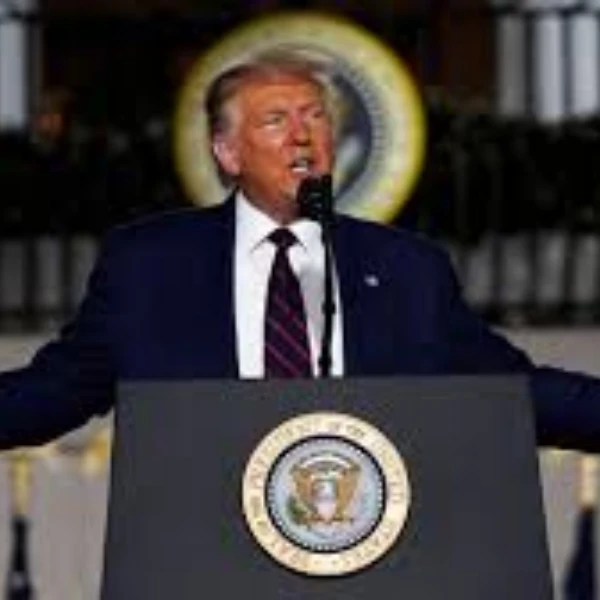
United States President Donald Trump is promising “really big news” in a rare primetime address on Thursday night, though he won’t say exactly what it is.
The surprise speech was announced on Tuesday. But when pressed by reporters about what he planned to talk about, Trump only revealed that the speech would be about elections and “a couple of other things”.
Recommended Stories
list of 4 items
list 1 of 4US Senate Democrats block defence bill over Iran war, Israel integration
list 2 of 4Why has Lindsey Graham’s sister inherited his Senate seat after his death?
list 3 of 4Donald Trump removes final members of independent US election commission
list 4 of 4US intelligence director pick refuses to acknowledge Trump loss in 2020
end of list
“It doesn’t get bigger, because without free and fair elections, you don’t have a country,” he told journalists in the Oval Office on Tuesday.
Asked to elaborate, Trump said he wanted to “save it” for the speech.
“We’ll be discussing other things, too,” he added. “It’s going to be a very big announcement.”
The White House has since confirmed that the address will focus on elections, including information related to the 2020 presidential election, which Trump has falsely claimed he won.
The speech is also expected to discuss what the White House describes as vulnerabilities in US voting machines.
Here’s what we know about the upcoming primetime presidential address.
When is Trump’s speech?
Trump is expected to speak from the White House on Thursday at 9pm US Eastern Time (01:00 GMT Friday).
How can you watch it?
Major US television networks are expected to carry the address live. The Trump administration has requested airtime from major broadcasters.
It will also be livestreamed on WhiteHouse.gov and on the White House’s YouTube page.
Why is the timing significant?
Trump’s speech comes three and a half months before the November 3 midterm elections.
At stake is control over the US Congress. Currently, Trump’s Republican Party holds slim majorities in both of Congress’s chambers.
But Democrats are seeking to tip the balance in their favour, leveraging backlash to Trump’s second term.
Critics fear Trump may use his primetime address to erode voter confidence in the upcoming elections, or to assert federal influence over election administration, which is run at the state and local level.
There is also speculation that Trump may be angling to fire up his base amid drooping poll numbers. The research firm YouGov suggested this month that more than 57 percent of US voters disapprove of the president’s second-term performance so far.
What is Trump expected to talk about?
So far, much remains unknown about Thursday’s speech.
Administration officials say Trump will discuss newly declassified intelligence connected to its investigations into the 2020 presidential election.
They have also suggested that Trump will discuss alleged vulnerabilities in voting machines that could allow foreign cyber intrusions.
Trump has revealed little else. When asked this week whether the speech would focus on voting machine integrity, he replied simply: “It will concern that subject.”
What happened in the 2020 elections?
Trump was a first-term incumbent when he ran for a second term in the 2020 presidential election.
He faced Democratic nominee Joe Biden, who had previously served as vice president under Barack Obama.
Biden defeated Trump, winning both the Electoral College vote – which determines the presidency – and the popular vote, an important symbolic metric.
The Democrat scooped up 306 Electoral College votes and more than 81 million individual ballots, compared with 232 Electoral College votes and 74 million ballots for Trump.
Critically, swing states like Georgia, Michigan and Arizona voted in Biden’s favour.
After the election, Trump repeatedly rejected the results, and his supporters attacked the US Capitol during the Electoral College certification on January 6, 2021.
What is Trump’s history of questioning US elections?
Trump has spent years casting doubt on the integrity of US elections, even before 2020.
Before the 2016 election, he refused to say whether he would accept a loss to Democratic nominee Hillary Clinton.
After winning his first term in office, he created a presidential commission to investigate his claims that he lost the popular vote due to widespread fraud. The commission was disbanded after finding no evidence to support those claims.
After losing the 2020 election, Trump repeatedly alleged that the vote had been stolen despite numerous investigations finding no evidence to support those claims.
In Georgia, he urged the state’s secretary of state to “find 11,780 votes”, the number needed to overturn Biden’s victory there.
Trump and his allies later faced two indictments – one on the state level, one on the federal level – over allegations they attempted to overturn the 2020 election results.
The federal case was dropped when Trump was re-elected in 2024, in accordance with Department of Justice norms not to prosecute a sitting president.
The state-level case, meanwhile, fell apart after Fulton County District Attorney Fani Willis was disqualified from prosecuting the case.
Trump, however, has continued to assert he was the rightful winner of the 2020 race, despite there being no evidence to support the claim.
The Cybersecurity and Infrastructure Security Agency (CISA), a federal cybersecurity watchdog, has called the 2020 election “the most secure in American history”.
Investigations, including several by Trump allies, have produced no evidence that vote-machine rigging or foreign cyber intrusions changed the outcome.
What has the administration done lately to advance Trump’s 2020 claims?
In January, FBI agents descended upon Fulton County, Georgia, to execute a search warrant to collect election materials related to the 2020 race.
Officials in Fulton County, which contains the state capital, Atlanta, have protested against the search and called for the return of the confidential election materials.
They have also claimed they were not given an inventory of what was taken.
An FBI memo obtained by US media this month indicates the agency has diverted hundreds of agents to the case, which officials say is about “irregularities that occurred during the 2020 presidential election”.
Trump has called on Bill Pulte, the acting director of national intelligence, to declassify documents related to the 2020 vote.
What do Trump’s claims have to do with the midterms?
Trump appears to be ramping up his election fraud claims as the November midterms approach.
According to a review published by the Reuters news agency in May, Trump claimed the 2020 vote was stolen more than 107 times over the preceding six-month period.
Already, Trump has suggested that California’s primary vote in June was “rigged”.
Just last week, he invited defeated Los Angeles mayoral candidate Spencer Pratt to the White House after crediting Pratt’s loss to voter fraud. “What they did to that guy was unbelievable,” Trump told Fox News on Sunday.
Trump has expressed fear he could be impeached if his party does not retain control of Congress in the midterms. Major Democratic victories in the midterms could also stymie his legislative agenda for the final two years of his presidency.
What has Trump done to advance his election reform agenda?
Since returning to office in 2025, Trump has pushed to overhaul voting procedures.
Under the US Constitution, election administration falls to the states. It is not within the federal government’s control.
But critics say Trump is attempting to nationalise the election and tighten voter access.
Trump has championed election restrictions like those in the SAVE America Act, a bill that would require voters to produce in-person proof of citizenship, like a birth certificate or passport.
Already, non-citizens are barred from voting. But opponents argue that the SAVE America Act would present a hurdle to legal voters who do not have access to such documents. Many states allow voting with other forms of identification, like a state driver’s licence or a Social Security number.
Trump has also sought to limit the use of mail-in ballots through bills like the SAVE America Act and executive orders. But federal courts have repeatedly blocked his attempts.
In June, for instance, the Supreme Court ruled that states can continue to count mail-in ballots after election day, so long as they are postmarked on or before that date.
Trump has also faced legal challenges against his attempts to compel states to hand over their voter rolls and create a national voter file. And he has threatened to withhold funds – including from the Federal Emergency Management Agency (FEMA) – if states fail to comply with his demands.
Earlier this month, his administration issued letters to election officials nationwide, warning that they “could be criminally prosecuted” if there are instances of non-citizen voting.
But non-citizen voting is exceedingly rare, as is voter fraud overall.
How have Democrats responded to Thursday’s upcoming speech?
Democrats have warned against giving Trump airtime for his unsubstantiated claims.
“Trump is going to use a primetime address to stoke misleading claims about our elections in order to justify interfering in our midterms,” Senator Mark Warner wrote on social media on Wednesday.
“It’s on all of us to follow the facts and not accept his constant stream of misdirections and lies.”
Another senator, New Mexico’s Ben Ray Lujan, pointed to Trump’s second impeachment as evidence of his willingness to subvert elections.
“This is the same man who was impeached after inciting an insurrection to overturn the election,” Lujan said, calling Trump “corrupt”.