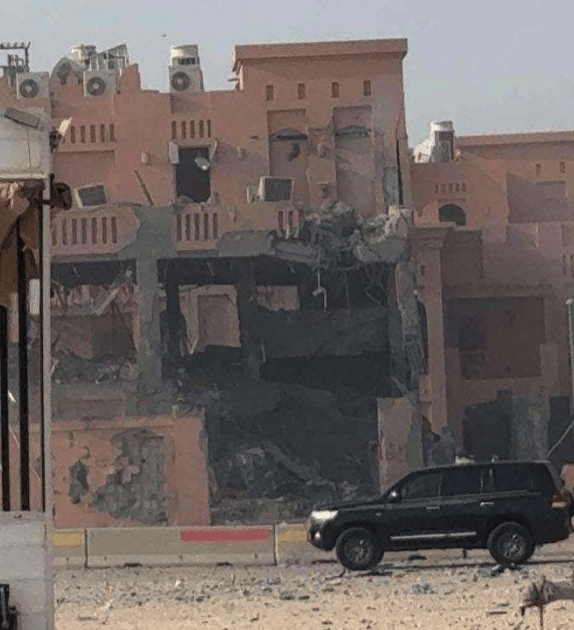
The United States informed Israel that it intends to expand its strikes against Iran to include infrastructure and energy facilities, as the U.S. military launched another wave of attacks Thursday night against the Iranian regime. The latest strikes, carried out for a fifth consecutive night, targeted an airport, bridges and a communications tower, according to Iranian media reports.
Despite the escalation, Israeli officials assess that Iran does not currently want to fire at Israel and risk drawing the IDF into the confrontation. Jerusalem, however, views that assessment as far from certain and is preparing for the possibility of an Iranian attack. “We are ready, and if they make that mistake, they will pay a heavy price. Let them come,” an Israeli official said.
Iran has publicly threatened to broaden its attacks if the United States further intensifies its campaign. Tehran has so far targeted Gulf states and American military bases across the Middle East. Iranian launches were reported toward Jordan and Kuwait, where authorities said 32 drones were intercepted Thursday. Tasnim news agency reported that U.S. forces struck a communications tower in the port city of Bandar Abbas, near the Strait of Hormuz, while a separate report said seven people were wounded in the strike.
U.S. fighter jets later attacked Iranshahr Airport in Iran’s southeastern Sistan and Baluchestan province, according to Iranian media. Explosions were also reported in Bandar Khamir and Kohurestan district. Several bridges were hit, including one intended to maintain the road connection between Bandar Abbas and Shiraz, and electricity supplies were disrupted in parts of Kohurestan. Iranian media reported that one person was killed and eight others wounded in one of the strikes in Hormozgan province, while two civilians were reportedly wounded in a U.S. attack on a railway station in Bandar Abbas.
Iran’s Fars news agency said the attacks damaged both the Kohurestan Bridge and the Giriyeh Bridge. “Two people were killed and four were wounded in these attacks,” the agency reported. “The Bandar Abbas-Khamir-Lar road is completely blocked, and the Keshar-Kohurestan road is also blocked.”
At the same time, U.S. Central Command said Marines from the 11th Marine Expeditionary Unit boarded the oil tanker Wen Yao in the Gulf of Oman to verify that it was complying with the U.S. maritime blockade on Iran. CENTCOM said three commercial vessels attempting to breach the blockade had so far been diverted, another vessel had been disabled after failing to obey instructions and one had been inspected. The military said the Strait of Hormuz and surrounding waters remained open to maritime traffic, except for vessels attempting to violate the blockade.
Iranian military spokesman Abolfazl Shekarchi said Tehran would not relinquish control over the Strait of Hormuz and warned that regional infrastructure could be targeted if Iranian facilities were attacked. “The only way to pass through the region is through the Strait of Hormuz,” he said. “The sovereignty of the Islamic Republic over the strait is a source of security for the entire region, not insecurity. We insist on America’s withdrawal from the region and will never give up Hormuz. If our infrastructure is damaged, all infrastructure in the region will become our target. We have delivered a crushing response to the enemy and will continue to do so. They have suffered heavy blows.”
Israeli officials say two developments could bring Israel back into the fighting: a direct Iranian attack on Israel or a U.S. request for Israel to join the strikes. Neither has happened, and the confrontation between Washington and Tehran remains limited despite the intensified campaign. Mediators from Pakistan, Egypt and Qatar said they were working to restart negotiations and noted that neither side had announced its withdrawal from the memorandum of understanding reached between Washington and Tehran. They said freedom of navigation through the Strait of Hormuz remained the central issue in the talks.
The White House said Thursday that “Iran continues to talk to us” and “wants a deal,” while accusing Tehran of violating the memorandum through its attacks against Gulf states. Prime Minister Benjamin Netanyahu warned this week that Iran would face a far more powerful Israeli response if it attacked. “Do not assume there will be quiet if you attack us,” Netanyahu said. “Do not expect a repeat. It will be a different response, much more powerful. We are prepared for every scenario. The days when someone could harm us without being struck back are over. We did this to Iran’s axis of evil, and we will continue to do so against anyone who harms us.”
‘You cannot make deals with Iran’
President Isaac Herzog, speaking Thursday in an interview with Al Arabiya, expressed Israel’s deep reservations about negotiations with Tehran. “With the pattern of Iranian behavior that we know, you cannot make deals with them,” Herzog said. “They violate them and have their own way of interpreting very clear things.” Addressing the renewed U.S. strikes, Herzog said he welcomed Washington’s firm response. “I am not surprised that this is the situation,” he said. “I am glad the American response is firm, so that everyone understands, especially the Iranians, that they must get back on track if they truly want to implement a path out of the war.”
Turning to Israel-Saudi relations, Herzog said it was his dream to see peace established between the two countries. “I have great respect for Crown Prince Mohammed bin Salman,” he said. “What we want more than anything in Israel is to see the nations draw closer. The dialogue between Jerusalem and Mecca should be the true essence. I believe Jews and Muslims should live together in this region in peace. I hope I will be able to meet the Saudi leadership officially when the time comes.”
Herzog also cited Israel’s existing regional agreements. “We are pleased with the Abraham Accords and proud of our relations with the Kingdom of Morocco, the Kingdom of Bahrain and the United Arab Emirates,” he said. “This is the example of how successful it can be.” Asked about relations with Washington, Herzog said Israel and the United States maintained particularly close dialogue behind closed doors despite occasional disagreements. “We may have disagreements. That is natural, but ultimately they are tactical,” he said. “We all understand that we are facing the evil empire in Tehran, with its proxies and its belief that the United States is the Great Satan and Israel is the Little Satan.”