
On this page
The Manifold Markets API supports public market search and probability reads without an API key. Use the documented https://api.manifold.markets host, select the market’s stable ID, and preserve its outcome type, token and timestamps with every observation.
This independent read-only guide was reviewed November 21, 2026 (Pacific time). Its bounded public checks were recorded on November 22 UTC. It covers prediction-market discovery, not Manifold’s separate perpetual products or an authenticated trading bot. No account records, credentials or trades were used.
Start with the official Manifold API documentation
The official API reference identifies the current host and warns that the API is alpha. The former manifold.markets/api host is a migration concern, not a base URL to copy into new examples. Follow the official API schema alongside the documentation when checking request and response types.
For a public search request, a small page keeps the first experiment reviewable:
curl -fsSL 'https://api.manifold.markets/v0/search-markets?sort=newest&contractType=BINARY&limit=2'This selects binary-market search results; it does not establish that the results are open, eligible for a particular account, executable at a displayed probability or a complete export. Preserve the exact filters rather than describing an arbitrary search page as “all markets.”
Search-markets and markets use different cursors
| Workflow | Documented continuation | Value to preserve |
|---|---|---|
| GET /v0/search-markets with sort=newest | beforeTime | Last result’s createdTime, in milliseconds |
| GET /v0/markets | before | Market ID |
The search reference caps offset at 1000 and directs deeper newest-first pagination to beforeTime. Do not send an ID where a timestamp belongs or a timestamp where an ID belongs. Those mistakes can look like empty data rather than an obvious parsing failure.
Our first search at 2026-11-22 01:05:06 UTC returned HTTP 200 and two records. We passed the second record’s createdTime, 1795307285463, unchanged as beforeTime. The second request returned two more records, both strictly older, with four distinct IDs across the two pages.
GET /v0/search-markets?sort=newest&contractType=BINARY&limit=2
  &beforeTime=1795307285463
This verifies a two-page observation only. Keep retrieval time and source time separate: the cursor above converts to 2026-11-22 00:28:05.463 UTC. It is not the request’s retrieval timestamp. These values will differ in a fresh run.
A timestamp boundary can hide an unseen market
Consider a fictional descending result set: A at time 3000, B at 2000, C at 2000 and D at 1000. A two-row first page returns A and B. A strict next query for records before 2000 can return D while skipping C, which shares B’s timestamp.
The two pages have no duplicate IDs, yet the collected set is incomplete. This is a counterexample explaining a possible strict-time boundary, not an observed omission in Manifold’s live response. Our small public check did not establish how every equal-timestamp boundary behaves.
Record IDs and boundary timestamps, stop if a cursor fails to advance, and verify the provider’s tie behavior before claiming completeness. Do not invent a safe workaround by subtracting a millisecond. For a complete research export, evaluate the documented ID-based listing or an appropriate data export and verify its own coverage and usage conditions.
Read a probability by market ID
One observed binary result had ID n6uN0IlqhL, outcomeType=BINARY, token=MANA and isResolved=false. A subsequent public request returned HTTP 200:
GET https://api.manifold.markets/v0/market/n6uN0IlqhL/prob

{"prob": 0.5499999992241315}
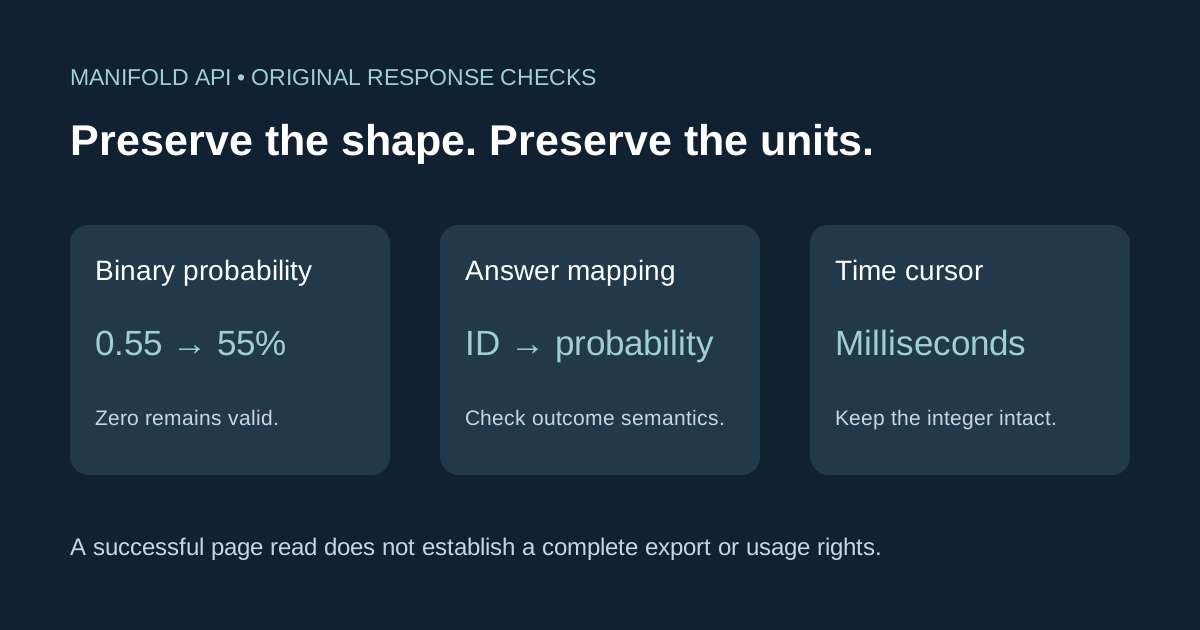
That value is approximately 55%, not 0.55%. It is a timestamped market-probability observation, not a forecast made by this article, an executable full-size quote or a claim about a cash return. We did not place a mana bet or test how that probability changed after the read.
The official schema exposes two probability shapes: a scalar prob and an answerProbs mapping by answer ID. Market metadata determines the meaning of those answers. A generic parser should not silently force every response into one binary number.
Zero is valid; missing and malformed values are different
For an original parser fixture, {"prob":0} represents a valid zero probability. A truthiness check such as “if prob” can accidentally treat it as unavailable. A missing probability, null, a boolean or a value outside zero to one should receive a separate validation outcome.
| Fictional response | Worksheet treatment |
|---|---|
| {"prob":0} | Retain a binary probability of zero |
| {"prob":0.55} | Retain the fraction; display 55% separately |
| {"prob":1} | Retain a binary probability of one |
| {"error":"unavailable"} | Reject as unsupported/error data |
| Both probability shapes present | Flag ambiguity under this worksheet’s policy |
The last row is a deliberate parser policy, not a claim that the upstream API schema forbids every such payload. Keep the raw response so a future schema change can be investigated.
For a separate fictional independent-answer example, probabilities of 0.70 for A and 0.60 for B add to 1.30. If the underlying questions can both resolve Yes, that need not be a normalization error. Rescaling to 53.846% and 46.154% would change the supplied beliefs. Check whether outcomes are mutually exclusive before expecting a sum of one.
Keep milliseconds intact in Manifold requests
The API reference specifies Unix milliseconds. Convert to a human-readable UTC date for display, while retaining the original integer for requests and joins. Do not import a seconds-based timestamp convention from another provider’s API.
The offline Python worksheet checks scalar and answer-map probability shapes, valid boundary values, malformed inputs and the synthetic pagination gap. It also converts the captured cursor to UTC without rounding it to whole seconds. It contains no network, authentication, signing or order functions and does not certify a full export.
Rate limits, API keys and data licensing
The API page currently states 500 requests per minute per IP. Stay below the published limit and handle errors with a bounded collection plan; do not rotate IPs to evade it. Public reads and authenticated account actions remain separate. This guide does not generate or rotate API keys.
Manifold’s data page labels its free dumps non-commercial and shows a July 6, 2024 update date. A published download is not automatically a fresh November 2026 dataset. The same page describes commercial licensing, while the API page specifically addresses licensing for commercial AI/ML training. Check the current API licensing guidance and terms for the intended use; a successful HTTP response does not establish those rights.
No bulk dump was downloaded and no commercial license was obtained for an integration. This article documents limited public reads and original offline examples.
From a response to a useful research dataset
Keep market ID, outcome type, token, created time, observation time, resolution state, probability shape and source payload as separate fields. A current probability is not the final outcome. Resolve that distinction before computing a Brier score or log loss.
Do not merge MANA records with another venue’s cash contracts just because the questions look similar. Compare purpose and rules with our prediction-platform alternatives guide. For other provider contracts, see the Metaculus API and Kalshi historical-data guide. Explore Alphascope for prediction-market research; this page does not claim a Manifold trading or commercial-feed integration.