
On this page
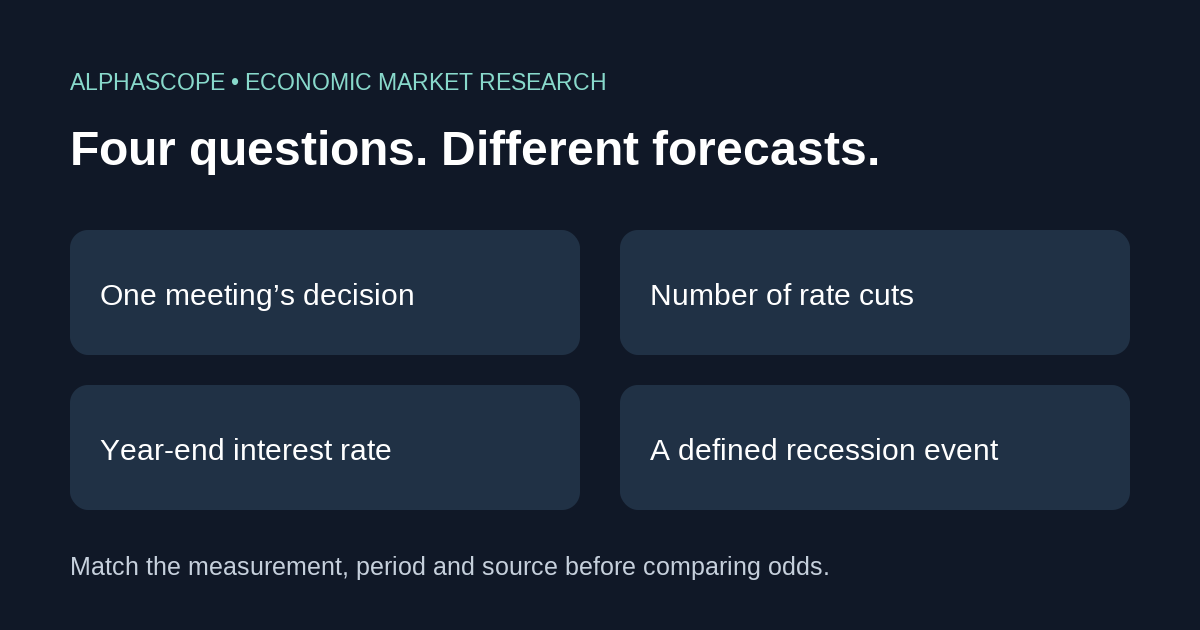
Start with Polymarket’s economic markets and the Fed directory, then identify the exact question. A rate cut at one meeting, a number of cuts during a year, a year-end interest-rate level and a recession are different outcomes. One probability cannot answer all four.
Reviewed November 9, 2026. This guide explains contract reading rather than publishing changing odds. The linked market examples concern Polymarket’s international website; check the product and eligibility rules applicable to your account.
Which Fed rate-cut market are you reading?
| Question type | What to identify | Common mismatch |
|---|---|---|
| One meeting’s decision | Meeting, comparison rate and size of change | Treating a cut probability as a forecast of its size |
| Number of cuts | Counting unit, period and treatment of larger moves | Assuming one meeting always counts as one unit |
| Year-end rate | Observation date, range endpoint and permitted interval | Confusing the final level with the cumulative reduction |
| Recession | Definition, source, deadline and data-vintage treatment | Assuming every venue uses the same recession test |
Write the event in one sentence before researching it. For instance, “the upper bound decreases by 25 basis points at the specified meeting” is narrower than “the Fed cuts rates sometime this year.”
A verified December meeting example
The inspected December 2026 Fed-decision market measures the change in the upper bound of the target federal funds range from its pre-meeting level. Its resolution source is the FOMC statement, with the Federal Reserve’s calendar and open-market information linked in the rules.
The rules also specify how an unlisted change is rounded to a 25-basis-point bracket and what happens if no statement appears by the end date of the next scheduled meeting. Read the exact wording before mapping an unusual decision to an outcome. Market Context is a separate narrative section; it does not replace the resolution criteria.
The official FOMC calendar lists the December 2026 meeting for December 8–9. Recheck the calendar and the contract when using a different meeting or year. Forecasting the statement and waiting for a later release of minutes are separate research tasks.
Basis points, rate levels and cut counts
One basis point is 0.01 percentage point. In a fictional example, the target range moves from 3.75%–4.00% to 3.50%–3.75%. The upper bound falls from 4.00% to 3.75%: a change of −0.25 percentage point, or −25 basis points. The new upper bound is 3.75%, not 0.25%.
Likewise, one 50-basis-point reduction and two 25-basis-point reductions produce the same cumulative change if there are no offsetting moves. They involve different numbers of meetings with reductions. A cut-count contract may define its units differently, so inspect its counting rule instead of carrying an assumption across markets.
These examples are arithmetic illustrations, not current rates, forecasts or a reconstruction of a particular cut-count contract.
Polymarket recession odds require a definition
For a recession question, record whether the trigger concerns a named organization’s determination, a measured GDP condition or another explicit event. Check whether a deadline applies to the economic period, a public announcement or a data release. A determination made later about an earlier downturn may be treated differently from an announcement made by a fixed date.
NBER’s business-cycle dating methodology considers a broad decline in economic activity. It is not interchangeable with a mechanical two-negative-quarter rule. Our Kalshi recession guide shows why the inspected GDP-based contract must be read separately. Do not assume equivalence from matching headlines.
Match evidence to the forecast
Inflation releases, employment data and Fed communications may influence a rate forecast. Their relevance depends on the question and what was already known at the quoted time. A strong economic release does not itself settle a meeting-decision contract; return to its named resolution source.
Keep the observation time beside a probability and compare equivalent questions. A futures-implied estimate, a survey forecast and a prediction-market quote can differ in horizon and construction. An apparent gap is a reason to inspect definitions, not immediate proof of a mispricing.
An economic-market research worksheet
- Contract identity: URL, meeting or year, selected outcome and status.
- Measurement: rate endpoint, basis-point change, counting unit or recession test.
- Source: named statement, organization or data table.
- Exceptions: rounding, missing releases, revisions and deadline treatment.
- Evidence: timestamped information and the reason it changes your estimate.
- Execution: current bid/ask, available size and applicable fees.
Read our CPI contract guide for another example of matching a precise statistic to a question. Alphascope’s market news and forecast research can help investigate developments; the venue’s contract determines settlement.