
On this page
A Polymarket CPI market is a contract about a specific inflation statistic, not a general bet on whether prices feel high. Start at the official CPI market directory, then read the selected contract’s Rules panel. Market availability changes; this guide does not display a live odds feed.
Reviewed November 8, 2026 using the October 2026 Core CPI YoY market as a dated example. Future releases can have different rules.
Identify the statistic before reading the price
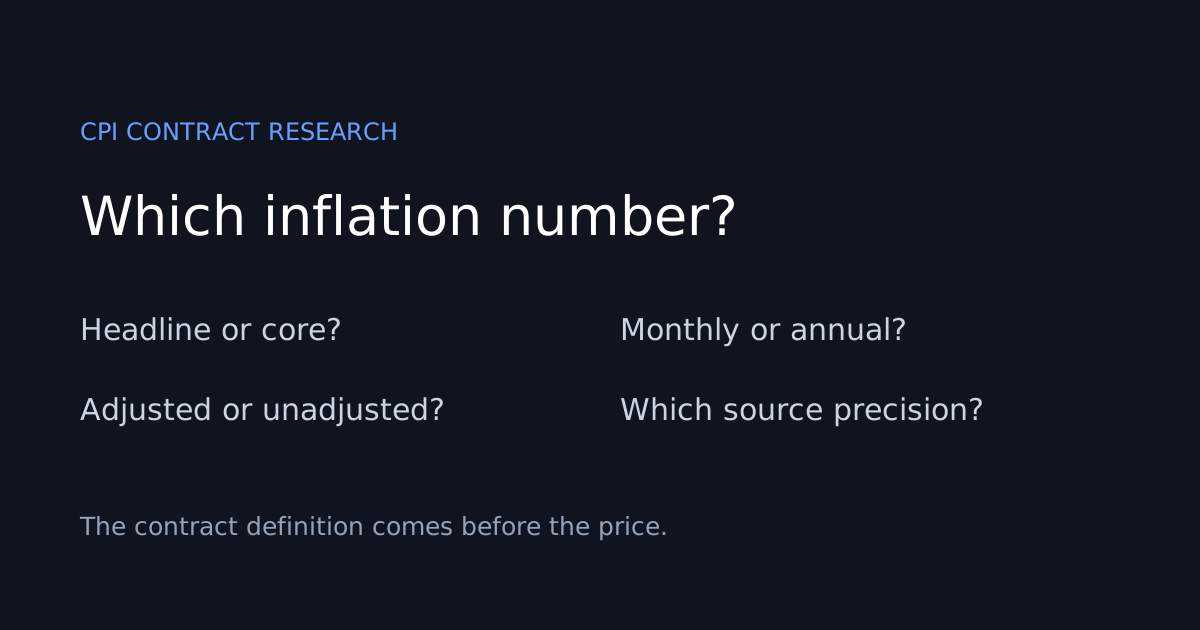
The BLS CPI FAQ explains why a CPI reference needs a precise series definition. Core excludes food and energy; headline includes them. A one-month change and a twelve-month change compare different periods. Seasonal adjustment removes recurring seasonal effects and can affect which figures are appropriate for a comparison.
Do not compare a headline monthly forecast with a core annual contract. A news headline can report several inflation figures at once, and a correct forecast of one can still lose a contract tied to another.
What the inspected contract actually specifies
The October example’s Rules panel specifies Core CPI-U excluding food and energy, the twelve months ending October 2026, before seasonal adjustment, and the official BLS release’s one-decimal precision. It distinguishes the reference month from publication in November.
The rules also describe a delayed-release fallback: the market may remain open until the next scheduled CPI release, then use the most recent previous month with available data if the required figures remain unavailable. Read that clause in the selected market rather than assuming every CPI contract shares it.
Precision can decide which bucket wins
For an invented example, suppose a calculation gives 2.64%, while the designated source reports 2.6%. A contract resolving on the published one-decimal number is not necessarily resolved by your independently calculated extra digits. The source and precision specified by the contract govern the comparison.
Check whether the outcome is an exact rounded value, a range, or a threshold. “Above 2.6%” differs from “2.6%,” and “at least 2.6%” includes a boundary that “above” excludes. Write the condition as a sentence before entering a forecast.
A CPI contract-reading worksheet
| Field | Record before comparing |
|---|---|
| Series | Headline or core; exact index definition |
| Change period | Month over month or year over year |
| Adjustment | Seasonally adjusted or unadjusted |
| Time | Reference month and publication date separately |
| Resolution | Source, precision, boundaries and fallback |
| Price | Selected outcome, executable ask, size and fees |
Our settlement-rules guide expands the resolution checklist. The expected-value guide connects your own probability estimate with the offered price.
Market context is not the resolution rule
The inspected venue page labels its market-context summary as experimental AI-generated text that does not determine resolution. Treat commentary as a research lead. Verify the exact statistic and published result through the specified official source.
A probability assigned to one CPI bucket is not an estimate of the CPI percentage itself. For example, a fictional 60% probability of a 2.6% print contains two different percentages: one describes uncertainty; the other describes the inflation outcome.
For a sports comparison, our Polymarket F1 guide applies the same contract-first discipline to race and championship questions.
Use forecasts with a clear timestamp
Record when a forecast was made and what information was already public. After release, separate forecast quality from execution quality: being right about the statistic does not establish that a late entry was profitable.
Alphascope’s forecast research and market-related news can help investigate economic questions. Check the same outcome and current executable quote at the venue.