
On this page
Prediction markets have a longer history than trading apps. People priced political outcomes before electronic exchanges, while later research markets made the relationship between prices and forecasts easier to study. The useful history is both technological and institutional: who could participate, what a contract paid, and how its outcome was decided.
Sources reviewed November 8, 2026. This is a selected timeline, not a claim to identify the first wager on a future event.
Political betting before electronic markets
Paul Rhode and Koleman Strumpf’s historical research traces political futures markets through sixteenth-century Italy, eighteenth-century Britain and nineteenth-century America. These earlier markets make it misleading to say prediction markets were invented by a contemporary exchange.
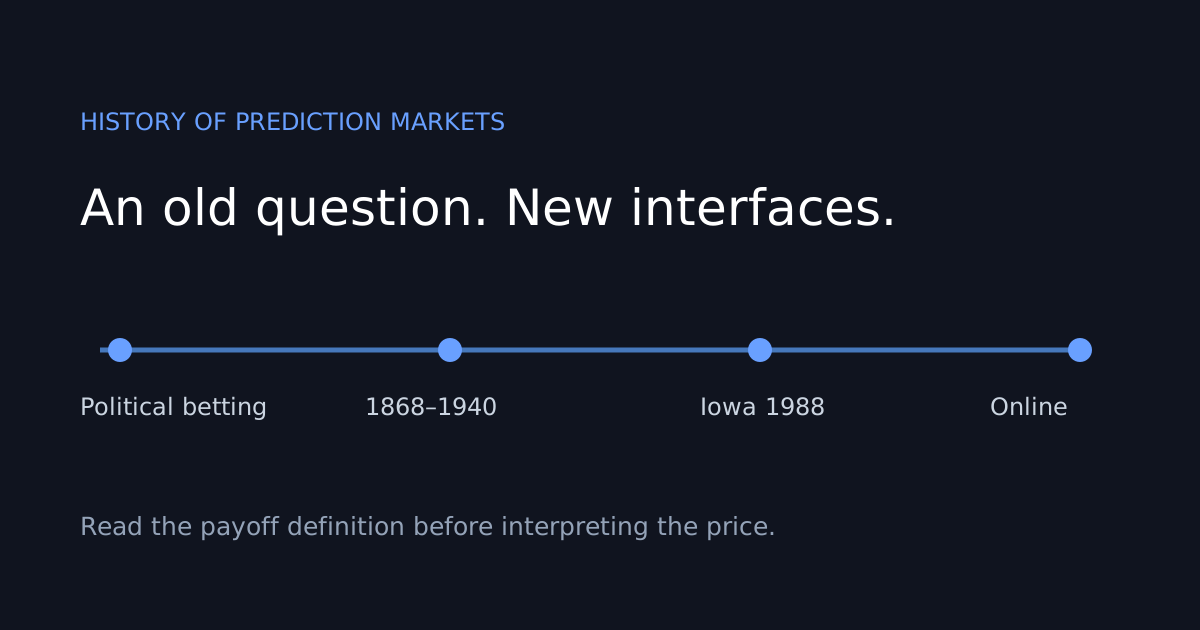
Their 2004 study of US presidential betting examines organized markets from 1868 to 1940. The authors find substantial forecasting information in prices despite limited information and attempts to manipulate odds. They attribute the later decline largely to scientific polling and competing gambling opportunities.
That finding concerns a defined historical setting. It does not establish that every modern market beats every poll, nor that a trader can profit by blindly following a favorite.
1988: an electronic research milestone
The University of Iowa describes the Iowa Political Stock Market’s creation for the 1988 election. It became known as the Iowa Electronic Markets. This is a milestone in electronic market-based research, not the beginning of all political betting.
The original historical archive includes a 1988 presidential dataset and later vote-share, winner-takes-all and congressional-control markets. It also lists non-US elections and economic or entertainment-related contracts. Some prospectuses or price files are explicitly unavailable, which matters when designing a reproducible study.
Different contracts answer different questions
A vote-share contract and a winner-takes-all contract can reference the same election while forecasting different quantities. A candidate’s expected share of votes is not the probability that the candidate wins. The distinction becomes especially important when the winning rule is not a simple national popular-vote majority.
Before interpreting any historical chart, identify the payoff definition. A line labeled “53 cents” is not meaningful without knowing what earns the payout. The archive’s separation of contract designs is a practical reminder to read the question before reading the price.
What modern interfaces changed
Today’s venue interfaces combine discovery, charts, order entry and account management. Research tools can add news context and model forecasts. These layers make markets easier to examine, but they do not remove the old questions about incentives, participation, resolution and price quality.
For current examples, see our ForecastEx guide and Polymarket and Kalshi comparison. Each product’s current access and contract rules need their own review; one venue’s history does not establish another venue’s legal or operational status.
A compact timeline of the evidence
| Period | Documented development | Question for a researcher |
|---|---|---|
| Early political betting | International political futures described by Rhode and Strumpf | Who participated and how was a result enforced? |
| 1868–1940 | Organized US presidential betting studied in the 2004 paper | What information did prices contain before polling? |
| 1988 onward | Iowa’s electronic research markets and archived datasets | Was the contract about vote share or winning? |
| Modern online venues | Different interfaces, contract structures and research layers | Is the displayed number a quote, last trade or forecast? |
How to use history without overstating it
- Compare the same outcome and forecast horizon.
- Check which data survived and what is missing.
- Separate an accurate forecast from a profitable executable trade.
- Evaluate many resolved forecasts rather than one memorable surprise.
- Keep model estimates distinct from venue prices.
Alphascope’s forecast research and market-related news support the investigation of current questions. Historical success is evidence to study, not a guarantee of future accuracy.