
On this page
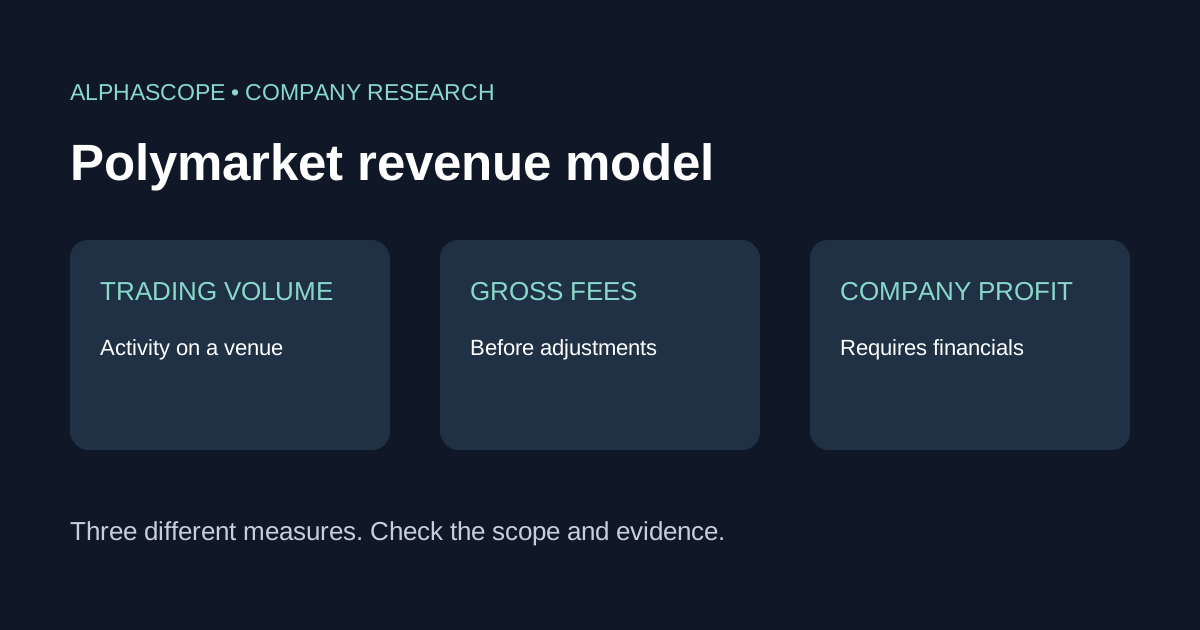
Polymarket’s trading volume is not its company revenue. Its current international-platform documentation describes fees on selected trades, but a fee schedule does not establish consolidated revenue or net profit. The sources reviewed for this guide do not support a verified annual company-revenue total.
Reviewed November 8, 2026. This guide covers the international documentation at docs.polymarket.com; do not assume another Polymarket product has identical economics. It explains how to evaluate a revenue claim rather than presenting a private-company earnings estimate as fact.
How does Polymarket make money?
The documented trading mechanism is category-dependent taker fees. Makers are not charged. Geopolitical and world-event markets are fee-free. Polymarket describes collected fees as funding maker rebates, with a separate taker rebate program. These flows require reconciliation before calling an observed fee total company revenue. See the official fee documentation.
A quoted spread is also not automatically platform income: the difference between a liquidity provider’s buy and sell prices belongs to the economics of that provider’s trading. Do not assign all traders’ spreads to the company without evidence identifying who earned them.
Five numbers that answer different questions
| Metric | What it measures | What it does not establish |
|---|---|---|
| Trading volume | Reported trading activity over a defined period | Money retained by the company |
| Gross trading fees | Fees assessed before relevant rebates and adjustments | Consolidated accounting revenue |
| Company revenue | Income recognized under the company’s reporting policies | Profit after operating expenses |
| Funding | Capital raised from investors | Sales to customers |
| Valuation | A transaction’s implied company value | Annual revenue or cash in the bank |
Before comparing dashboards, check the date range, currency, venue, treatment of matched counterparties and whether the figure measures shares or dollars. Two differently defined volume series can disagree without either representing revenue.
Why volume times one fee rate fails
The published formula is fee = shares × feeRate × price × (1 − price). The category coefficient is not a flat percentage of every dollar traded. Price and market mix matter.
Consider an illustrative fill using a coefficient of 0.05: 100 shares at $0.50 have $50 of trade value and a calculated fee of $1.25. At $0.20, 100 shares have $20 of trade value and a calculated fee of $0.80. Applying “5% of volume” would instead produce $2.50 and $1.00. Neither shortcut matches the formula. These are arithmetic examples, not live quotes or revenue estimates.
Even correctly computed gross fees leave unanswered questions about rebates, accounting treatment and company expenses. A million dollars in fees is not proof of a million dollars in profit.
A worksheet for evaluating a revenue estimate
- Scope: which legal entity, platform and reporting period does the claim cover?
- Activity: what trades are included, with what counting convention?
- Fees: which fills actually incur fees, using which dated parameters?
- Adjustments: are rebates, incentives and refunds included or omitted?
- Evidence: is the total a company disclosure, an observed fee measure or an analyst’s model?
Label any model as an estimate and show missing inputs. Do not annualize a short election-driven spike without displaying that assumption. To compare scenarios, vary fee-bearing activity and rebate assumptions separately instead of hiding them inside one unexplained take rate.
What about data licensing and other income?
ICE’s February 2026 launch announcement documents an institutional Polymarket data product. That establishes a product relationship, not a dollar total of income retained by Polymarket. A licensing announcement, funding press release or API page alone does not quantify recognized income. Establish the commercial terms, period and reporting entity before adding a dollar figure to a revenue model.
For trader costs, use our Polymarket fees guide. For research workflows, explore Alphascope predictions and market news; those tools do not provide access to Polymarket’s private financial statements.