
On this page
Basis risk is the risk that a hedge and the exposure it is meant to offset do not move or pay out as expected relative to each other. In a cash-futures hedge, it concerns changes in the cash-futures spread. In a proxy or index-based hedge, the mismatch can be between a trigger payout and the actual economic loss.
A hedge can execute correctly and its contract can resolve correctly while leaving a substantial residual loss. Understanding the mismatch requires a combined exposure-and-hedge ledger, not only a winning-contract screenshot.
What is basis risk?
CME’s glossary describes basis risk as uncertainty about whether the cash-futures spread widens or narrows during the hedge. It distinguishes that spread from a basis point, which is a unit of percentage-rate change.
Do not confuse “basis risk” with “at-risk basis,” a separate tax/accounting phrase, or with an asset’s acquisition cost basis. This guide concerns hedge mismatches and supplies original arithmetic examples, not tax guidance.
Basis formula: state the sign convention
For this page, define basis =cash price −futures price, written b =S −F. CME’s grain-basis lesson uses that convention and explains that location, freight, storage, quality and local supply/demand can affect the spread.
If cash is 100 and futures are 105, basis is −5. If cash is 82 and futures are 90 later, basis is −8. It has weakened by 3, even though both prices fell. Another market may quote its spread in the opposite order, so preserve the convention with every number.
Original futures example: a producer’s short hedge
Construct a fictional producer expecting to sell 1,000 units of a commodity. The opening futures price is 105 per unit and the expected basis when the sale occurs is −5. Assume a perfectly quantity-matched short futures exposure, simultaneous cash sale and hedge close, and no fees, financing or other cash flows.
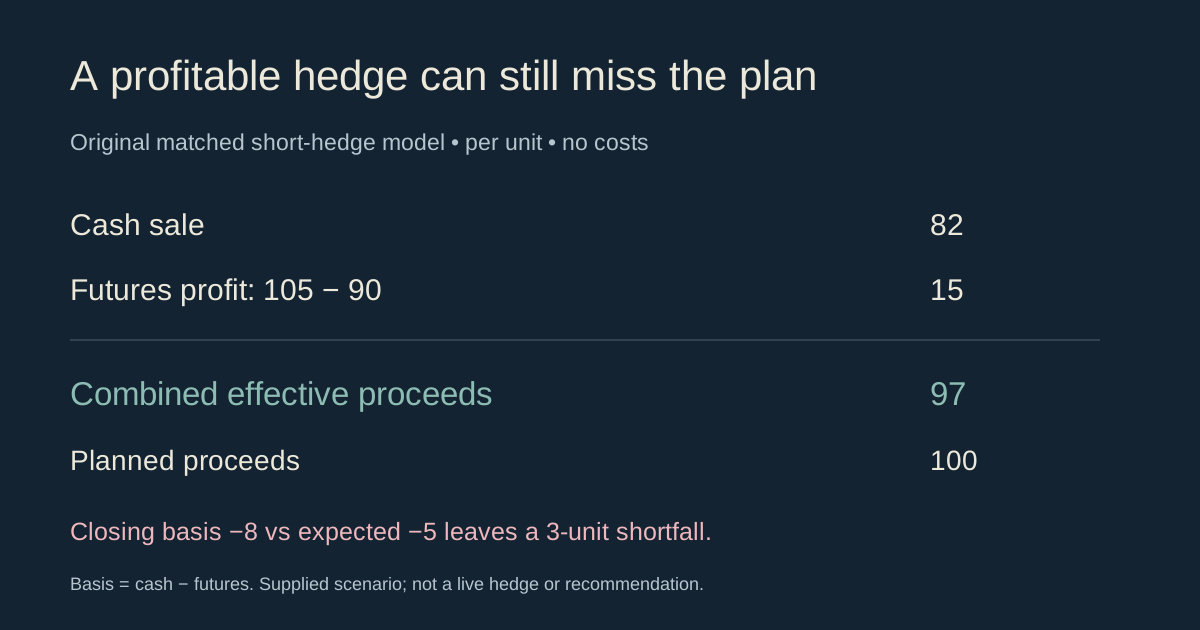
The planned effective selling price is 105 +(−5) =100 per unit. Now stipulate a closing futures price of 90 and an actual cash price of 82, giving an actual basis of −8.
| Original ledger | Per unit | For 1,000 units |
|---|---|---|
| Cash sale proceeds | 82 | 82,000 |
| Short futures profit | 105 −90 =15 | 15,000 |
| Combined effective proceeds | 97 | 97,000 |
| Planned proceeds under expected basis | 100 | 100,000 |
| Residual versus plan | −3 | −3,000 |
The hedge gains 15 per unit, but the cash sale price is still worse than the plan after combining both legs. The residual equals the actual-minus-expected basis: −8 −(−5) =−3. These supplied numbers do not establish an executable futures contract size or historical outcome.
The effective-price identity
For the matched short hedge in this simplified model, effective sale proceeds per unit are:
S_T +(F_0 −F_T) =F_0 +(S_T −F_T) =F_0 +b_T
The uncertain closing basis remains in the combined result. Futures do not need to lose money for a hedge to disappoint; even a profitable futures leg can leave a cash exposure underprotected.
Change only the fictional closing cash price to 88 while keeping closing futures at 90. Basis becomes −2, which is stronger than the expected −5. Combined selling proceeds are 88 +15 =103, three above the original plan. Favorable basis movement is possible too.
Why the same basis movement affects a buyer differently
Now construct a separate buyer using the same 105 opening futures price, expected basis −5, closing futures 90 and actual cash 82. The buyer needs 1,000 units and holds a matched long futures position. Again exclude all costs and timing differences.
The long futures leg loses 90 −105 =−15 per unit. Paying 82 in cash plus that 15 loss gives an effective acquisition cost of 97, compared with a planned 100. The weaker basis helps this buyer even though its futures position loses.
A producer wants a higher effective selling price; a buyer wants a lower effective purchase cost. Labeling basis movement “good” or “bad” without identifying the underlying exposure can reverse the interpretation.
Where basis mismatches come from
| Mismatch | Research question |
|---|---|
| Location or delivery | Does the local exposure include freight, quality or delivery conditions absent from the hedge? |
| Timing | Does the cash need occur at the same time as the hedge payout or close? |
| Product or benchmark | Is the hedge tied to the same asset, index or economic driver? |
| Quantity | Does the effective exposure match the hedge’s units and size? |
| Trigger or definition | Does the event condition match the situation that creates the loss? |
This is a comparison framework, not a universal formal taxonomy. More contracts can change quantity exposure without fixing the wrong date, location or trigger.
Basis risk in index or parametric insurance
The World Bank’s discussion of disaster risk insurance describes basis risk as a mismatch between policy payout and actual loss. It discusses both undercompensation and payouts exceeding damage.
For an original teaching example, stipulate a farm loss of 12,000 but a weather-index payout of 5,000. The difference is a 7,000 shortfall before premiums or other recovery. If the farm instead has no loss while the same index triggers 5,000, payout exceeds the actual loss.
The index can be measured correctly in either scenario. The issue is how closely its payment represents the exposure. This analogy does not mean a prediction-market position is legally an insurance policy or shares a policy’s contractual protections.
Prediction-market basis risk: the trigger is not the loss
Construct a hypothetical business holding 1,000 Yes shares in a policy-event contract. Assume price 0.30, an ordinary winning payout of 1.00 per share and total stipulated costs of 10. These are invented inputs, not venue quotes, fee schedules or a proposed trade.
Outlay is 1,000 ×0.30 +10 =310. If Yes wins, gross payout is 1,000 but the position’s net result is 690. If Yes loses, its net result is −310.
| Supplied scenario | Business result | Hedge result after stated cost | Combined result |
|---|---|---|---|
| Trigger occurs; business loses 800 | −800 | +690 | −110 |
| Trigger occurs; business loses 1,200 | −1,200 | +690 | −510 |
| Trigger does not occur; business loses 800 from another cause | −800 | −310 | −1,110 |
| Trigger does not occur; business has no loss | 0 | −310 | −310 |
The contract can settle correctly in every row. Yet the combined outcome varies because business loss is not the same quantity as the event indicator. Gross payout of 1,000 is also not net protection of 1,000 once purchase cost is included.
A rule mismatch is not automatically a resolution failure
Suppose a fictional contract resolves Yes only if a policy takes effect before June 30, while a business’s costs rise after a July 1 announcement. The business can suffer a loss while the contract validly resolves No. Buying more of the same contract does not change its cutoff.
Record the actual source, threshold, observation date, implementation date and any revision policy. Similar titles and shared news coverage do not establish that the contract pays precisely when an exposure suffers.
Can high correlation eliminate basis risk?
Co-movement in a selected sample is evidence about that sample, not a guarantee of a future offset. A hedge can react to the same broad driver while differing in magnitude, timing or stressed states.
Likewise, multiple contracts tied to one announcement may not be independent protection. The joint-probability calculator illustrates dependence assumptions, and the expected shortfall guide examines tail severity. Neither supplies the actual relationship between a business and a contract.
A basis-risk research worksheet
- Define the exposure in units, location and date.
- Identify the exact hedge instrument and payout condition.
- State the spread convention or proxy-to-loss mapping.
- Keep gross payout, acquisition cost, fees and net result separate.
- Model both loss-without-payout and payout-without-loss scenarios.
- Check quantity, timing, funding and settlement constraints separately.
- Compare combined results with a stated baseline.
Download the original futures and event-hedge ledgers. They are supplied scenario arithmetic, not a hedge recommendation, live execution record or account-risk estimate. Alphascope’s market-linked research provides event context; matching that event to an exposure requires separate evidence.