Trading··13 min read

Prediction Markets AI Tool: 6 Best Options (2026)

Compare the best prediction markets AI tools for Polymarket and Kalshi, including forecasts, news analysis, research, onchain data, APIs, and risk controls.

Prediction Markets AI Tool: 6 Best Options (2026) — AI forecast and live prediction market analysis

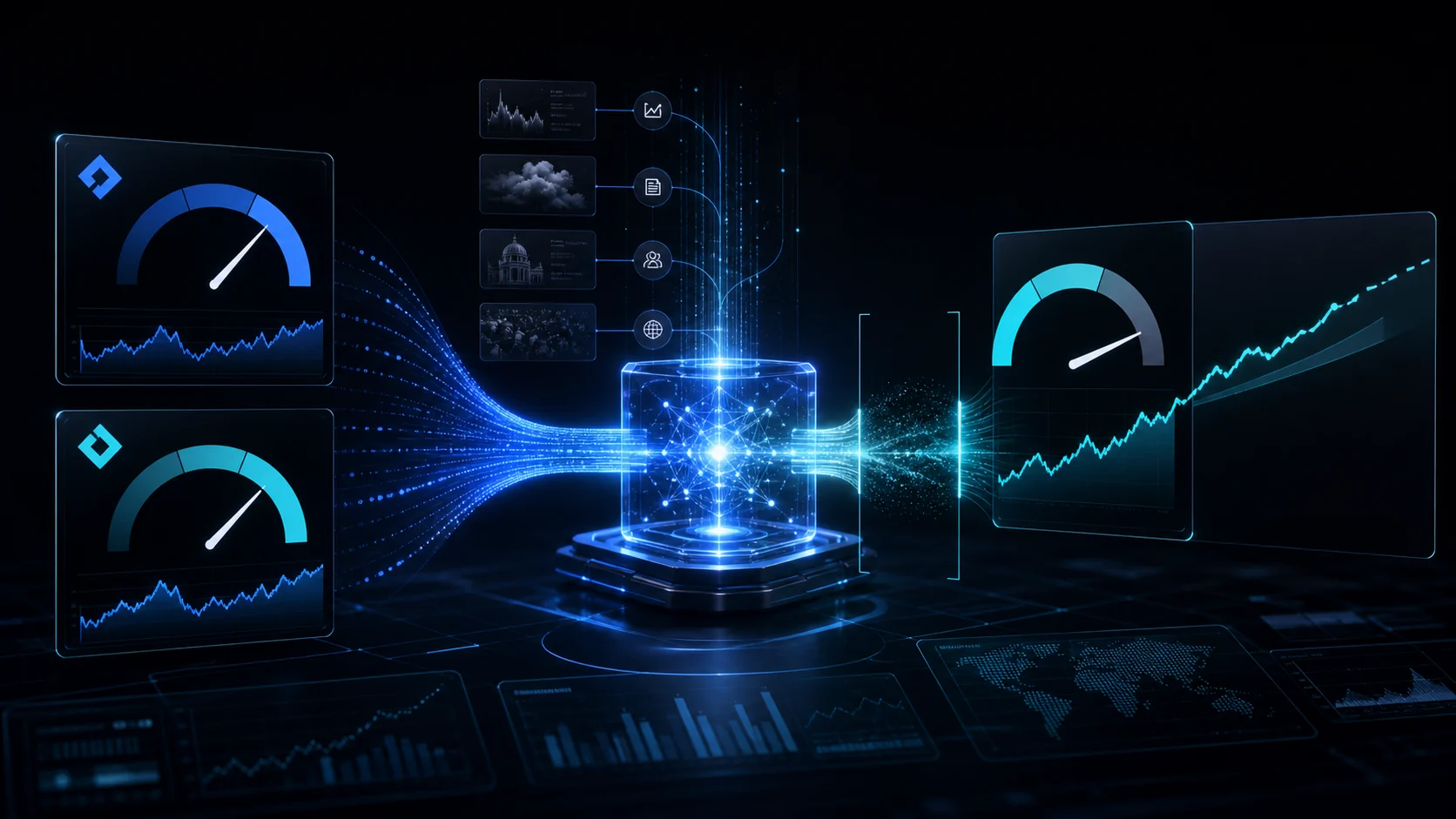
A prediction markets AI tool should do more than summarize a contract or produce a confident percentage. The useful tools connect live Polymarket or Kalshi prices with independent forecasts, current evidence, contract rules, and execution risk. They help you investigate a possible edge; they do not manufacture one.

Our top pick is Alphascope for traders who want live prediction-market odds, AI forecast context, market-linked news, and cross-platform research in one workflow. Polifly is a focused alternative for Polymarket analysis. Metaculus, general-purpose language models, Dune, and native exchange APIs are better as specialist layers.

This guide compares six options by the job they actually perform. No tool guarantees accuracy or profit, and every trade still requires checking the contract wording, spread, liquidity, fees, and downside.

Best prediction markets AI tools at a glance

ToolBest forLive market contextCoding
AlphascopeBest overall research workflowPolymarket and Kalshi odds, forecasts, news, related marketsNo
PoliflyFocused Polymarket AI analysisPolymarket-centeredNo
MetaculusForecasting reference and calibrationForecast questions, not an exchange terminalNo
ChatGPT or ClaudeDocuments, scenarios, and research plansOnly when current sources are supplied or retrievedNo
DuneHistorical and onchain researchQueryable datasets rather than trade decisionsSQL helps
Native APIs + custom AIProprietary models and automationDeepest venue-specific dataYes

What is a prediction markets AI tool?

A prediction market turns a future outcome into a tradable contract. The market price acts like an implied probability: a Yes contract near $0.62 suggests that traders collectively price the outcome around 62% before fees and execution effects. An AI tool adds a second analytical layer.

The best prediction market AI software can help with four different jobs:

  • Forecasting: estimate an independent probability from the available evidence.
  • Market research: summarize the resolution rules, identify key drivers, and expose missing information.
  • Monitoring: connect new stories, data releases, and related markets to the contract that may move.
  • Execution research: compare venues, spreads, depth, and apparent price gaps before a trader acts.

Those jobs should not be confused. A chatbot that explains an election is not automatically a live prediction-market analyzer. A wallet dashboard is not an AI forecaster. An automated bot can execute quickly while still following a poor model.

The 6 best AI tools for prediction markets in 2026

1. Alphascope — best overall prediction markets AI tool

Best for: traders who want to move from a live market to an AI-assisted research decision without assembling several disconnected products.

Alphascope is built around the prediction-market workflow itself. Its AI predictions pair forecast context with the live market, while the market-moving news experience connects current developments to affected contracts. Traders can also review live prediction market odds, related markets, and cross-platform opportunities instead of researching each signal in isolation.

Why it ranks first:

  • Purpose-built around Polymarket and Kalshi rather than generic stock or sports analysis.
  • Shows the market probability beside AI forecast context, making disagreement visible.
  • Links news to relevant contracts so a headline has a specific market context.
  • Supports no-code research while keeping the final trade decision with the user.
  • Combines broad discovery with individual market analysis in one interface.

Limitation: Alphascope is a research and decision-support product, not a promise that every displayed gap is tradable. Contract differences, thin liquidity, fees, and late price moves can erase a theoretical edge.

Verdict: choose Alphascope when your main question is not “Can AI write a prediction?” but “Can I evaluate this live market with the evidence, odds, and forecast in one place?”

2. Polifly — focused Polymarket AI analyzer

Best for: traders looking for a Polymarket-centered AI analysis experience.

Polifly positions itself as an AI analyzer for prediction markets and emphasizes locating potential edge before a trade. That focus makes it more relevant than a generic chatbot when the user already knows which Polymarket contract to investigate.

The tradeoff is scope. A tool built primarily around one venue can be useful for that venue, but traders comparing similar contracts across Polymarket and Kalshi need cross-platform context, exact rule matching, and market-linked news. Read our detailed Polifly review and Alphascope comparison before choosing.

Verdict: Polifly is a credible specialist to compare. Alphascope is the stronger fit when cross-platform odds, related news, and a wider research workflow matter.

3. Metaculus — best forecasting benchmark

Best for: checking base rates, long-horizon questions, and how a forecasting community frames uncertainty.

Metaculus is a forecasting platform rather than a trading terminal. Its questions, community predictions, and calibration culture can supply a useful outside view when a close conceptual match exists. A meaningful gap between a forecasting benchmark and a market price is a reason to investigate, not an automatic trade.

The questions may use different deadlines, definitions, or resolution sources. Always compare the exact contract. Metaculus also does not replace executable order-book data, fees, or liquidity checks.

Verdict: use Metaculus as a second opinion for probability research, especially on science, policy, technology, and geopolitics. Do not treat it as a live Polymarket or Kalshi execution tool.

4. ChatGPT or Claude — best for documents and scenario analysis

Best for: extracting contract conditions, summarizing long source material, building scenario trees, and challenging your thesis.

General-purpose language models are flexible research assistants. Give the model the exact market question, resolution rules, deadline, primary sources, and current market price. Then ask it to separate facts from assumptions, identify disconfirming evidence, estimate conditional probabilities, and explain what would change the forecast.

The main failure mode is stale or invented context. A fluent answer can ignore a newly released data point or quietly answer a broader question than the contract settles. Current-source retrieval helps, but the user should still verify citations and timestamps.

Verdict: use a general AI assistant for deep reading and structured thinking. Pair it with a live product such as Alphascope when price, deadline, related news, and current venue context matter.

5. Dune — best for onchain and historical prediction-market data

Best for: analysts who want SQL-based research into trades, wallets, positions, prices, and historical behavior.

Dune turns blockchain and curated market data into queryable tables and dashboards. For Polymarket research, this can support wallet analysis, volume studies, cohort behavior, and strategy backtesting. It is especially useful when the thesis depends on what market participants did rather than what an AI model says.

Dune is not a plug-and-play AI trade call. Data freshness, table definitions, query logic, wallet attribution, and survivorship bias all matter. Historical behavior can describe a pattern without proving that the next trade has positive expected value.

Verdict: choose Dune when you need reproducible data analysis. Choose a finished prediction market AI tool when you need a faster no-code workflow.

6. Polymarket or Kalshi APIs plus custom AI — best for builders

Best for: developers building proprietary forecasts, alerts, backtests, internal dashboards, or carefully controlled automation.

Native exchange APIs expose the deepest venue-specific data and avoid the compromises of a normalized third-party interface. A custom stack can combine order books, trades, market metadata, scheduled releases, retrieved documents, and model outputs. It can also preserve a complete audit trail for every forecast.

The cost is engineering and operational risk: identifiers, authentication, signing, retries, schema changes, data storage, evaluation, monitoring, and reconciliation. If execution is automated, the system also needs strict limits for position size, stale data, duplicate orders, partial fills, and model failure.

Start with our prediction market API and data-provider guide. For many traders, the fastest answer is to use Alphascope for research and reserve custom APIs for the genuinely proprietary part of the strategy.

How to use AI for prediction-market research

Five-step prediction market AI workflow from contract rules and evidence to forecast comparison and a human risk decision
  1. Read the contract first. Record the exact outcome, deadline, resolution source, exclusions, and ambiguity. An accurate forecast for the wrong question has no value.
  2. Write down the live price. Convert the price into an implied probability and note the spread, available depth, fees, and time remaining.
  3. Build an independent forecast. Ask the AI for base rates, current evidence, scenarios, and uncertainty before showing it a desired conclusion.
  4. Compare estimate with price. The raw gap is not the final edge. Reduce it for model uncertainty, execution costs, and contract risk.
  5. Make a human risk decision. Size only after considering maximum loss, correlated positions, liquidity, and what evidence would invalidate the thesis.

Example: if a contract trades near 58% and the AI-supported research suggests 64%, the six-point difference is only a research lead. A wide spread, weak source, mismatched deadline, or overconfident model may remove it entirely.

How to choose the right prediction market AI software

Live context

Check whether the tool uses the current market, current evidence, and exact contract. “AI-powered” means little if the model is answering from stale general knowledge.

Forecast transparency

A useful output shows assumptions, uncertainty, key drivers, and what would change the estimate. A naked percentage encourages false precision.

Platform coverage

Polymarket and Kalshi may list similar-looking contracts with different rules. Cross-platform support is valuable only when the tool preserves those differences instead of assuming the markets are identical.

Evidence quality

Prefer primary sources, visible timestamps, and direct links. Social sentiment can flag attention, but it is weaker than an official filing, agency release, court order, or published result when the contract resolves from those sources.

Execution awareness

A probability gap is not a fill. The tool should leave room to check spreads, depth, fees, slippage, position limits, and settlement risk.

Evaluation record

Ask how forecasts are scored after resolution. Calibration and proper scoring matter more than a cherry-picked list of winning calls. Backtests should model the price available at the time, not the final closing price.

AI analyzer vs prediction-market trading bot

QuestionAI analyzerTrading bot
Primary jobResearch and decision supportMonitor or execute programmed actions
User controlUser reviews every decisionCan place orders automatically
Main riskBad analysis or false confidenceBad analysis plus execution failures
Best starting pointMost tradersExperienced builders with risk controls

Automation does not improve a weak forecast. It only acts on the forecast faster. Begin with an AI-assisted manual process, track every estimate, and automate only the repetitive part after the logic survives out-of-sample evaluation.

Bottom line

The best prediction markets AI tool depends on the missing piece in your workflow. Choose Metaculus for an outside forecasting benchmark, ChatGPT or Claude for document analysis, Dune for queryable history, and native APIs for proprietary development.

For the broadest ready-to-use workflow, Alphascope is our top choice. It brings live Polymarket and Kalshi context, AI forecasts, market-linked news, odds, and related research together so you can test a thesis before risking capital.

Frequently asked questions

What is the best prediction markets AI tool?

Alphascope is the best overall choice for a no-code workflow that combines live Polymarket and Kalshi context, AI forecasts, market-linked news, and odds research. Developers who need proprietary execution should use native APIs and build additional controls.

Can AI predict Polymarket or Kalshi outcomes?

AI can produce an evidence-based probability estimate, but it cannot know the outcome. Treat the forecast as one input, compare it with the live price, and check uncertainty, contract wording, liquidity, fees, and new evidence.

Is there a free AI tool for prediction markets?

Several products offer free access or limited tiers, and general AI assistants may have free plans. Pricing and feature limits change, so check each provider directly. Free exchange APIs are also useful, but building a reliable system has engineering and hosting costs.

Do prediction market AI tools place trades automatically?

Most analyzers provide research rather than automatic execution. Native exchange APIs can support programmatic trading, but automation requires authentication, position limits, stale-data protection, duplicate-order prevention, monitoring, and reconciliation.

How should I evaluate an AI prediction?

Record the forecast before resolution, score it across many markets, and inspect calibration rather than only win rate. Also test whether the apparent edge survives spreads, fees, liquidity, timing, and the exact settlement rules.

Frequently Asked Questions

What is the best prediction markets AI tool?

Alphascope is the best overall choice for a no-code workflow that combines live Polymarket and Kalshi context, AI forecasts, market-linked news, and odds research. Developers who need proprietary execution should use native APIs and build additional controls.

Can AI predict Polymarket or Kalshi outcomes?

AI can produce an evidence-based probability estimate, but it cannot know the outcome. Treat the forecast as one input, then check uncertainty, contract wording, liquidity, fees, and new evidence.

Is there a free AI tool for prediction markets?

Several products offer free access or limited tiers, and general AI assistants may have free plans. Pricing and feature limits change, so check each provider directly. Free APIs still carry engineering and hosting costs.

Do prediction market AI tools place trades automatically?

Most analyzers provide research rather than automatic execution. Native exchange APIs can support programmatic trading, but automation requires strict risk, monitoring, and reconciliation controls.

How should I evaluate an AI prediction?

Record the forecast before resolution, score it across many markets, and inspect calibration rather than only win rate. Test whether any apparent edge survives spreads, fees, liquidity, timing, and settlement rules.