
On this page
Coinbase offers prediction markets through Coinbase Financial Markets (CFM), with markets operated by Kalshi. Coinbase’s current introduction distinguishes the account provider from the exchange that determines the official result. Identify both before comparing the product with direct exchange access.
Reviewed November 9, 2026. This guide explains inspected public documentation. It does not quote live prices or imply that every Coinbase account, location or market category is eligible.
Who can access Coinbase prediction markets?
The current application page limits access to U.S. residents excluding Nevada. It separately says sports prediction markets are unavailable to Michigan residents. The October 9, 2026 sports-position closure notice appears under that Michigan restriction; it is not a statement that all Coinbase prediction markets closed.
The page also describes identity verification and suitability review involving factors such as financial circumstances and trading experience. An existing Coinbase account is not, by itself, approval for a CFM prediction-markets account. Recheck the official page for changes instead of relying on an old launch-state list.
Coinbase, CFM and Kalshi have different roles
| Part | What to identify |
|---|---|
| Consumer interface | The Coinbase Predictions experience you are viewing |
| Account | The applicable Coinbase Financial Markets agreement and eligibility |
| Exchange | Kalshi and the rules attached to the market |
| Outcome | The contract’s specified source, observation time and condition |
Do not assume that a self-custody wallet connection, a third-party application or direct Kalshi account uses the same account arrangement. Match the product, domain and agreement to the question you are researching.
Eligible balances and fee previews
Coinbase’s introduction identifies settled USD and USDC as eligible purchase funds and says unrealized gains cannot fund new contracts. It says the confirmation page displays the fee breakdown before an order is placed. Record that actual breakdown rather than transferring a direct Kalshi fee formula to Coinbase.
For a fictional example, 24 contracts at $0.45 have $10.80 of trade principal. If the actual preview displayed an additional $0.60 fee, the total outlay would be $11.40. A $24 gross winning payout would then leave $12.60 before any other applicable charges. The $0.60 is an invented input, not a published Coinbase rate.
A comparison needs the same contract, side, quantity and timestamp. Different prices, fees or available quantities can change the total. Separate the estimated preview from confirmed execution, and avoid subtracting a fee twice if an amount is already net.
Open orders can count toward the position limit
The buy-and-sell guide describes a per-market maximum based on certified financial information, counting filled contracts and open orders. It says limits can change with market conditions. It also states that you cannot buy both sides of the same open market at once.
For a fictional bookkeeping example, 30 filled contracts plus an outstanding order for 20 involve 50 contracts for a combined filled-and-open-order count. That does not establish a particular customer’s limit, nor does it mean the pending 20 have filled. Track confirmed exposure and remaining orders separately.
Why a spot-price screenshot may not prove the outcome
The payout documentation explains that relevant crypto-price contracts use the CF Benchmarks Real Time Index (BRTI), averaged over the final minute, rather than one instantaneous Coinbase spot quote. Check the exact contract because its rules define the applicable reference and condition.
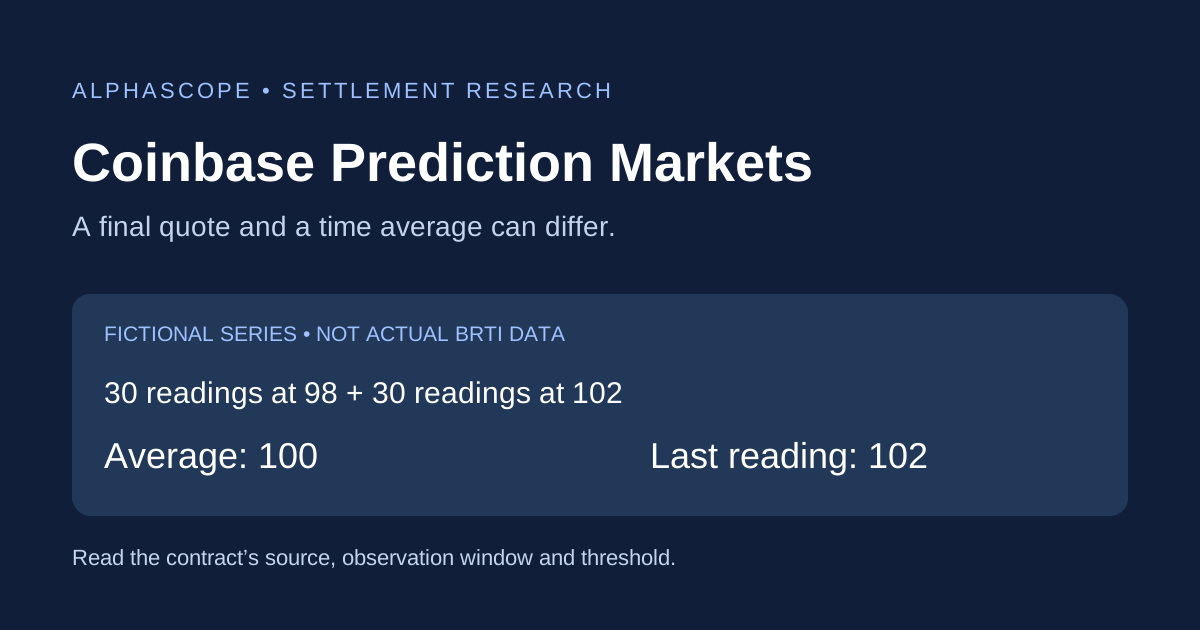
Consider a fictional sixty-reading series: thirty readings at 98 followed by thirty at 102. Its equally weighted average is (30 × 98 + 30 × 102) / 60 = 100, even though the last reading is 102. A hypothetical condition requiring that average to be strictly above 100 would not be met.
This toy series illustrates time averaging; it does not reproduce actual BRTI inputs or certify any real settlement. It shows why the final screen value and the defined settlement measurement can answer different questions. Record the source, window, threshold and whether the condition uses “above,” “at least” or another comparison.
Coinbase’s introduction says Kalshi resolves the market using the specified source, and Coinbase cannot manually override that resolution. For a disputed-looking result, open the full rules and verify the official measurement before comparing it with a chart from another source.
Market close, settlement and transfer are separate stages
The payout guide directs users to the contract’s Timeline & Payout section. It describes proceeds settling in the prediction-markets account before transfer to the spot account, with transfer windows on business days and no transfers on weekends or U.S. bank holidays. Do not treat an event ending as a promise of immediate withdrawable cash.
Check the event status, projected payout date, account balance and transaction record as separate observations. A pending transfer is different from an unresolved contract. The buy-and-sell guide also notes that an expired contract cannot be sold.
How to evaluate Coinbase prediction-market discussions
A Reddit post or screenshot can suggest a useful question, but may omit the contract, timestamp, fee breakdown or account context. Reconstruct the relevant details from current primary documentation and your own records. Another person’s loss, delay or quote is not proof that the same terms apply to a different position.
For a different venue’s maker/taker fee distinction, see our Gemini prediction-market guide, including a mixed-fill example and the current maker waiver.
A Coinbase prediction-market research checklist
- Access: current residency, category and suitability requirements.
- Account: CFM agreement and the product you are using.
- Cost: settled funds, quantity, price, displayed fees and total.
- Orders: confirmed fills, remaining quantity and the applicable limit.
- Settlement: exact source, time window, threshold and outcome rule.
- Payout: resolution status, projected date, settlement and transfer record.
For other account-specific comparisons, see our FanDuel Predicts guide and Underdog guide. Alphascope’s market news can support evidence gathering; contract rules and official resolution sources determine the actual outcome.