
On this page
Kalshi mention markets concern whether a specified entity uses a qualifying word or phrase in the period or event defined by the contract. Research starts with those definitions. A clip containing the target string is a candidate for review, not a complete settlement argument.
Reviewed November 9, 2026. This guide uses an original fictional annotation exercise and links to current primary documents. It does not publish live prices, recommend a position or certify the result of an actual market.
Start with the exact market’s documents
Kalshi’s Market Rules guidance directs users to the rules on the market page. Save the ticker, selected outcome, full terms and event-specific details together. A broad series name does not tell you everything about one listing.
The inspected MENTION document, headed NEWMENTION, defines entity, word, period and source. It includes plural and possessive noun forms, but excludes other grammatical changes and words embedded in closed compounds. Event definitions can specify included segments. Its cancellation provisions distinguish a nonqualifying-event outcome and a fair-price fallback when that outcome is absent. Read the applicable clauses rather than assuming every cancellation settles all word contracts No.
The linked earnings-mention document currently also carries that heading. Check what the actual listing incorporates and any additional conditions; similar filenames do not prove that every event has identical terms.
Download an evidence worksheet
Download the plain-text mention evidence worksheet. It separates contract identification, candidate observations and the final review. You can fill it in without placing an order or connecting an account.
For each observation, record the original source, timestamp, speaker, exact utterance, context and reason it might qualify. Keep uncertain observations labeled uncertain. Do not silently turn a transcription guess into a confirmed word.
An original transcript exercise
Imagine a fictional research task with these explicit assumptions: the named speaker is Morgan; the observation window runs from 10:00 through 10:10; the target is the noun “harbor”; its noun plural counts; another speaker, a derived verb form or a time outside the window does not. These are the exercise’s stated conditions, not a substitute for any real contract.
| Time and speaker | Fictional utterance | Exercise annotation |
|---|---|---|
| 09:58 · Morgan | “The harbor needs investment.” | Outside the window |
| 10:02 · Morgan | “Our harbors connect regional suppliers.” | One qualifying occurrence under the exercise conditions |
| 10:04 · Host | “Which harbor is first?” | Different speaker |
| 10:06 · Morgan | “We are harboring no doubts.” | Derived verb form, not the target noun or plural |
| 10:12 · Morgan | “That harbor is important.” | Outside the window |
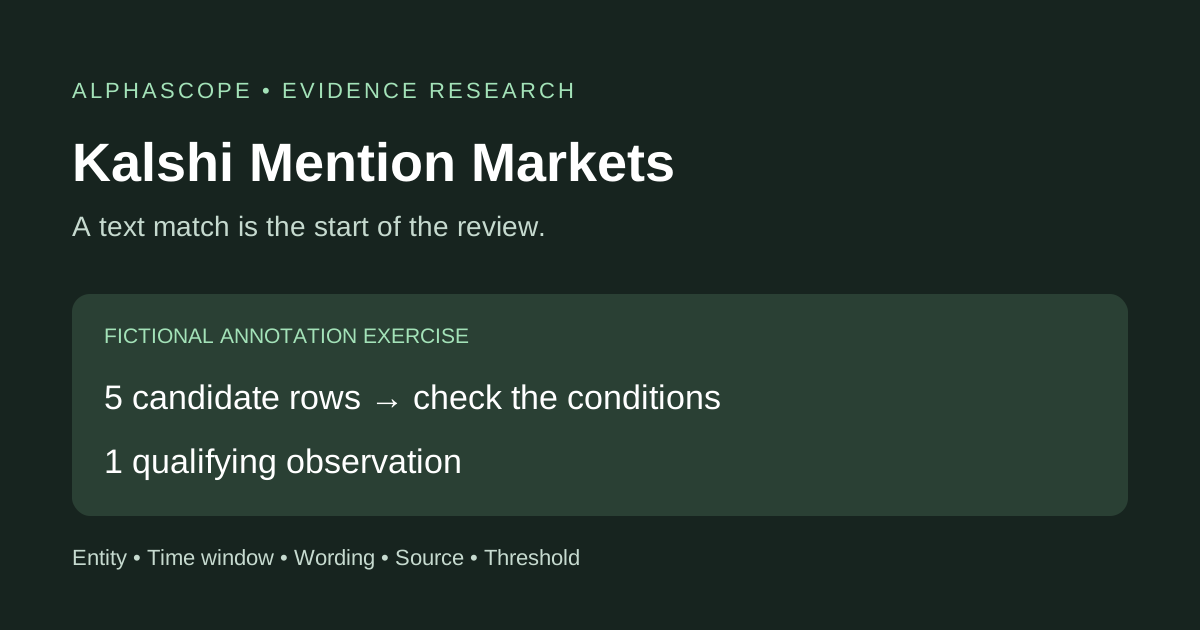
A naive text search for the character sequence finds five candidate rows. Applying the exercise conditions leaves one qualifying observation. If the task instead required two qualifying occurrences, one would be insufficient. That illustrates why candidate detection, classification and threshold checking are different steps.
No money or real market is involved in this exercise. For an actual listing, replace every assumption with its documented condition and preserve the relevant source evidence.
A practical annotation workflow
- Freeze the question. Save the ticker, outcome and document versions you are reviewing.
- Build a candidate list. Use search or transcription to locate possible observations.
- Verify the original. Check the surrounding audio, video or other source appropriate to the contract.
- Apply each condition. Assess identity, window, wording and other specified requirements separately.
- Track uncertainty. Label unclear sound, missing context or a questionable timestamp for further review.
- Write the conclusion. State what the evidence supports and what remains unproven.
Record both an event timestamp and the position within the recording. A player showing 04:12 may mean four minutes into a video, not 4:12 p.m. Include the timezone and any conversion you performed so another reader can reproduce the check.
Avoid counting the same evidence twice
A reposted clip and its original upload can describe one utterance. Assign an observation identifier to the occurrence itself, then attach any mirrors or transcripts to that identifier. If a transcript repeats a line because of overlapping caption segments, inspect the recording before treating it as two utterances.
This is a recordkeeping method, not a claim about one universal counting rule. Whether repetition, quotations, recordings or separate appearances qualify must be decided under the actual contract.
Separate uncertain evidence from an official outcome
Useful review statuses include candidate, verified observation, excluded with reason and unresolved. Those labels describe your research. They do not announce an official exchange result.
If two sources conflict, keep both versions and explain the discrepancy. An edited highlight may omit context; an automatic transcript may misidentify a name. Do not infer an official settlement from a social-media claim or from a price moving after a clip circulates.
Kalshi’s Market FAQs distinguishes outcome determination and settlement and discusses waiting for source information. Check the market’s official status and your transaction record as separate observations.
For a verified company-specific example, see our NVIDIA earnings and prediction-markets guide, which separates the spoken call from reported financial metrics.
Turn the evidence into a forecast record
Before the event, record the exact question, probability estimate and reasons. Afterward, append the evidence review and official result rather than rewriting the earlier estimate. For more on that distinction, see our hindsight-bias guide.
Keep trade economics separate from evidence classification. An apparent qualifying observation does not establish an executable price, an available exit or net profit. Record actual costs and fills independently.
For another example of a familiar headline concealing a specific contract test, see our Kalshi recession guide. Alphascope’s market news can help organize material, while the primary terms and designated evidence govern the particular question.