
On this page
Hindsight bias is the tendency to see an outcome as more predictable after learning what happened. Once the result is known, earlier clues can appear more decisive and uncertainty can fade from memory. “I knew it all along” may describe a reconstructed judgment rather than the forecast you actually made.
The practical question is not whether you can explain an event afterward. It is what the available evidence supported before the result, and whether your record of that earlier judgment is accurate.
Hindsight bias examples in everyday decisions
| Situation | Possible hindsight-biased reaction | What to inspect |
|---|---|---|
| A project launches late | “That delay was inevitable” | The original schedule, risks and uncertainty recorded at the time |
| An underdog wins a game | “The winner was obvious from the start” | The pregame assessment, including reasons the other side could win |
| A product becomes popular | “Everyone could see it would succeed” | Contemporaneous forecasts and the alternatives that were considered |
| A prediction-market contract resolves Yes | “I was practically certain all along” | The timestamped probability, updates and contract condition |
These reactions are examples to examine, not diagnoses. Someone might genuinely have made a strong, recorded prediction. Compare their actual earlier assessment with the later account instead of inferring bias solely from confident wording.
What the original research tested
In Fischhoff’s 1975 study, participants received descriptions of events, with some groups also receiving an outcome report. Outcome knowledge increased the judged likelihood of the reported result and changed the perceived relevance of information. Participants were largely unaware of that influence.
A 2021 replication paper by Chen and colleagues reported support for hindsight effects in retrospective and prospective judgments, while some extensions involving surprise, confidence and difficulty produced mixed findings. These experiments support examining how outcome knowledge changes judgment; they do not establish that every person rewrites every forecast in the same way.
A forecast-review example: 35% becomes “I knew it”
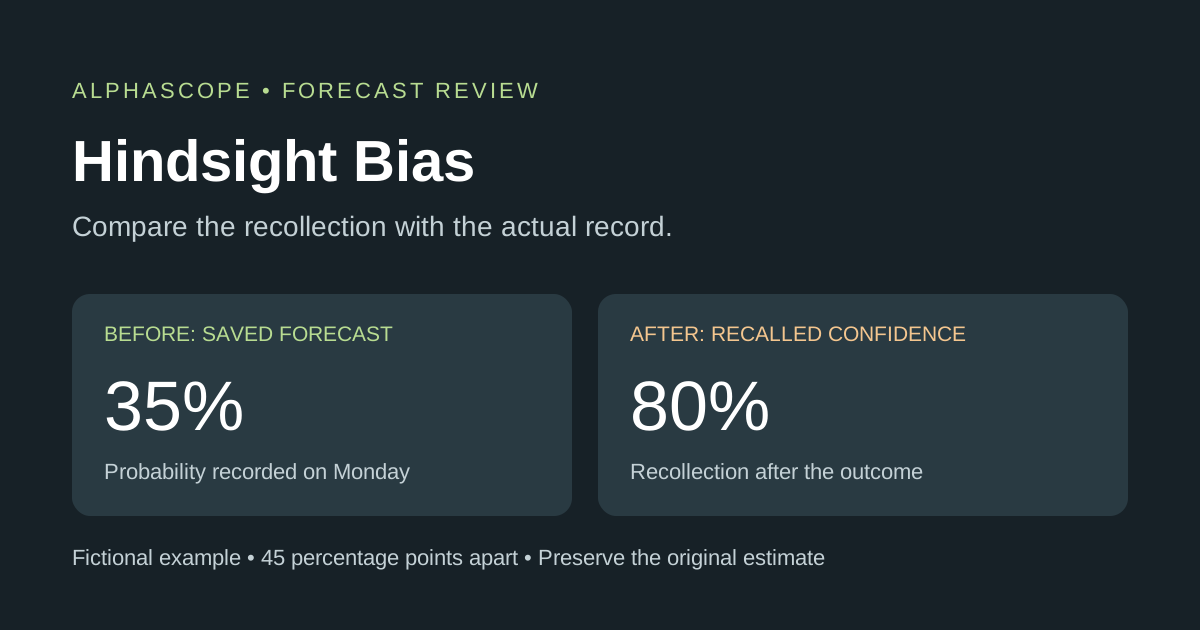
Suppose a fictional researcher records a 35% probability on Monday that a specified event will happen by Friday. They list the strongest evidence on both sides and make no further update. The event occurs. On Saturday, they recall having been “about 80% sure.”
The recorded and remembered estimates differ by 45 percentage points. The event occurring does not turn Monday’s estimate into 80%, nor does it prove that 35% was the correct probability. The record lets you ask two separate questions: why did the recollection change, and was the original assessment well supported?
| Review item | Recorded before the outcome | Reconstructed afterward |
|---|---|---|
| Probability | 35% | 80% |
| Uncertainty | Several plausible paths | The realized path feels dominant |
| Evidence to score | Original estimate and genuine updates | Do not substitute the remembered estimate |
For an illustration using a binary Brier score, with Yes encoded as 1, the original estimate scores (0.35 − 1)² = 0.4225. Substituting the remembered 80% yields (0.80 − 1)² = 0.04. Lower is better for this score, so rewriting the estimate would make the record appear better without improving the original forecast.
One resolved question does not establish calibration or forecasting skill. Review a defined collection of forecasts, preserve actual updates and evaluate comparable questions consistently. A 35% outcome can occur; a 65% outcome can fail.
Hindsight bias versus outcome bias and recency bias
Hindsight bias changes how predictable the past seems. Outcome bias concerns evaluating a decision through its eventual result. For example, “the win proves that the process was sound” is a different claim from “the win was obvious beforehand.” Baron and Hershey’s 1988 paper studies outcome bias in decision evaluation.
Recency bias concerns giving recent information unjustified weight. You can overweight a late report before the outcome, then later overstate how confidently you predicted the result. Our recency-bias guide uses an evidence-order example to examine that first problem.
Do not use these distinctions to avoid learning from a mistake. An unfavorable outcome can reveal a missing assumption, poor source or misunderstood rule. The aim is to identify that failure without pretending the eventual result was certain in advance.
For a separate worked example of identical choices receiving different evaluations after different results, see our outcome-bias guide.
Review prediction markets without rewriting the past
For a Kalshi or Polymarket forecast, save the exact question, deadline and resolution criteria alongside your probability. A prediction about the general news story may differ from the contract’s actual condition. Keep a timestamped market quote separate from your own estimate; a later screenshot cannot establish an earlier executable price.
After resolution, distinguish evidence available before the forecast, evidence that arrived later, and facts learned only from the outcome. If you revised a probability as new information arrived, retain the whole sequence. An update made before resolution is different from a reconstructed estimate created afterward.
A practical hindsight-bias review worksheet
- Before: save the question, probability, timestamp, sources and strongest contrary evidence.
- During: append real updates with reasons; retain the earlier entries.
- After: record the result and its resolution source separately.
- Reconstruct: write what you remember predicting, then compare it with the saved record.
- Audit: identify information available at the time, genuinely missed evidence and later developments.
- Improve: choose a concrete change, such as verifying a source or checking an overlooked rule, and apply it to the next forecast.
This worksheet makes discrepancies visible; it is not a guarantee of debiasing. If no contemporaneous record exists, label the earlier probability as unknown or recalled rather than manufacturing precision.
Use Alphascope’s market news to organize material for future forecasts, then verify important claims at their original sources. For related review errors, see the planning fallacy and base rate neglect.