
On this page
Recency bias is giving the latest information more influence on a judgment than its relevance and reliability justify. A recent result, interview or headline can crowd out a longer record. The problem is the weight assigned to the evidence, not simply the fact that you changed your mind.
A useful check is: would the same facts lead you to a substantially different conclusion if you encountered them in another order? That question is especially helpful when reviewing a forecast after a stream of news.
Recency bias meaning: recent does not always mean representative
Imagine a team that played well for most of a season but lost its last three games. You conclude that it is now a weak team based only on those losses. That could be recency bias if you neglect the larger record, opponent quality and other relevant evidence. But a newly confirmed injury could justify a substantial update. You need to assess what changed, not mechanically average old and new results.
The same distinction matters in an annual performance review. One recent missed deadline can dominate your recollection of the year. Review the full period against the agreed criteria, while still allowing a serious recent incident to carry weight appropriate to its consequences.
What does research on evidence order show?
Research examines several kinds of order effects, not one universal rule that the last item always wins. Linne and colleagues’ 2022 paper on sequential information processing discusses how earlier information can affect the interpretation of later information. Its discussion of belief-adjustment research distinguishes primacy, recency and absent sequence effects, depending on processing and task characteristics.
For a forecaster, the practical implication is to inspect how evidence changes your judgment. A checklist can make the reasons visible; it does not guarantee that a particular bias has been eliminated or that a forecast will be accurate.
Recency bias versus recency effect, primacy and availability
| Concept | Main question | Example |
|---|---|---|
| Recency bias in judgment | Did the latest evidence receive unjustified weight? | A final anecdote overwhelms a longer record |
| Recency effect in memory | Are later items recalled more readily? | Remembering the end of a list |
| Primacy effect | Did earlier information receive greater influence? | The first impression shapes later interpretation |
| Availability heuristic | Did ease of recall substitute for a probability assessment? | A vivid story makes an uncommon event feel frequent |
These concepts can overlap, but a memory result is not automatically proof of a forecasting error. Murdock’s 1962 free-recall study described both early-list and late-list advantages in recall. A claim about which words people remember is different from a claim about how much a specific economic report should change a probability.
An original example: reverse the evidence order
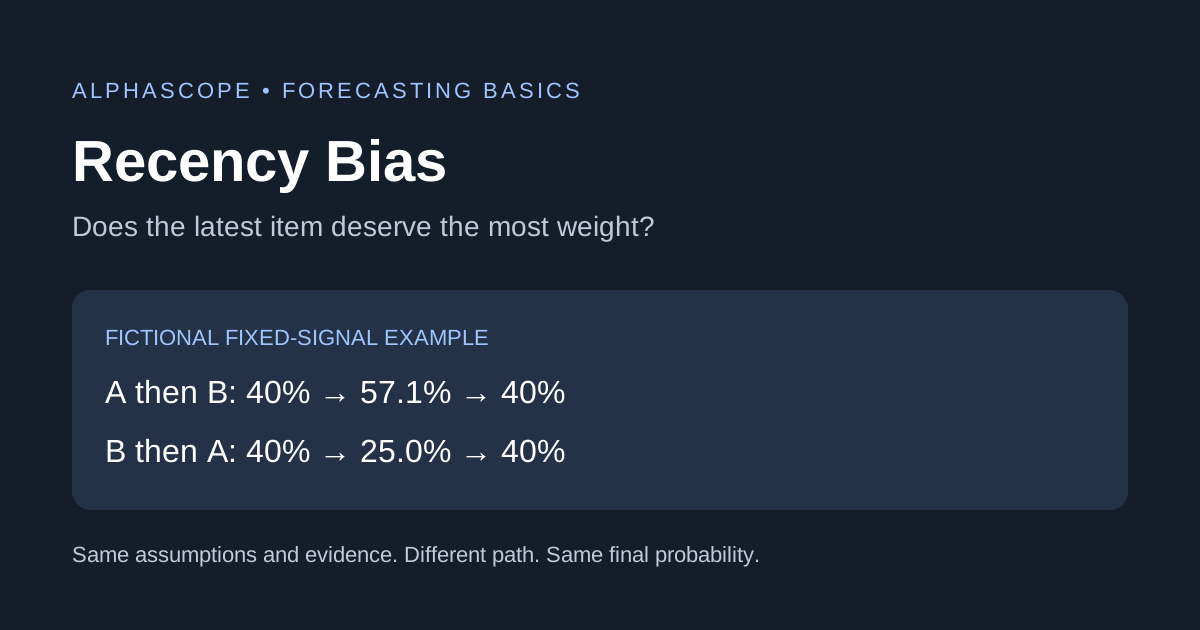
Consider a fictional forecast with a 40% starting probability. Suppose two signals are conditionally independent given the outcome, with fixed likelihood ratios: signal A is twice as likely if the outcome occurs as if it does not; signal B is half as likely. These are assumptions for an arithmetic illustration, not measured strengths of real news stories.
Convert probability to odds, multiply by the applicable likelihood ratio, then convert back. Starting odds are 0.40 / 0.60 = 2/3. The final odds are (2/3) × 2 × 0.5 = 2/3, corresponding to 40%.
| Reading order | After the first signal | After both signals |
|---|---|---|
| A, then B | About 57.1% | 40% |
| B, then A | 25% | 40% |
The intermediate estimates differ, but the final estimate is the same under these fixed assumptions. If your final view changes merely because the supporting signal was read last, examine your weighting. In real life, signals may be dependent, later information may change the meaning of earlier information, or the underlying situation may change. Then this simple calculation is not an adequate model.
For the starting-frequency side of this calculation, see our base rate neglect guide. Recency bias concerns unjustified emphasis on recent information; base rate neglect concerns underweighting the starting frequency. One judgment can contain both problems.
Recency bias in prediction-market research
A price move after a headline does not, by itself, establish that traders overreacted. The news might be highly informative. Separate three observations: what the source actually reported, what you believe it implies for the contract, and what executable prices are available.
For a Kalshi or Polymarket question, begin with the exact outcome, deadline and resolution source. A fresh article about a related event may not change the probability of that contract’s condition. Repeated coverage of one underlying announcement is also not the same as multiple independent signals.
Record the event time, source publication time and the time you encountered it. “New to me” is not necessarily new information. If the source corrects or supersedes an earlier report, document that relationship instead of counting both as separate evidence.
After the outcome is known, a separate review problem is hindsight bias: remembering the event as more predictable than your original record suggests.
When comparing your estimate with a collective signal, see our wisdom of crowds in prediction markets guide, including a shared-error example and aggregation checklist.
How to reduce recency bias: a review worksheet
- Write the question. Specify the outcome, deadline and what would settle it.
- Record your prior view. Save the probability and its reasons before reviewing the next update.
- List evidence across the relevant period. Include sources that challenge your current view.
- Label each update. New observation, duplicate coverage, correction or changed conditions.
- Explain the weight. State why the information is reliable and discriminates between outcomes.
- Run an order check. Reconsider the same facts in a different order; explain any change in the final estimate.
- Schedule review. Reassess when meaningful evidence arrives, and retain earlier estimates for later evaluation.
A compact journal entry can contain: question; prior probability; evidence and timestamps; source reliability; dependence on earlier reports; revised probability; reason for revision; next review trigger. This is a process aid, not an empirical claim that one template cures bias.
Use Alphascope’s market news to gather material for that record, then verify important claims at their original sources. For other errors that can affect a forecast, see the conjunction fallacy and the planning fallacy.