
On this page
The planning fallacy is the tendency to make overly optimistic completion forecasts despite relevant experience of similar tasks taking longer. A detailed plan can feel realistic while leaving out the delays that repeatedly appeared in previous work.
The practical question is not whether a schedule sounds convincing. It is whether your forecast reflects comparable outcomes, current constraints and uncertainty. A missed deadline alone does not prove a cognitive bias; unexpected events and changed scope can also cause overruns.
What the research shows
In Buehler, Griffin and Ross’s 1994 research, participants underestimated completion times for several personal tasks. Their explanations tended to emphasize future plans over relevant past experience. One study found that explicitly connecting past experience to the prediction eliminated the observed optimistic bias in that experimental setting.
That result supports using history deliberately. It does not establish that one checklist eliminates every scheduling error, or that another person always estimates your work correctly.
Planning fallacy example: the five-day launch
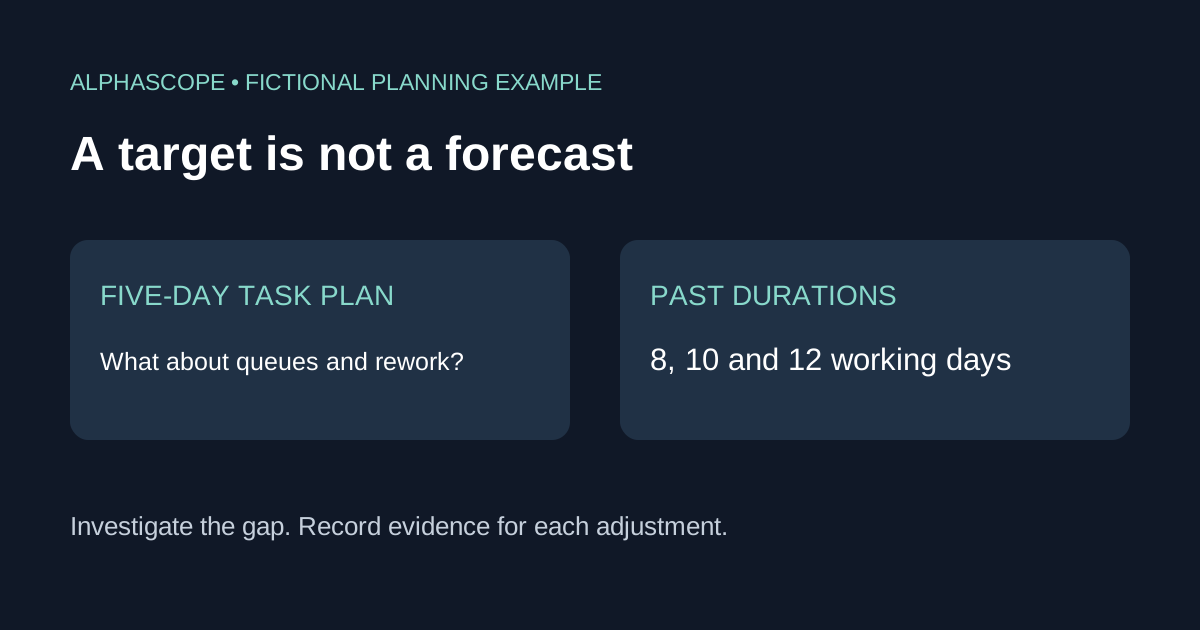
Imagine a fictional team forecasting a small launch. The task list adds up to five working days, so the team predicts completion in five days. But its previous three comparable launches took eight, ten and twelve elapsed working days, including reviews and handoffs.
| Observation | What it tells you | Question to investigate |
|---|---|---|
| Five days of listed tasks | A plan’s estimated work content | Are waiting, rework and dependencies included? |
| Eight, ten and twelve days previously | Observed durations for three cases | Are scope and measurement definitions comparable? |
| Ten-day sample median | The middle historical duration | What evidence justifies departing from it? |
The five-day estimate is half the ten-day median. That gap should prompt investigation rather than an automatic instruction to double every estimate. Three cases are a thin sample, and a genuine process change might make them less relevant. Record the change and its evidence instead of dismissing history with “this time is different.”
A deadline, target and forecast are different
A deadline is a constraint. A target is an intended outcome. A forecast is a statement about what you expect, with uncertainty. “We must finish Friday” does not establish that Friday is the most likely completion date.
Write both the target date and the forecast independently. If your forecast suggests the target is unlikely, use that information to change scope, sequence or resources. Silently moving the forecast to match the target hides the problem.
Planning fallacy versus procrastination and optimism bias
Procrastination concerns postponing action; planning fallacy concerns an estimate. They can occur together, but someone can start promptly and still underestimate elapsed time. Optimism bias is broader: it can affect beliefs about success or setbacks beyond scheduling.
A schedule can also omit ordinary queues without involving poor personal motivation. For example, two days of editing and one day of review do not necessarily mean three elapsed days if the reviewer is unavailable until the following week. Specify whether your estimate measures effort, calendar time or working-day duration.
How to reduce planning fallacy in your forecasts
- Define done. Include acceptance, review and delivery rather than stopping at the first draft.
- Retrieve comparable outcomes. Use recorded durations rather than a convenient memory of the fastest case.
- Map dependencies. Identify external approvals, queues and possible rework.
- Explain adjustments. State what differs from prior cases and why it changes the estimate.
- Keep uncertainty visible. Report a range or dated probability where justified, rather than a certain-sounding point estimate.
- Review without rewriting history. Preserve the original forecast alongside later revisions and the final outcome.
Our reference class forecasting guide works through building a comparison distribution. Our base rate neglect guide explains how to combine a starting probability with new evidence.
An estimate-versus-outcome worksheet
| Field | What to record |
|---|---|
| Forecast date and definition | When you predicted, what counts as finished and the time unit |
| Target and forecast | The desired deadline separately from the expected completion range |
| Comparison evidence | Past cases, exclusions and reasons they apply |
| Assumptions | Availability, dependencies, scope and expected rework |
| Revisions and outcome | Dated updates, actual completion and error explanation |
For the fictional five-day forecast and ten-day outcome, signed duration error defined as actual minus forecast is +5 days. The duration ratio is 10 ÷ 5 = 2. These are review measures, not a universal planning multiplier. Use a consistent convention across your own records.
For event forecasting, announced launch dates are claims to investigate rather than guaranteed outcomes. Alphascope’s market news can help gather evidence; preserve the exact event, deadline and dated reasoning in your notes.