
On this page
Wisdom of crowds in prediction markets is the idea that combining dispersed judgments through trading can produce a useful collective forecast. It is a possibility that depends on information, incentives and market design, not a guarantee that a crowd knows the future.
A useful starting distinction: averaging a set of guesses is one aggregation procedure; a market price emerges from trading. The two are related ideas, but they are not the same calculation.
What does “wisdom of the crowd” mean?
Different people can bring different observations and make errors in different directions. Combining their estimates can cancel some of those errors. If everyone relies on the same mistaken premise, adding more people may simply repeat the same mistake.
Evaluate the process: who contributes, what information they use, how their judgments are combined and what outcome is later used to judge accuracy. A large participant count, confident discussion or narrow range of estimates does not answer all four questions.
An original example: five guesses and one shared error
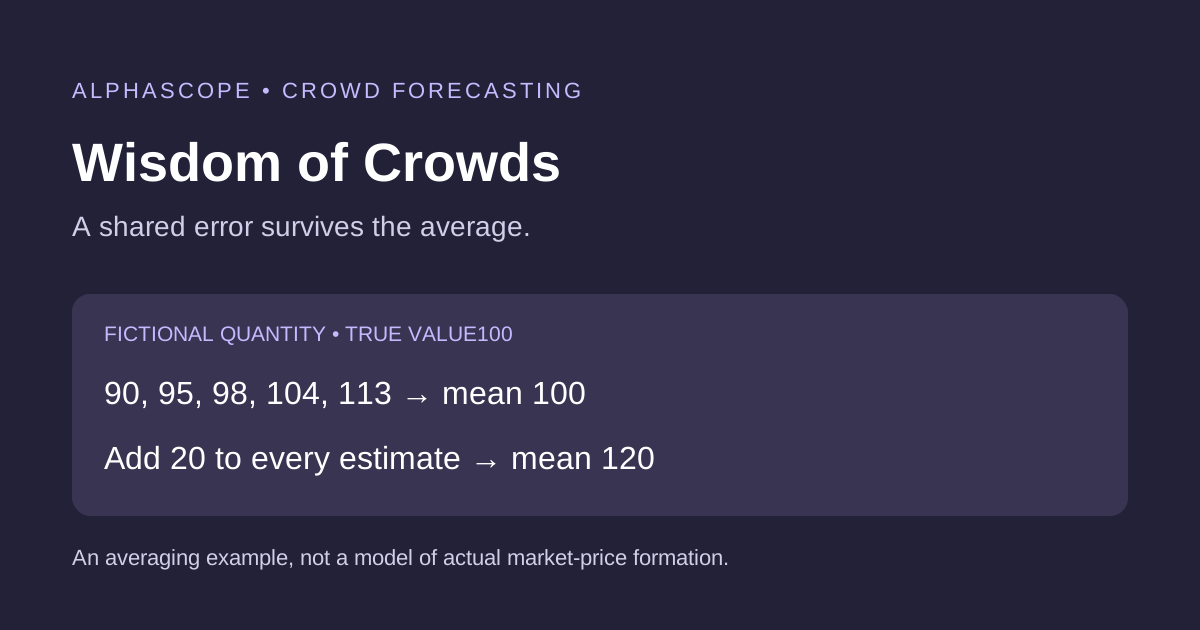
Suppose the true quantity in a fictional estimation exercise is 100. Five people submit estimates of 90, 95, 98, 104 and 113. Their mean is exactly 100. Their individual errors point in different directions and cancel in this deliberately constructed example.
| Estimator | Original estimate | Error from 100 | With a shared +20 error |
|---|---|---|---|
| A | 90 | −10 | 110 |
| B | 95 | −5 | 115 |
| C | 98 | −2 | 118 |
| D | 104 | +4 | 124 |
| E | 113 | +13 | 133 |
| Mean | 100 | 0 | 120 |
Now imagine each estimate contains the same additional twenty-unit error, perhaps because everyone copied one faulty reference. The average becomes 120. The estimates still differ from one another, but averaging does not remove the shared component.
These figures are invented to explain a mechanism. They are not evidence that five people generally outperform an expert, that errors normally cancel exactly or that a prediction market calculates this mean.
The aggregation method changes the answer
In the original five-number exercise, the median is 98, while the mean is 100. Neither method has a universal advantage for every question. Outliers, systematic bias and the type of quantity being estimated matter.
Even the evaluation metric needs to be explicit. Here, the mean squared individual error is (100 +25 +4 +16 +169) /5 =62.8, while the squared error of the group mean is zero. After the shared shift, those figures become 462.8 and 400. A crowd can outperform its average member on that metric and still be substantially wrong.
When someone claims a crowd “won,” ask what it beat: the average participant, the best participant, a specified expert, a prior forecast or a simple baseline. Those comparisons are not interchangeable.
A prediction-market price is not a headcount average
For a binary contract with a $1 winning payout, people often read a $0.60 price as a roughly 60% market-implied probability. That interpretation needs assumptions. It does not mean 60% of registered users voted Yes.
Wolfers and Zitzewitz’s 2006 paper on interpreting market prices develops conditions under which prices correspond to mean beliefs, and explores departures involving beliefs and risk preferences. Their argument supports useful approximate interpretation under models, rather than an identity that holds for every market.
A quote also requires context: is it the last trade, a bid, an ask or a midpoint, and for what size and time? A market-based forecast and an executable trade are separate observations. Fees and the spread affect a purchase even when a displayed number is used as a forecasting signal.
Does sharing forecasts help or hurt?
Lorenz and colleagues’ 2011 experiment studied 144 participants answering factual estimation questions. They reported that social information reduced diversity without improving the collective error measure and could increase confidence.
Farrell’s response examined the same data and emphasized improved individual rewards and the difference between individual and aggregate performance measures. This is a reason to specify the outcome being evaluated, not to conclude that all discussion is harmful.
The experiment is not a direct test of every Kalshi or Polymarket market. Distinguish copying an answer from learning a reliable new fact. An update grounded in a corrected source can improve a judgment; convergence caused only by imitation may add little independent information.
A forecast-quality checklist for crowd signals
- Question: Are participants forecasting the same event, deadline and resolution condition?
- Sources: How much genuinely distinct evidence is present, and which reports repeat one underlying claim?
- Participation: Who is represented, and what relevant knowledge may be missing?
- Aggregation: Is the displayed result a mean, median, model output or trading price?
- Market context: What quote, size, spread and timestamp support the observation?
- Evaluation: What baseline, outcome measure and set of questions will test performance?
This checklist identifies questions to investigate. It does not certify that a forecast is unbiased or that a trade will profit.
For a worked example of matching actions that cease to reveal private signals, see our information-cascade guide.
For an aircraft example and a worked winners-only performance calculation, see survivorship bias and missing results.
Build an evidence trail before reading the consensus
For a question you follow, first save your estimate and supporting sources. Then record the crowd signal, its timestamp and any new evidence it reveals. If you revise your estimate, explain whether you learned a fact, corrected a definition or merely moved toward a popular number.
Tag duplicate coverage so ten articles about one announcement do not silently become ten independent observations. Keep unresolved source disagreements visible. For more on evidence order, see our recency-bias guide.
After resolution, evaluate a defined set of forecasts using the original recorded probabilities. Include failures as well as successes, and retain genuine pre-outcome updates. Our hindsight-bias guide explains why later recollections need not match the original record.
Alphascope’s market news can help organize material for this process. Verify significant claims at their primary sources, and inspect the exact contract rather than treating an attractive crowd narrative as proof.