
On this page
An information cascade occurs when observing earlier choices leads someone to take the same action regardless of their own private signal. Later observers see that action, but may learn nothing new about the signal behind it. A growing line of matching choices need not represent a growing collection of independent evidence.
This is the economics concept of an informational cascade. It is different from a management plan for passing announcements through an organization.
What is an information cascade?
The classic 1992 paper by Bikhchandani, Hirshleifer and Welch explains how people making sequential choices can rationally follow predecessors without their own information affecting the action. Conformity can then coexist with incomplete information aggregation.
To analyze a possible cascade, distinguish what someone privately knows, what they publicly do, and what later observers can infer. Similar behavior alone does not establish the mechanism.
A worked example with 75%-accurate signals
Here is a numerical illustration of the standard sequential-learning idea. Assume two equally likely states, H and L. Each participant receives a private signal that names the true state 75% of the time. Signals are independent conditional on the state. Participants know the setup, see earlier actions but not earlier signals, choose once, and receive one point for choosing the true state and zero otherwise. If exactly indifferent, they follow their own signal.
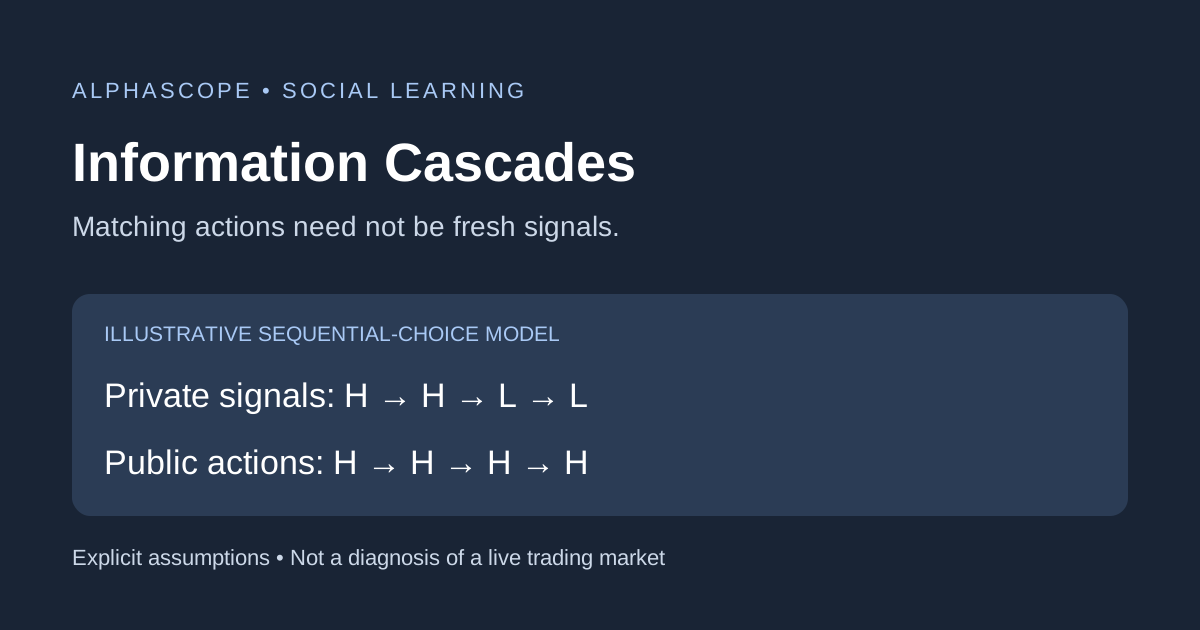
Consider the particular signal sequence H, H, L, L. The first two actions reveal their signals under these assumptions. After two H signals, the likelihood ratio favoring state H is (0.75 /0.25)² =9, corresponding to a 90% posterior probability before considering another signal.
| Participant | Private signal | Probability of H at decision | Action |
|---|---|---|---|
| 1 | H | 75% | H |
| 2 | H | 90% | H |
| 3 | L | 75% | H |
| 4 | L | 75% | H |
Participant 3 combines public odds of 9:1 with a private likelihood ratio of 1:3. The resulting odds are 3:1, or 75% for H. With an H signal instead, the participant would also choose H. The public action therefore fails to distinguish those two possible private signals.
Participant 4 should not treat participant 3’s H action as another independently observed H signal. The action was the same under either signal. With the same public evidence and an L signal, participant 4 also has a 75% posterior and chooses H.
These calculations depend on the stated information structure and decision rule. They are not measured trading probabilities or a diagnosis of a real crowd.
The error to avoid: counting actions as fresh signals
If participant 4 incorrectly counted participant 3’s action as a third independent H signal, public odds would appear to be 27:1. Combining that with the participant’s L signal would produce 9:1, or 90%, instead of 75%. The extra confidence comes from double counting, not new independent information.
That distinction also matters in a research file. Five endorsements may originate from five separate investigations, or from one report copied four times. Count the sources of information, not just the number of visible repetitions.
Are information cascades always irrational or wrong?
No. In the example, following H after two informative H actions is individually optimal even with an L signal. The problem is that the resulting action stops transmitting that signal to later participants. A rational action can contribute to a poor collective learning process.
The first two signals can also be misleading. If the true state were L, their both being H would have probability 0.25 ×0.25 =6.25% under the exercise assumptions. That is the probability of this initial signal pair conditional on state L, not the overall error rate of every possible cascade.
A cascade can favor the correct state as well. The key feature is the loss of information in actions, not an automatic claim that the shared choice is false.
Information cascades versus herding and common evidence
| Observed pattern | Possible explanation to investigate |
|---|---|
| Many people make one choice | They may have separately received strong evidence |
| People copy a visible choice | They may infer hidden knowledge, seek approval or face incentives |
| An action no longer changes with a private signal | This matches the cascade mechanism in the stated model |
Calling every consensus a cascade hides these alternatives. Ask what participants observed, what they could choose and whether different private information would have changed the action.
What does this imply for prediction markets?
A rising Kalshi or Polymarket price is not, by itself, evidence of a cascade. The review by Bikhchandani, Hirshleifer, Tamuz and Welch discusses how market-price determination and other modeling choices change social learning. A fixed, one-time binary-choice exercise is not a complete model of repeated trading at changing prices.
For a market observation, record the exact contract, timestamp, quote type, available size and underlying news. A sequence of trades may reflect new facts, revised interpretations, changed liquidity or other motives. Those possibilities require evidence before selecting a behavioral explanation.
Our wisdom-of-crowds guide explains why neither participant count nor agreement alone certifies a good aggregate forecast.
A practical evidence-chain audit
- Original claim: what was reported, by whom and when?
- Independent checks: which sources obtained distinct evidence?
- Repetitions: which posts or articles cite the same underlying source?
- Observed actions: what choices or trades are actually visible?
- Missing information: what private signals, motives or constraints are unknown?
- Alternative explanations: what else could produce the same visible pattern?
Save your estimate before reviewing the crowd signal, then explain any update. If the crowd reveals a credible new fact, document it. If you move only because several people repeated one claim, label the dependence instead of treating the repetitions as independent confirmation.
After resolution, compare the earlier evidence and probabilities with the result. See hindsight bias for why a later narrative can conceal uncertainty that was visible beforehand. Alphascope’s market news can organize material for this audit; primary sources and the exact contract remain essential.