
On this page
Outcome bias is allowing the eventual result to distort your evaluation of how well a decision was made. A favorable result can make weak reasoning look sound; an unfavorable result can make a reasonable choice look foolish. The question is whether the result adds relevant evidence about the process, or merely changes your reaction to it.
Results still matter. They reveal consequences and can help test assumptions across comparable cases. The mistake is treating one result as a complete verdict on a decision made under uncertainty.
Outcome bias examples
| Situation | Possible outcome-biased judgment | A better review question |
|---|---|---|
| A poorly researched forecast succeeds | “The win proves the research was excellent” | Were the sources and probability assessment defensible? |
| A project encounters a documented risk | “The delay proves the original choice was careless” | Was the risk reasonably assessed and managed? |
| A risky shortcut causes no incident | “Nothing happened, so the shortcut was safe” | Did the action meet the relevant standards before its result was known? |
| A careful forecast misses | “The analyst must have had no useful process” | Was this a foreseeable failure, bad luck, or evidence of a process defect? |
These are prompts for investigation, not automatic defenses of a decision. A missed forecast can expose a bad source or ignored information. A successful forecast can also have been well made. Examine the evidence rather than assigning quality from the result alone.
What the original outcome-bias research examined
Baron and Hershey’s 1988 paper, Outcome Bias in Decision Evaluation, presented descriptions and outcomes of uncertain decisions in five studies. Participants rated thinking or decision makers more favorably when results were favorable, despite receiving the relevant probability information.
The paper distinguishes that direct influence from appropriate uses of outcomes, such as learning about unknown probabilities or inferring information the decision maker may have possessed. That distinction matters: using results is not inherently biased. The review must explain why the outcome changes your assessment.
An original example: the same decision, different results
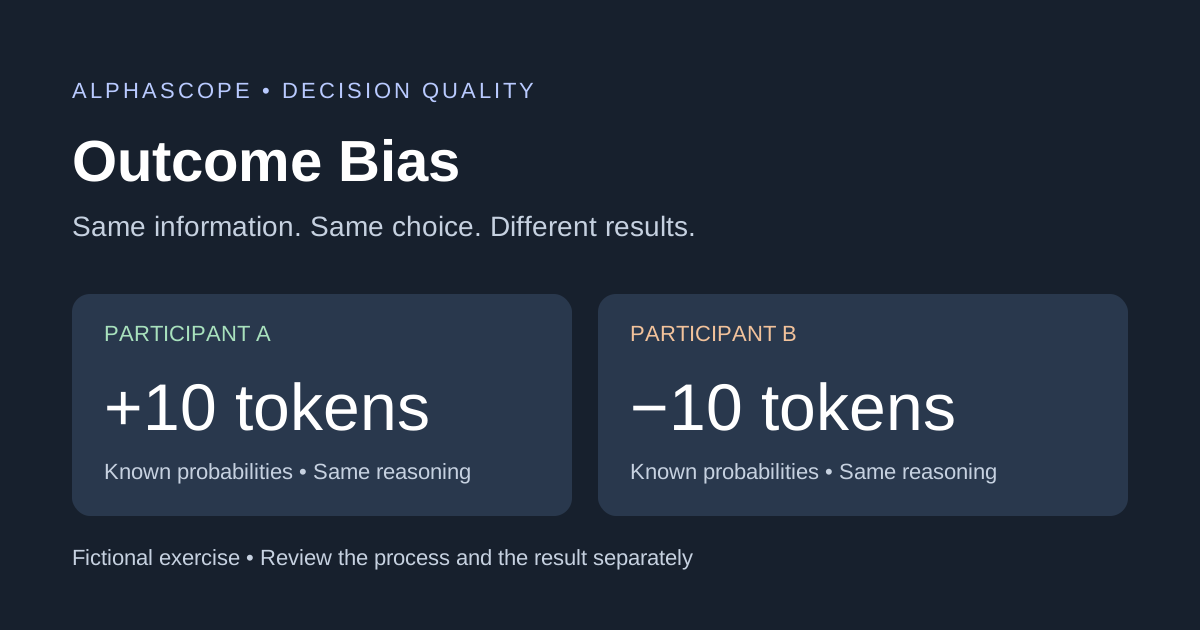
Consider a fictional, risk-neutral classroom exercise. Two participants receive identical information and can choose between a guaranteed gain of one token and a random option with a known 60% chance of gaining ten tokens and a 40% chance of losing ten. Both can afford the loss, have the same objective of maximizing expected tokens, and select the random option.
The random option has expected value 0.60 × 10 + 0.40 × (−10) = 2 tokens, versus one token for the guaranteed option. One participant gains ten; the other loses ten. Their realized results differ by twenty tokens, but their information, objective and reasoning were the same.
| Review item | Participant A | Participant B |
|---|---|---|
| Information before choosing | Known 60%/40% probabilities | Identical probabilities |
| Choice and objective | Random option; maximize expected tokens | Identical choice and objective |
| Realized result | +10 tokens | −10 tokens |
| Process evidence | Same calculation | Same calculation |
Calling A’s reasoning brilliant and B’s reasoning foolish solely because of those results is the problem illustrated here. The calculation does not say every person should prefer the random option: risk tolerance, resources, constraints and goals can change an appropriate choice. Nor does it establish that real-world forecast probabilities are known or accurate.
Outcome bias versus hindsight bias
Outcome bias concerns judging the quality of a decision after seeing its result. Hindsight bias concerns how predictable the result appears once it is known. “Winning proves the method was good” and “winning was obvious all along” are different claims, even when made about the same event.
Our hindsight-bias guide compares a saved 35% forecast with an 80% recollection. For outcome bias, the central comparison is between the decision process and the result. Preserve the original record so those questions can be assessed separately.
How outcome bias can distort prediction-market reviews
A profitable Kalshi or Polymarket position does not by itself establish a repeatable forecasting advantage. The result may reflect a sound estimate, an incidental price move or luck. Likewise, a losing position does not alone show that its estimated probability was unreasonable.
Review the exact contract, available evidence, timestamped probability, fees, execution and position constraints. Keep forecasting accuracy separate from trading profit: entry price and costs affect profit, while a probability forecast is evaluated against the defined outcome. Do not substitute a later quote for an earlier executable price.
Across a defined collection of comparable forecasts, outcomes can help reveal persistent overconfidence, missing variables or unreliable sources. That is different from selecting a single winner as proof of skill. Include failures and successes, and retain genuine updates made before resolution.
A decision-quality review rubric
Before seeing a result, record what a reasonable process should include. Afterward, inspect each criterion with supporting evidence:
- Question: Was the outcome, deadline and decision objective explicit?
- Information: Were relevant sources checked and contradictory evidence considered?
- Uncertainty: Were probabilities, assumptions and plausible failure paths recorded?
- Alternatives: Were realistic options and constraints compared?
- Execution: Was the intended decision carried out, with costs and limitations accounted for?
Then add a separate outcome review: what happened, what caused it, what was foreseeable, and what the result teaches about an assumption. A process can satisfy the rubric and still contain a mistaken model; the rubric makes review concrete rather than certifying quality automatically.
How to learn without judging only by results
Where practical, review the saved reasoning before looking at the result, then examine the result in a second pass. Compare similar decisions using the same criteria. Identify a specific improvement—such as checking the original source, recording a base rate or verifying settlement rules—and test whether it helps future work.
This approach does not require ignoring harm, abandoning accountability or refusing to revise a model. It asks you to explain the link between the outcome and the decision defect, instead of assuming that link.
For related forecasting habits, see base rate neglect and recency bias. Alphascope’s market news can support evidence gathering; verify important claims at their original sources and preserve the record used for each forecast.