
On this page
Polymarket’s public analytics documentation describes open interest as value held in outstanding positions. It is a point-in-time measure, distinct from trading volume over a period, orders currently resting in a book, or the number of traders.
This guide checks the documented Data API v2 workflow and includes a read-only endpoint observation from November 21, 2026, plus original aggregation examples and an offline parser. It is not a live dashboard: any observed total below belongs to its stated retrieval time.
What does Polymarket open interest mean?
The official analytics reference treats open interest as the value in outstanding positions and labels its values in USDC. Do not relabel that monetary value as a contract count or a count of people.
Preserve the source’s unit definition. This review did not independently reconstruct the valuation or collateral composition behind the aggregate. A reporting unit does not by itself prove that the displayed amount is cash immediately available for withdrawal.
Our open interest vs volume guide explains conventional opening, transfer and closing trade bookkeeping. This page focuses on Polymarket’s particular data shape and scope rather than assuming every venue uses an identical quantity.
For the wider discovery, pricing, credential and migration workflow, use our Polymarket API guide. This page stays focused on open-interest units and scope.
Open interest, volume and liquidity are different
| Measure | Record beside the value | Avoid inferring |
|---|---|---|
| Open interest | Point in time, source unit and selected markets | Period trading activity or a unique-person count |
| Volume | Window, counting convention and instruments | The outstanding amount at the window’s end |
| Order-book depth | Price levels, executable size and quote time | Guaranteed future fills |
| Position valuation | Holder scope, price basis and observation time | A platform-wide aggregate without reconciliation |
A large outstanding total need not mean the exact outcome and size you want can fill near its displayed price. Conversely, many transfers can create substantial volume while the stock of outstanding positions changes little.
The documented Polymarket open-interest API
The analytics reference documents GET https://data-api.polymarket.com/v2/oi. A market filter uses its condition ID, for example ?condition=YOUR_CONDITION_ID. Its SDK examples distinguish selected conditions from a single global figure.
Use a real condition ID obtained from the correct market object, not the event title, human-readable slug or an outcome token ID. These identifiers serve different purposes. Store the exact condition set with the response.
The Data API migration guide says v1 retired on November 2, 2026 and maps /oi to /v2/oi. It documents a data response envelope, snake-case fields and condition filtering in place of old market parameters. It says obsolete parameters return HTTP 400 rather than being silently accepted.
A response parser expecting a bare v1 array should not blindly run over the v2 object. Likewise, an HTTP error is not evidence that a market has zero outstanding value. Preserve status, body and retrieval time separately from your interpreted metric.
A read-only observation: GLOBAL versus null
At 2026-11-21 23:36:26 UTC, an unauthenticated GET to the documented global endpoint returned HTTP 200 with:
{"data":[{"condition_id":"GLOBAL","value":316126028.004082}]}This is one captured response, not a current total or a complete service-health test. No wallet was connected and no account, order or trading operation was performed.
The analytics SDK examples describe the global condition marker as null or None. The raw REST response observed here used GLOBAL. Different layers may normalize identifiers, and this observation does not establish the cause of the difference.
An integration should explicitly recognize the representation it has verified rather than infer that every row with a missing or unfamiliar identifier is global. Preserve the raw record so a representation change can be investigated.
Original example: selected markets are not automatically the global total
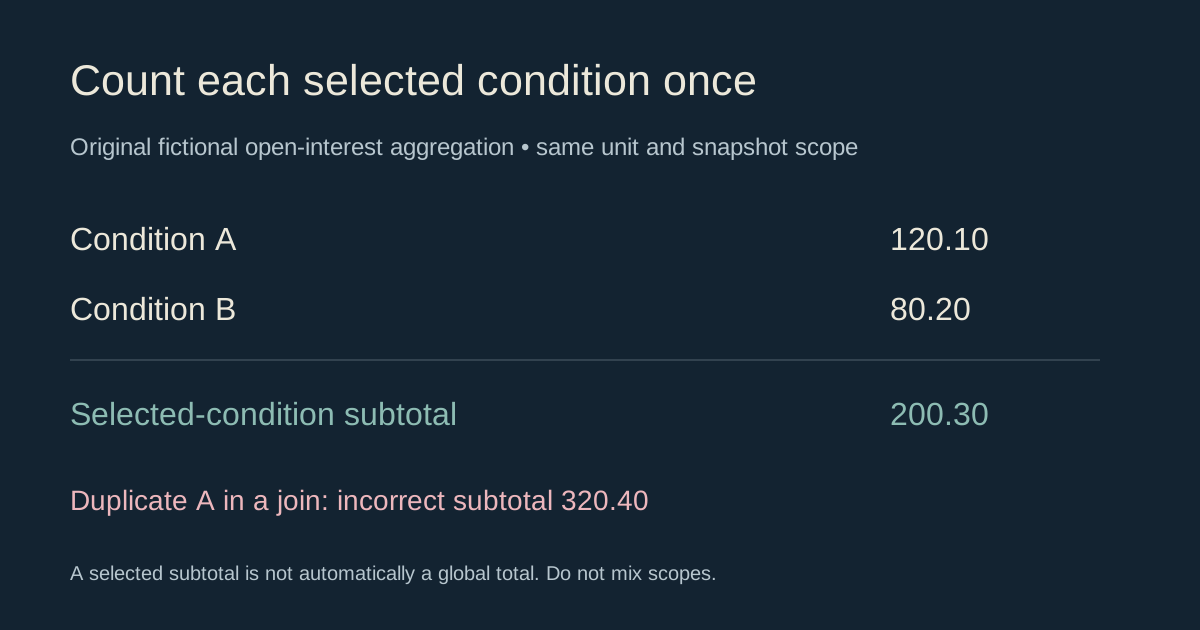
Construct a fictional response for two distinct condition IDs, A and B. A has value 120.10 and B has value 80.20 in the same stipulated unit, scope convention and observation period. The selected-condition subtotal is:
120.10 +80.20 =200.30
That subtotal is global only if the selected conditions are a complete, nonoverlapping representation of the global measure under the provider’s aggregation rules. Two selected rows do not establish that coverage.
Now imagine joining these rows to a separate table where A appears under two labels. A naive sum becomes 120.10 +120.10 +80.20 =320.40. The extra 120.10 comes from the join, not from new outstanding positions.
Validate the expected unique condition set before aggregating. If a duplicate represents a different timestamp or source revision, resolve that difference rather than silently keeping an arbitrary row. A global row must also remain separate from its possible constituent rows.
Missing is different from zero
In another original parsing scenario, the requested set is A and B but only A returns. Reporting B as zero would invent an observation. The correct first conclusion is that the returned condition set does not match the request.
Likewise, an empty data list, a missing envelope, an unexpected identifier or an invalid value needs its own state. Zero is a valid numeric observation when the source actually returns it with the right scope; it is not a safe default for a failed request.
Store raw values and the request’s identifiers before joining, formatting or filtering. That makes it possible to distinguish a market genuinely reporting zero from a display bug or coverage gap.
Keep decimal precision and timestamps
The response observed above encodes its value as a JSON number. Some client examples expose decimal strings or Decimal objects. Passing a decimal monetary field through binary floating-point and then rounding early can create reconciliation differences.
For a self-contained original example, parse numeric JSON 120.10 and decimal-string "80.20" using decimal arithmetic; their exact sum is 200.30. Preserve the original response bytes when exact reproduction matters. A more precise parser cannot repair an imprecise or incomplete source.
Record retrieval time separately from any source timestamp. Receiving a response at 12:00 does not independently prove every underlying position was indexed at 12:00. Comparing numbers from different snapshots requires an explicit timing caveat.
Download an offline Polymarket open-interest parser
Download the original Python snapshot parser. Run python3 polymarket-open-interest.py to execute its fictional fixtures. It uses only the standard library and makes no network requests.
To inspect a saved market response, use python3 polymarket-open-interest.py snapshot.json. For a saved global response, add --global. The explicit scope flag prevents a global row from being silently added to market rows.
The example accepts the observed GLOBAL marker and the documented null global marker only in global mode. For market mode, it validates condition identifiers, rejects duplicates and can compare the result with an expected condition set. It rejects missing observations, negative/nonfinite values and boolean values masquerading as numbers.
Those checks validate a small educational parser, not every Polymarket schema or protocol generation. They do not reconstruct how the source calculates OI, infer trading access or establish that a downloaded response is fresh.
What a change in open interest does not prove
A larger number does not, by itself, establish a better forecast, bullish sentiment, an increase in unique users or an equal amount of fresh deposits. A change can be interpreted only after checking matching instruments, reporting units, timing and methodology.
Do not infer a complete account lifecycle from two aggregate snapshots. Resolution, redemption, valuation and indexing each have their own states and definitions. Our resolution guide addresses a separate question from the size of an aggregate metric.
A Polymarket open-interest research checklist
- Identify the exact product and current data reference.
- Choose global scope or a specific set of condition IDs.
- Keep the request, HTTP status and raw response.
- Record units and source/retrieval timestamps.
- Validate the response envelope, scope and expected rows.
- Reject duplicate joins and separate global totals from constituents.
- Keep missing values distinct from returned zero.
- Use current order-book data for executable liquidity questions.
Alphascope’s market-linked research supplies event context. Outstanding value is one activity measure, not independent evidence of forecast accuracy or profitable execution.