
On this page
Volume counts contracts traded during a period; open interest counts contracts still outstanding at a point in time. A contract can trade several times while an outstanding position passes between holders. Consequently, substantial volume need not produce an equally large increase in open interest.
Always attach units, time window and contract identifiers to both numbers. Contract counts, dollar-valued measures and counts of people are different quantities.
Open interest vs volume at a glance
| Measure | What it describes | Time information needed | What it does not establish |
|---|---|---|---|
| Volume | Trading activity measured in contracts | The interval counted | How many contracts remain outstanding |
| Open interest | Outstanding contracts | The observation or reporting time | How often those positions traded |
| Change in open interest | Difference between two outstanding counts | Both snapshots and a matching scope | The complete sequence of intervening trades |
CME’s column definitions distinguish traded contracts from open interest and count one side of an outstanding contract, despite its having both a buyer and seller. Its volume lesson also emphasizes that volume alone does not identify whether participants are opening or closing positions.
Original example: opening, transfer and closing trades
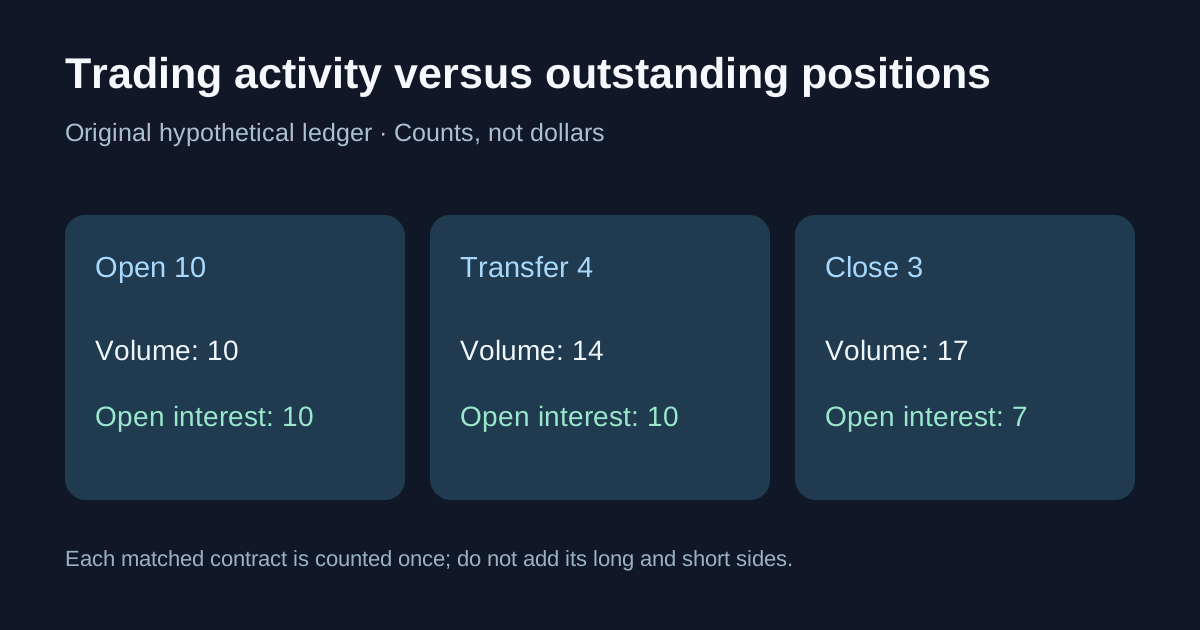
Here is a fictional single-contract ledger using conventional long-short bookkeeping. Start with no outstanding contracts and zero volume for the chosen period. Assume the trades are matched and recorded once, with no exercises, settlement, corrections or other position adjustments.
| Step | Matched trade | Volume added | Open-interest change | Cumulative volume | Open interest |
|---|---|---|---|---|---|
| 1: both open | A opens long 10; B opens short 10 | 10 | +10 | 10 | 10 |
| 2: transfer | A sells 4 to close; C buys 4 to open | 4 | 0 | 14 | 10 |
| 3: both close | C sells 3 to close; B buys 3 to close | 3 | −3 | 17 | 7 |
After step 1, ten contracts are outstanding, not twenty: the matching long and short are two sides of each contract. After step 2, C has replaced A as holder of four long positions; the outstanding total remains ten. Step 3 offsets three long-short pairs, leaving seven.
The ending positions reconcile: A is long six, C is long one and B is short seven. Total longs equal total shorts. The sum of absolute position quantities is fourteen, but counting both sides would double the seven outstanding contracts.
The period’s volume is 10 +4 +3 =17, while its open-interest change is 10 +0 −3 =7. Volume measures the activity; the outstanding count measures the remaining stock. These are invented records, not an actual venue’s trade history.
Can volume be higher than open interest?
Yes. The ledger ends with volume seventeen and open interest seven. Repeated transfers can increase period volume further without creating additional outstanding contracts. Conversely, a period can have little trading while many positions created earlier remain open.
A volume-to-open-interest ratio needs a defined numerator window and denominator time. In the example, 17 /7 ≈2.43 is merely a ratio of those two specified quantities. It is not the average number of trades per person or a claim that each of the seven surviving contracts traded 2.43 times.
Options volume vs open interest
For an options comparison, identify the full series: underlying, call or put, strike and expiration, plus the applicable contract terms. A total across every expiry is a different scope from a single strike’s open interest. Do not compare them without explaining the aggregation.
Distinguish buying from opening and selling from closing. A purchase can open a long or close a short; a sale can open a short or close a long. The ledger demonstrates why the direction of an individual trade does not by itself identify its effect on outstanding contracts.
Also distinguish contracts from units of the underlying asset. Converting a contract count into an underlying quantity or monetary exposure requires the instrument’s actual specifications. A count alone does not supply a multiplier, price or risk measure.
Check when the numbers are published
CME’s reporting page describes its end-of-day report as preliminary and its following-morning Daily Bulletin as official; the figures can differ. That schedule describes those CME reports, not every venue or API.
Save the source timestamp, retrieval time, time zone and whether a figure is preliminary or final. A current intraday volume counter and a previous close’s open-interest figure are not observations from one instant. That comparison may still be useful, but its timing needs to be visible.
Kalshi open interest: preserve the API units
Kalshi’s Get Market response includes volume_fp, volume_24h_fp and open_interest_fp. Its ticker message documentation separately shows contract-count fields and dollar-volume/open-interest fields. Those example payloads illustrate a schema; they are not current live-market observations.
The fixed-point guide, updated November 5, 2026, explains contract quantities as decimal strings with up to two places. It also warns that the _fp suffix alone does not determine whether a field is contracts or money. Read the particular field’s unit and precision.
For an original parsing example, a contract quantity string "12.50" represents 12.5 contracts, or 1,250 hundredths of a contract for integer arithmetic. It is not automatically $12.50 and should not be truncated to twelve. This conversion is an arithmetic illustration, not a claim that every market supports fractional orders.
Keep a market’s ticker, field name and time window beside any value you display. A market-level count should not silently become an event-wide total. Nor should fields from a different prediction-market provider be assumed to use the same dollar convention or reporting schedule.
Neither number proves liquidity or direction
High historical volume does not guarantee enough executable size at the price you need now. Open interest describes outstanding positions, not resting orders available for an immediate trade. Inspect current bids, asks and quantities; our order-book guide explains that separate question.
Neither count alone proves that a market is bullish, that new participants arrived, or that money flowed in by the same numeric amount. Every matched trade has two sides. A stronger interpretation needs additional evidence about positions, prices, participants and the venue’s measurement conventions.
For converting a contract quantity into a specified reference exposure while separating margin and cash paid, see notional value and worked examples.
A metric-comparison checklist
- Instrument: same exact contract or clearly defined aggregation?
- Units: contracts, underlying units or a specified dollar measure?
- Window: daily, rolling 24-hour, lifetime or another interval?
- Timing: observation, retrieval and publication times?
- Status: preliminary, final, delayed or corrected?
- Precision: decimal strings preserved and arithmetic units documented?
- Interpretation: what evidence supports any claim beyond the counts themselves?
Alphascope’s market news can support event research. Preserve source definitions alongside numerical comparisons so a more active market is not automatically described as a more accurate or easier-to-trade one.