
On this page
Notional value is a reference amount describing the size of a financial contract or position. For a linear futures position, it is commonly calculated from the contract quantity, contract unit or multiplier, and quoted futures price. It is distinct from the margin posted, the instrument’s current market value and the eventual profit or loss.
Start with the instrument’s specifications. “Notional” is not one universal formula that can be applied unchanged to every future, option, swap or binary event contract.
How to calculate notional value for linear futures
CME’s contract-notional lesson defines the contract unit and combines it with the futures price to calculate contract notional. The unit may be a physical quantity or a financial multiplier, depending on the product.
For the simple linear setup used here:
Position notional =contracts ×units per contract ×price per unit.
For an index contract, the unit term may instead be a currency amount per index point. Match the units so the calculation produces a currency amount. For a different payoff structure, first verify the relevant product’s definition rather than forcing this formula onto it.
An original example: $16,000 notional, $2,400 margin
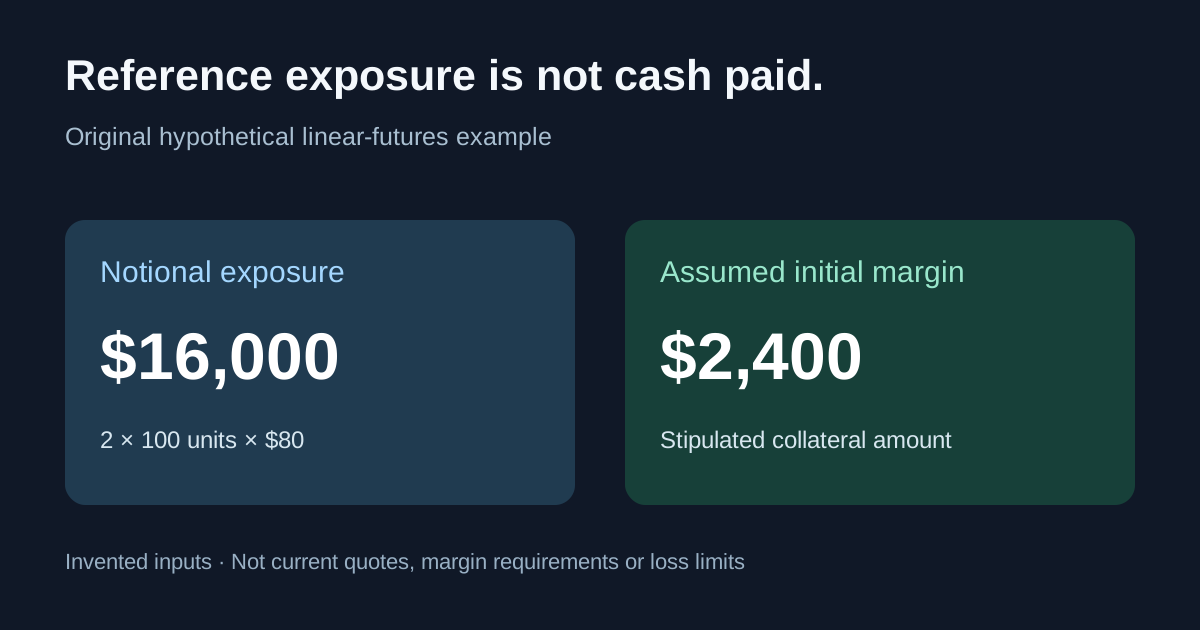
Assume a fictional linear futures contract represents 100 units of a commodity and trades at $80 per unit. A participant holds two long contracts. Assume initial margin of $2,400 for the whole position. These numbers are invented, not current exchange quotes or margin requirements.
| Quantity | Calculation | Result |
|---|---|---|
| Underlying quantity | 2 contracts ×100 units | 200 units |
| Position notional | 200 units ×$80 | $16,000 |
| Assumed initial margin | Stipulated for the exercise | $2,400 |
| Notional divided by initial margin | $16,000 /$2,400 | About 6.67 |
The $16,000 measures reference exposure at that price. It does not mean the participant paid $16,000 to purchase the commodity, and the $2,400 assumption does not establish the maximum possible loss. Initial margin, maintenance requirements and account cash flows require their own rules.
Now suppose the futures price rises from $80 to $83. The linear gross change is 2 ×100 ×($83 −$80) =$600. That is 3.75% of the starting notional and 25% of the assumed initial margin. A fall from $80 to $77 gives a gross change of −$600 under the same simple calculation.
These are arithmetic changes before fees and other costs. They do not simulate margin calls, liquidation, variation settlement or the cash needed along an actual price path. A real account’s return denominator can also differ from the initial margin stipulated here.
Notional value vs margin, market value and cash paid
| Term | Question it answers | What to avoid assuming |
|---|---|---|
| Notional or reference exposure | How large is the contract under its stated convention? | That this is cash paid or a guaranteed loss bound |
| Margin | What collateral does this account need? | That initial margin is the entire economic exposure |
| Market value | What value is assigned to the instrument or position now? | That one definition fits every derivative |
| Purchase cost or premium | What amount is paid for the instrument? | That it equals underlying notional |
| Payoff and profit | What does the contract pay, and what remains after costs? | That gross payout equals net profit |
When someone says “market value,” ask what is being valued: an underlying asset, an option premium, the value of a derivative position or its liquidation estimate. Likewise, a margin balance is an account measure, not a substitute for the contract’s payoff definition.
Kalshi stock-perp example: contract count is not share count
Kalshi’s single-stock perpetual-futures guide, checked November 9, 2026, specifies 0.02 shares of price exposure per contract. It distinguishes that exposure from margin and says holders do not own the underlying shares. The guide also describes funding, fees, maintenance margin and possible liquidation.
Using that stated unit with original hypothetical inputs, 125 contracts referencing a stock at $240 give 125 ×0.02 ×$240 =$600 of reference exposure. The equivalent underlying quantity is 2.5 shares for this calculation; this is not a statement that the participant owns 2.5 shares.
If the reference price rises by $12, the simple long-position gross change is 125 ×0.02 ×$12 =$30. That is 5% of the starting $600 exposure. If initial margin were hypothetically $150, the same $30 would be 20% of that assumed margin. The example does not quote an available leverage level or actual account requirement.
The provider notes that exceptional conditions can produce losses exceeding posted margin. Inspect the actual account agreement and current contract terms rather than deriving a loss limit from the margin figure alone.
Binary event contracts: cost, payout and reference amount
Consider a separate invented, fully paid binary contract: it pays $1 if a defined event happens and $0 otherwise. Suppose 100 Yes contracts are bought at 38¢ each, with fees excluded for this illustration.
- Purchase cost: 100 ×$0.38 =$38.
- Gross payout if Yes: 100 ×$1 =$100.
- Gross payout if No: $0.
- Profit if Yes, before fees: $100 −$38 =$62.
- Loss if No, before fees: $38 for this stipulated fully paid purchase.
The $100 payout reference and $38 purchase cost are different quantities. If a provider labels a field “notional,” read its definition before assigning either number to it. This binary payoff is also different from the linear price exposure in the futures examples above.
Kalshi’s Get Market schema includes notional_value_dollars alongside price and contract-count fields. A schema example is not a live contract specification. Preserve the field name, unit and market identifier rather than assuming every product has a $1 payout or the same notional convention.
Why equal notionals do not mean equal risk
Two positions can have the same reference amount but different payoff shapes, underlying price behavior, currency, expiry and offsetting relationships. Notional is useful for describing scale; by itself, it does not capture every feature needed to compare possible losses.
Before adding positions, distinguish gross amounts from a signed net amount and document the convention. Offsetting equal reference amounts is not proof of a complete hedge if the underlying variables or settlement conditions differ. Our open-interest and volume guide similarly separates outstanding counts from traded activity and dollar measures.
For ongoing account thresholds and the difference between a maintenance deficiency and a restoration target, see maintenance margin with worked calculations.
A notional-value calculation worksheet
- Record the exact instrument, market identifier and contract specification.
- State the quantity, multiplier or unit, reference price and observation time.
- Write the formula with units before substituting values.
- Keep margin, purchase cost, fees and potential payoffs in separate rows.
- State whether an aggregate is gross or net and what offsets are assumed.
- Explain which risks the reference amount does not describe.
Alphascope’s market news can support research into the underlying event. A clear forecast still needs a separate, correct understanding of the instrument used to express it.