
On this page
Maintenance margin is an ongoing minimum equity or collateral requirement for a margin account or position. The relevant amount, calculation and response to a shortfall depend on the product, account agreement and provider. It differs from the initial requirement used to establish a position.
First identify the account. Buying securities with borrowed funds and posting collateral for a futures or perpetual-futures position are different arrangements. A rule or formula from one should not be copied into the other.
Initial margin vs maintenance margin
CME’s performance-bond FAQ distinguishes initial margin from the ongoing maintenance level. It describes a call to restore equity to initial margin when equity falls below maintenance. Its performance-bond requirements vary by product and volatility.
| Term | Question to answer |
|---|---|
| Initial margin | What requirement applies when the position is established? |
| Maintenance margin | What ongoing threshold applies? |
| Account equity or qualifying collateral | What resources count toward that threshold? |
| Shortfall | How far below the applicable requirement is that measure? |
| Restoration target | Does the provider require maintenance, initial or another amount? |
A $50 shortfall below maintenance does not necessarily mean $50 satisfies a provider’s restoration requirement. The target and the time allowed are separate facts to establish.
Original securities example: equity and a 30% requirement
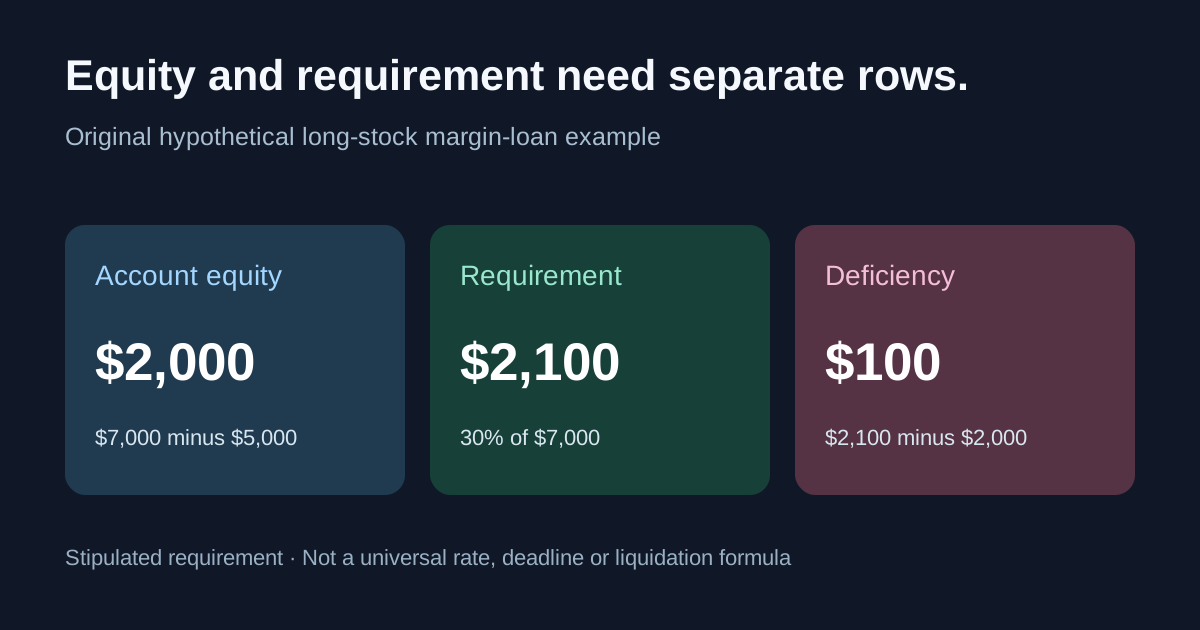
Assume a fictional long-stock margin account has $10,000 of securities and a $5,000 margin loan. Ignore interest, fees, other assets and all other positions. Stipulate a 30% maintenance requirement on the securities’ current market value. This is an invented account example, not a universal regulatory rate or a broker quote.
For this simplified setup, equity =securities value −loan balance and maintenance requirement =0.30 ×securities value.
| Measure | At $10,000 securities value | After value falls to $7,000 |
|---|---|---|
| Loan balance | $5,000 | $5,000 |
| Equity | $5,000 | $2,000 |
| 30% requirement | $3,000 | $2,100 |
| Equity less requirement | +$2,000 | −$100 |
At $7,000, equity is $2,000, but the requirement is $2,100. The static calculation shows a $100 deficiency under the assumptions. It does not provide a deadline, establish an acceptable remedy or guarantee the broker leaves the position unchanged.
The threshold-price calculation
Let V be securities value, L the fixed loan balance and m the stipulated maintenance fraction. Setting equity equal to the requirement gives V −L =mV, so V =L /(1 −m).
With L =$5,000 and m =0.30, the equality boundary is approximately $7,142.86. At that securities value, equity and the maintenance requirement are both approximately $2,142.86. Below the unrounded boundary, the simplified account is deficient.
This formula depends on a fixed loan, a percentage requirement and the specified asset set. It is not a general liquidation-price formula for futures, short positions, options portfolios or changing house requirements.
Original derivatives example: shortfall versus restoration
Now use a separate fictional derivatives account with $1,000 initial equity, a fixed $800 maintenance level and an assumed requirement to restore equity to $1,000 after a maintenance breach. Ignore costs, transfers, additional positions and requirement changes.
| Step | Change | Equity | Relation to maintenance |
|---|---|---|---|
| Start | Initial equity stipulated | $1,000 | $200 above |
| First loss | −$120 | $880 | $80 above |
| Further loss | −$130 | $750 | $50 below |
The maintenance deficiency is $800 −$750 =$50. But the assumed restoration target is $1,000, so the gap to that target is $1,000 −$750 =$250. Confusing the two amounts understates the stipulated requirement by $200.
This ledger demonstrates arithmetic rather than an operational funding instruction. Actual clearing, account rules, eligible collateral and liquidation processes determine what can happen. The equity path and threshold are assumed; the ledger does not simulate execution or promise an opportunity to add funds.
Can requirements change without a price move?
Yes. FINRA’s securities-margin disclosure rule warns that firms may increase house maintenance requirements without advance written notice. It also explains that firms may sell assets without first contacting the customer and that customers are not entitled to an extension on a margin call.
For an original illustration, keep the fictional securities account at $10,000 with its $5,000 loan and $5,000 equity. If its stipulated requirement changes from 30% to 55%, the required equity changes from $3,000 to $5,500. The account moves from a $2,000 excess to a $500 deficiency even though the assumed securities price and loan did not change.
The 55% figure is hypothetical. The point is to inspect both sides of the comparison: available qualifying equity and the current requirement. Monitoring prices alone does not establish whether the account meets a changing threshold.
Kalshi perps: do not assume a securities-margin grace period
Kalshi’s perpetual-futures position guide, checked November 9, 2026, says Kalshi Klear closes a position automatically when the account balance falls below the maintenance threshold. That description should not be replaced by an assumption that every provider sends a call and waits for a deposit.
Use the exact perps account and contract documentation to establish the monitored balance, threshold, valuation and liquidation process. Keep a fully paid event-contract purchase separate from a leveraged perps position. Similar app branding does not make the two account types interchangeable.
Our notional-value guide distinguishes reference exposure from margin and upfront purchase cost. A notional amount alone cannot supply a maintenance threshold or a maximum loss.
For mark-to-market cash flows and the separate role of variation payments, see variation margin with a worked settlement ledger.
How to read a maintenance-margin figure
- Account type: securities borrowing, futures collateral, perps or another arrangement?
- Scope: one position, one account or a portfolio calculation?
- Eligible resources: which cash, equity and collateral count?
- Requirement: percentage, currency amount or a model-based calculation?
- Valuation: what prices and observation times are used?
- Response: call, restriction, automatic liquidation or another contractual process?
- Target: what amount would satisfy the applicable requirement?
Record the source and time for each item. If a screenshot supplies a balance but omits the requirement or account type, it is insufficient for a reliable shortfall calculation. If rules change, revisit the requirement instead of continuing to use the original percentage.
Alphascope’s market news can support research into the event or underlying asset. That research does not replace the separate account rules governing collateral, maintenance and liquidation.