
On this page
Variation margin addresses changes in a derivative’s current mark-to-market exposure. In a cash-settled futures margining process, the corresponding gains and losses are exchanged as settlement variation. The precise legal and accounting treatment depends on the instrument and agreement, so identify the product before treating every transfer labeled “margin” as the same thing.
What is variation margin?
CME’s money-calculation document calls futures cash mark-to-market settlement variation, also known as variation margin. It calculates separately for trades cleared during the day and positions carried from the prior settlement.
For non-centrally cleared derivatives, the BIS executive summary describes variation margin as collateral addressing current mark-to-market exposure. It contrasts initial margin, which addresses potential future exposure during close-out following default. That framework is not a description of every retail account.
Initial margin vs variation margin vs maintenance margin
| Concept | What to identify | Different question |
|---|---|---|
| Initial margin | The applicable starting or risk-collateral requirement | What resources must support the position? |
| Variation margin or settlement variation | The current-exposure or mark-to-market transfer under the agreement | What change in value is being addressed? |
| Maintenance margin | The ongoing threshold used for the account or position | Is the qualifying balance below a required level? |
A maintenance deficiency, a restoration deposit and a mark-to-market payment need not be identical amounts. Our maintenance-margin guide gives a separate example where a $50 deficiency corresponds to a $250 restoration gap under stipulated rules.
Original futures example: pay $100, then receive $150
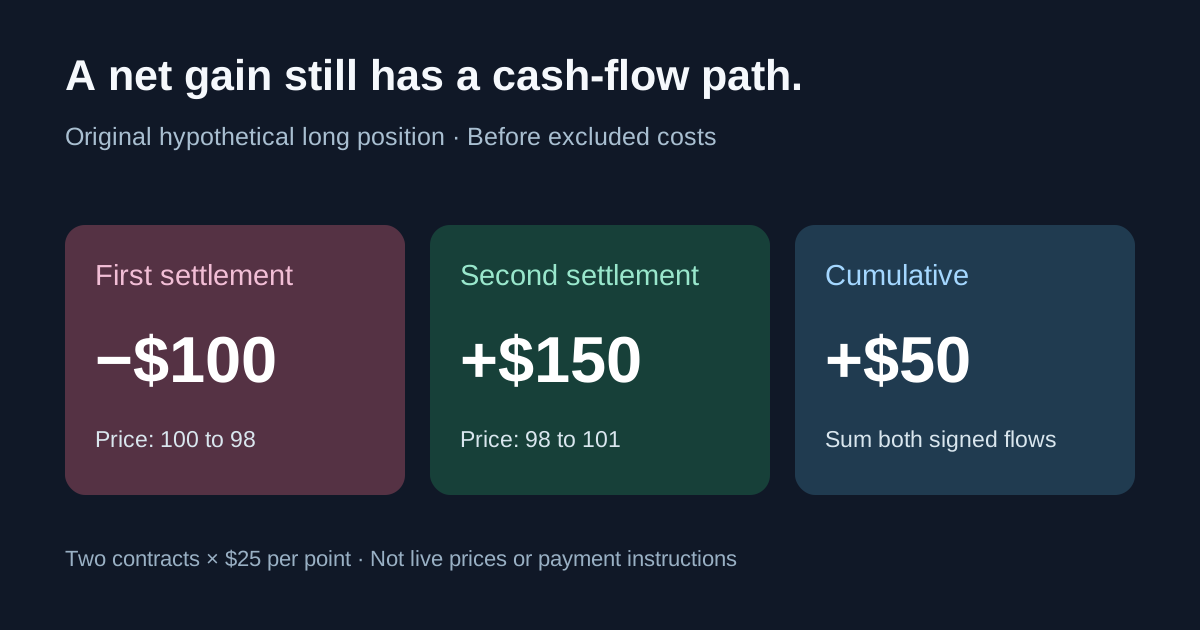
Consider a fictional linear futures contract with a $25 value change per price point per contract. A participant is long two contracts carried from an initial settlement price of 100. Assume both contracts remain open throughout, all variation is paid in cash at each illustrated settlement, and there are no fees, funding payments, new trades or corrections.
| Settlement step | Prior reference price | New settlement price | Long cash flow | Equal short cash flow |
|---|---|---|---|---|
| First | 100 | 98 | 2 ×$25 ×(98 −100) =−$100 | +$100 |
| Second | 98 | 101 | 2 ×$25 ×(101 −98) =+$150 | −$150 |
| Cumulative | 100 | 101 | +$50 | −$50 |
The long’s net cash variation is −$100 +$150 =+$50. The direct start-to-finish calculation agrees: 2 ×$25 ×(101 −100) =$50. The short’s flows have the opposite signs in this simplified matched-position example.
These are invented prices and a stipulated multiplier, not a live futures contract or account statement. The calculation excludes rounding complexity because all monetary results are already exact whole dollars.
Why the cash-flow path matters
The long must make the illustrated $100 payment before receiving the $150 inflow. Ending with a positive $50 does not erase the earlier cash requirement. A net-positive result and the ability to meet every intervening obligation are different questions.
For a separate bookkeeping illustration, suppose the tracked account begins with $1,000 cash and simply records those two flows. Its balances become $900 and then $1,050. The initial $1,000 is the starting balance, not trading income. The $150 receipt is not the full net gain because the earlier $100 payment also belongs in the record.
This balance illustration imposes no maintenance level and promises no continued access to the position. Actual collateral rules, liquidation and payment obligations could change the account path.
Download the blank variation-flow ledger to keep reference prices, signed transfers and starting balances in separate fields.
New trades need their own reference prices
Now consider a different fictional day with the same $25 multiplier. Start the day long one contract from a previous settlement of 100. Buy one additional contract at 101. The new settlement price is 102.
- Carried position: 1 ×$25 ×(102 −100) =$50.
- New trade: 1 ×$25 ×(102 −101) =$25.
- Total: $75 for this simplified day.
Marking both contracts from 100 would incorrectly produce $100. The newly purchased contract was not held over the move from 100 to 101. The reference-price mistake overstates the result by $25.
For actual reconciliation, also account for sales, partial closes, quantities, currency and the venue’s rounding procedure. A single ending position count does not reconstruct the trades that produced it.
Does “daily” mean there is only one payment cycle?
No. CME’s current financial-safeguards description, checked November 9, 2026, describes twice-daily mark-to-market and calls to clearing members for futures and options in its regular settlement cycle. Its settlement-variation section addresses portfolio gains and losses between cycles.
Those clearing-member processes are not a universal retail funding deadline. The 2015 calculation document explains money calculations; the current cycle description serves a different purpose. Check the applicable venue, account agreement, calendar, currency and payment instructions instead of assuming that “daily” guarantees a full day to act.
Collateral movements are not automatically another profit
In the non-cleared framework summarized by BIS, variation margin addresses current exposure while initial margin addresses potential future exposure. Moving collateral and recording a derivative’s change in value are related entries, not necessarily two independent gains.
Before adding statement lines, identify whether an item is a valuation change, cash settlement, collateral movement, fee, interest, funding payment or deposit. Record the account’s sign convention. Summing a reported profit and its corresponding settlement receipt as two profits can double count the same economic change.
The numerical futures ledger above assumes cash settlement of the illustrated mark-to-market changes. It should not be imported unchanged into a collateral agreement with a different legal or accounting treatment.
Applying the distinction to prediction-market research
For a Kalshi or Polymarket product, identify the account and instrument before interpreting its cash flows. A fully paid binary position, a leveraged perpetual position and an institutional collateral arrangement should not be assumed to share the same settlement process.
A displayed position-value change does not by itself show that cash has been transferred or become withdrawable. Match the price record to the relevant activity and settlement entries. Our notional-value guide separately distinguishes reference exposure from purchase cost and margin.
A variation-margin reconciliation checklist
- Record the exact instrument and account.
- Separate carried positions from trades opened during the period.
- Identify each applicable reference and settlement price.
- Preserve quantity, multiplier, currency and rounding rules.
- Label cash transfers separately from valuation and collateral records.
- Match payment cycles and observation times.
- Reconcile the cumulative result without counting the same change twice.
Alphascope’s market news can support research into an underlying event. Understanding the forecast and understanding how the chosen instrument moves cash remain separate parts of that work.