
On this page
Fill or kill (FOK) means execute the full order immediately under its applicable conditions, or execute none of it. It combines a full-quantity requirement with an immediate-execution requirement. It does not create liquidity or guarantee that your order will trade.
The Investor.gov stock-order definition describes the no-partial-execution condition. For prediction markets, confirm the instrument and venue’s current supported instructions. The examples below are original hypothetical calculations, not live order submissions.
What does fill or kill mean?
Separate three questions: how much must execute, which prices are acceptable, and how long the order can remain active. FOK answers the first and third. A price condition still determines which available liquidity qualifies.
For instance, a buy request for 100 units with a $0.52 maximum does not mean “buy whatever is available, then wait.” If the full qualifying quantity cannot execute under the FOK conditions, the stipulated result is zero fills. Changing the price cap or size changes the question being asked.
FOK vs IOC vs all-or-none
| Instruction | May an immediate partial quantity execute? | May an unfilled order remain active? |
|---|---|---|
| FOK: fill or kill | No; the full request must qualify | No resting remainder under this policy |
| IOC: immediate or cancel | Yes | The unfilled portion is canceled |
| AON: all or none | No partial execution | It can remain active if it does not immediately execute |
Investor.gov’s IOC definition permits the immediately available portion and cancels the remainder. Its AON definition distinguishes a full-size condition that can wait. Do not treat AON as a synonym for FOK.
These definitions concern stock-order instructions. The existence of a term in that glossary does not establish that every broker, exchange or prediction-market interface offers it.
Original example: 120 displayed, only 70 eligible
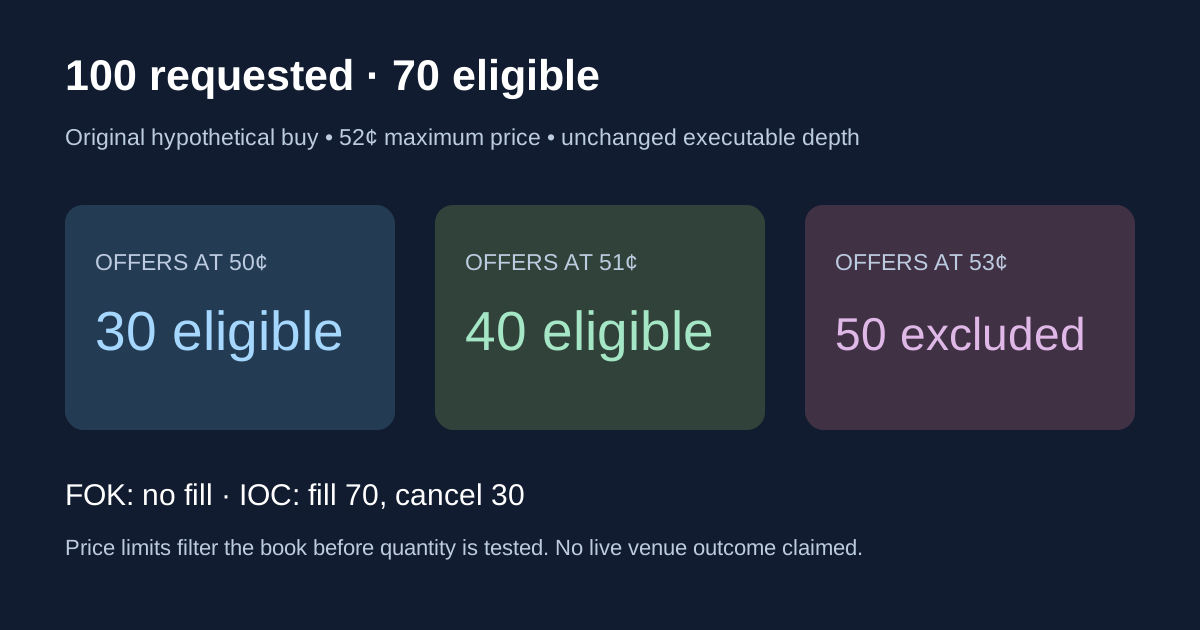
Consider a fictional buy request for 100 contracts with a maximum price of $0.52. Assume the following offers are immediately executable, remain unchanged during the decision, and can be aggregated across levels. Ignore fees, other traders, minimum sizes and rounding.
| Offer price | Available contracts | Eligible under $0.52 cap? |
|---|---|---|
| $0.50 | 30 | Yes |
| $0.51 | 40 | Yes |
| $0.53 | 50 | No |
The book displays 120 contracts, but only 30 +40 =70 fit the price condition. In this simplified model:
- FOK: fill zero because 70 is insufficient for the requested 100.
- IOC: fill 70 and cancel the remaining 30.
- AON: do not partially fill; an allowed order can remain active subject to its other conditions.
The IOC purchase costs 30 ×$0.50 +40 ×$0.51 =$35.40 before excluded charges. Its average price is $35.40 ÷70 ≈$0.5057. The favorable average does not mean the full 100-contract objective was achieved.
A full fill can involve several price levels
Now change the hypothetical book by adding 30 immediately available contracts at $0.52. Keep every other assumption unchanged. Eligible quantity becomes 100.
The stipulated FOK purchase can now fill all 100 across the three eligible levels. Its cost is $15.00 +$20.40 +$15.60 =$51.00, for an average $0.51 per contract. The request is fully executed even though no single level supplies 100 contracts.
This illustrates the difference between a full aggregate order and a single execution record. It assumes the venue can combine the eligible liquidity. A screenshot of three levels does not prove that a real request will see those levels unchanged when processed.
For a sell, reverse the price test
A sell limit sets a floor. In a separate fictional book, 30 bids at $0.52 and 40 at $0.51 qualify for a $0.50 minimum, while 50 at $0.49 do not. The eligible quantity is again 70.
A 100-contract FOK sell therefore has no fill in this model. An IOC sell can execute the 70 qualifying contracts for 30 ×$0.52 +40 ×$0.51 =$36.00 before costs and cancel 30. Do not copy a buy’s “at or below” price comparison into a sell.
Polymarket: FOK, FAK and the order’s units
Polymarket’s current order guide, checked November 9, 2026, describes FOK as full execution or no fill and FAK as filling available liquidity before canceling the remainder. Its market-buy SDK examples specify pre-fee USD notional, while market sells specify shares. An amount of “100” must therefore be interpreted using the exact method and side.
The quantity-based books in this article explain policy; they are not SDK payloads. Use the official method’s units, price bound and cost controls. A pre-fee purchase amount is different from an all-in spending cap.
The same documentation describes accepted orders subject to matching delays in some markets. An accepted or delayed response is not by itself evidence of an executed position. FOK should not be interpreted as a promise of zero network or processing latency.
For a venue-specific interactive illustration, use our existing Polymarket limit-order simulator. It compares immediate-execution policies with resting orders; this guide focuses on the broader definition and distinctions.
Two FOK orders are not one combined all-or-none instruction
Imagine a workflow that submits two separate hypothetical 100-contract FOK orders for two different instruments. The first finds its full eligible quantity and fills. The second finds only 70 and does not fill.
Each order has obeyed its own FOK condition, yet the workflow has only one executed leg. Treating two independent full-size instructions as a guarantee that both legs execute together would add a condition that was never specified.
This is a logical example, not a claim about a venue’s combination-order product. If a strategy requires linked execution, investigate the actual supported mechanism and its failure behavior. Similar labels do not establish the combined protection.
Check the result before issuing another order
Preserve the order identifier, requested amount and units, price condition, response status and actual fill records. A timeout leaves an observation problem, not proof that nothing executed.
For a canceled remainder, distinguish filled quantity from canceled quantity. If a request was rejected before execution, retain the reason rather than describing every failure as insufficient liquidity. Price increments, account permissions, funding and other validation rules can be separate issues.
For orders that may remain open, the good till canceled guide explains expiration, partial fills and pending cancellations. Our implementation-shortfall guide explains why unfilled quantity matters when evaluating a whole decision. The market-microstructure guide explains displayed depth and execution benchmarks.
A fill-or-kill research checklist
- Identify the exact instrument, side, request units and supported policy.
- Apply the price condition before adding eligible quantity.
- Keep a full-size requirement separate from a time-in-force choice.
- Record fees and all-in cost controls separately from the price limit.
- Distinguish order acceptance, delay, rejection, cancellation and fills.
- Reconcile actual positions before retrying an uncertain request.
Use event research to evaluate the underlying outcome. FOK describes how an order should execute, not whether the event thesis or eventual position is profitable.