
On this page
A good till canceled (GTC) order can remain active beyond the current trading day until it fills, is canceled, or reaches an applicable expiration or other termination condition. GTC describes the order’s lifetime. It does not guarantee execution, an unlimited lifespan, or permission to trade during every session.
“Good till cancelled,” “good ’til canceled” and GTC refer to the same general instruction. The Investor.gov definition also notes that brokerage firms typically impose their own maximum lifetimes. Check the actual order ticket and current venue rules.
For a broader view of the order ticket, see time in force: Day, GTC, GTD, IOC and FOK. It separates lifetime, price controls, session eligibility and reported order state.
What is a good till canceled order?
Consider a buy limit order for 100 units at a maximum $0.40 each. The limit answers which prices may execute? GTC answers how long may the unfilled amount remain eligible? An additional execution condition can affect whether partial fills are allowed.
A GTC limit order can execute immediately if matching liquidity is available. It can also fill partially and leave a remainder resting, subject to the venue’s rules. GTC does not mean “wait until tomorrow,” and a price touching your limit does not establish that your particular order filled.
The following examples are original hypothetical ledgers. They assume a simple quantity-based buy, permit partial fills, and exclude fees, rounding, funding restrictions and other orders. They are not trading records or recommended positions.
Day order vs good till canceled
| Instruction | What happens to an unfilled remainder? | What still needs checking? |
|---|---|---|
| Day | Expires at the applicable session or day deadline | The broker’s actual cutoff and eligible session |
| GTC | Can remain beyond that day until a terminating condition applies | Maximum lifespan, session eligibility and cancellation status |
| GTD: good till date | Expires under a specified deadline rule | Timestamp units, timezone and venue-specific timing |
| IOC: immediate or cancel | Immediate available execution; remainder canceled | Permitted partial fills and price conditions |
| FOK: fill or kill | Full immediate execution or none under its conditions | Full eligible quantity and supported instructions |
Our FOK and IOC guide works through price-filtered depth. The distinction here is lifetime: carrying an order into another day is different from requiring its entire size to execute immediately.
A partial-fill ledger: 100 requested, 50 executed, 50 canceled
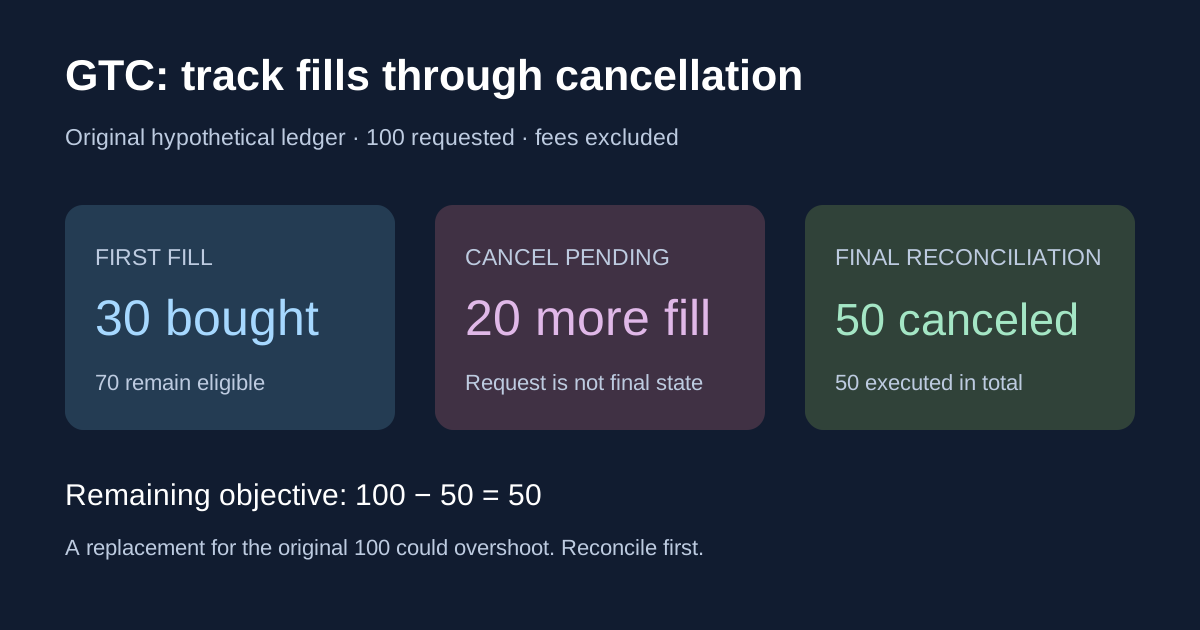
Suppose your total objective is 100 contracts and the original GTC buy has a $0.40 limit. After an initial partial execution, you request cancellation. A second execution occurs before cancellation takes effect.
| Event | New fill | Cumulative filled | Unfilled quantity | Interpretation |
|---|---|---|---|---|
| Order accepted | 0 | 0 | 100 | Acceptance is not execution |
| First execution at $0.40 | 30 | 30 | 70 | Partial position; remainder still eligible |
| Cancellation requested | 0 | 30 | 70 | Request pending; do not assume final cancellation |
| Execution at $0.39 before cancellation takes effect | 20 | 50 | 50 | Additional position acquired |
| Final cancellation reconciled | 0 | 50 | 50 canceled | No active remainder in this example |
The accounting identity is 100 requested =50 executed +50 canceled. Buying 30 at $0.40 and 20 at $0.39 costs $12.00 +$7.80 =$19.80 before excluded charges. The weighted average execution price is $19.80 ÷50 =$0.396. Cancellation of the remainder does not undo those 50 purchased contracts.
Why replacing the original 100 can overshoot
After reconciling the final state above, suppose the total objective is still 100 contracts and no other orders or position changes exist. The remaining quantity needed is 100 −50 =50.
A new order for 100, if fully executed, would instead bring the total acquired to 150. That is 50 above the stated objective. A new request for 50 would reach 100 if it fully executed. Neither calculation predicts whether a new order will fill.
Fidelity’s placing-orders FAQ says cancellation attempts remain subject to prior execution and that submitting another order does not automatically cancel the previous one. For its cancel-and-replace workflow, it describes sending the replacement after verified cancellation of the original. These are broker-specific mechanics; inspect the actual workflow you use.
Reconcile order identifiers, fills, remaining quantity, final status and current position before retrying an uncertain request. An acknowledgement that a cancellation request was received is different from evidence that the original order’s remainder has stopped being eligible.
Does GTC mean the order lasts forever?
No. Broker limits and instrument rules matter. Fidelity’s current order-types FAQ, checked November 9, 2026, describes a default stock/ETF GTC expiration 180 calendar days after entry at 4 p.m. Eastern, with a selectable earlier date or time. It separately explains treatment when the 180th day is a weekend or holiday. Use the expiration shown for your actual order.
That is an example of one broker’s current policy, not a universal 180-day definition. A different broker, instrument or exchange may use another maximum or terminate an order under other conditions. A prediction-market order also cannot be assumed to remain executable after the market stops accepting trades simply because its lifetime was GTC.
Does a GTC order work after hours?
Lifetime and session eligibility are separate settings. A stock order that survives overnight need not be eligible to execute in premarket or after-hours trading.
For a concrete example, Fidelity’s current placing-orders FAQ says GTC orders are unavailable for its extended-hours sessions. Do not transfer that broker’s rule to every venue, or assume an overnight order is active in every session. Confirm the actual instrument, session selection and expiration together.
GTC vs GTD on Polymarket
Polymarket’s current order documentation, checked November 9, 2026, distinguishes GTC limit orders without a specified deadline from GTD orders with an expiration. In its unified SDK limit-order examples, omitting expiration selects GTC; providing a Unix timestamp in seconds selects GTD.
The same documentation specifies a one-minute security threshold: GTD orders expire one minute before their stated expiration. It gives now +60 +N for an effective lifetime of N seconds and requires the stated expiration to be at least three minutes ahead.
For an original timing illustration, suppose “now” is 12:00 UTC and the desired effective lifetime is ten minutes. That documented calculation sets the stated expiration to 12:11 UTC, corresponding to the intended effective deadline of 12:10. This explains the documented offset; it is not a guarantee about client clocks, network delivery or processing precision.
Use our Polymarket limit-order guide and simulator for venue-specific execution policies. Do not copy a stock broker’s 180-day policy or session rules into a Polymarket order.
A resting order can outlive its original reasoning
A limit controls the acceptable execution price; it does not keep the underlying thesis current. In an invented event market, suppose your estimated probability falls from 55% to 30% after new information while a $0.40 buy remains active. A fill at $0.40 still respects the limit, but it no longer matches the earlier assessment.
This scenario illustrates stale intent, not a forecast or proof of a trading edge. Review outstanding orders when relevant information changes, and distinguish your estimate from the final outcome. Our adverse-selection guide explains why the circumstances in which a quote gets filled matter.
An order-lifetime and cancellation checklist
- Record the instrument, side, quantity units, price limit and total objective.
- Read the order’s exact expiration and eligible sessions.
- Track each fill and the remaining amount separately.
- Distinguish cancellation requested from a reconciled terminal state.
- Recalculate any replacement from current fills and outstanding exposure.
- Review resting orders when the original reasoning changes.
Download the blank GTC reconciliation worksheet to record these fields. It includes the fictional ledger for comparison. For evaluating the effect of unfilled quantity on a whole decision, see implementation shortfall.