
On this page
Time in force tells a trading system how long an order may stay eligible to execute and, for immediate-execution instructions, what happens to the unfilled amount. It is the order-ticket setting behind labels such as Day, GTC, GTD, IOC and FOK. Read it alongside the price condition, quantity, eligible session and instrument rules.
This guide explains how to read those settings together. It uses an original fictional timeline to show how identical size and price instructions can produce different filled quantities. The examples are educational calculations, not actual orders or a recommendation to trade.
What does time in force mean when buying stocks?
Suppose a ticket says “Buy 80 shares, limit $25, Day.” Buy specifies direction, 80 specifies quantity, the limit sets a maximum execution price, and Day supplies the lifetime. Changing Day to GTC changes how long an unfilled amount may remain eligible; it does not raise the price limit or change 80 into a dollar budget.
Investor.gov’s stock day-order definition explains that an unexecuted regular-session day order expires instead of automatically carrying into after-hours trading or the next regular day. Check your broker’s actual cutoff; do not apply one stock session’s clock to every product.
Five fields that answer different questions
| Ticket field | Question it answers | Example distinction |
|---|---|---|
| Instrument and side | What are you buying or selling? | A stock share differs from an event-outcome contract |
| Amount and units | How much is requested? | 80 shares differs from an $80 budget |
| Order type and price controls | Which prices or trigger conditions apply? | A buy limit is a price ceiling, not a fill guarantee |
| Time in force | How long can the request remain eligible? | A day deadline differs from carrying beyond today |
| Session and additional conditions | Where, when and under what extra constraints may it execute? | An all-or-none condition differs from session access |
Interfaces sometimes group several instructions in one menu. Classifying FOK as a time-in-force option does not remove its full-size requirement. Likewise, all-or-none describes a quantity condition and does not by itself supply an immediate deadline.
Day, GTC, GTD, IOC and FOK compared
| Label | General meaning | Key question before use |
|---|---|---|
| Day | An applicable day or session deadline limits the remainder | What exact cutoff applies? |
| GTC: good till canceled | Can remain beyond today until filled, canceled or otherwise terminated | What maximum lifetime and eligible sessions apply? |
| GTD: good till date | An explicit deadline limits the order’s lifetime | How is that deadline interpreted? |
| IOC: immediate or cancel | Execute what qualifies immediately; cancel the rest | Are immediate partial fills acceptable? |
| FOK: fill or kill | Execute the full request immediately under its conditions, or none | Must the whole quantity qualify now? |
Fidelity’s current order-types FAQ, checked November 9, 2026, describes Day, GTC, IOC and FOK among stock-order time limitations and lists all-or-none separately as an additional instruction. Its availability restrictions are broker-specific. A comparison table is not evidence that your instrument supports every combination.
For deeper treatment, use the GTC lifetime and cancellation guide or the FOK vs IOC qualifying-depth guide. This page focuses on interpreting the whole ticket rather than repeating their cancellation and depth examples.
Original timeline: one price cap, five different policies
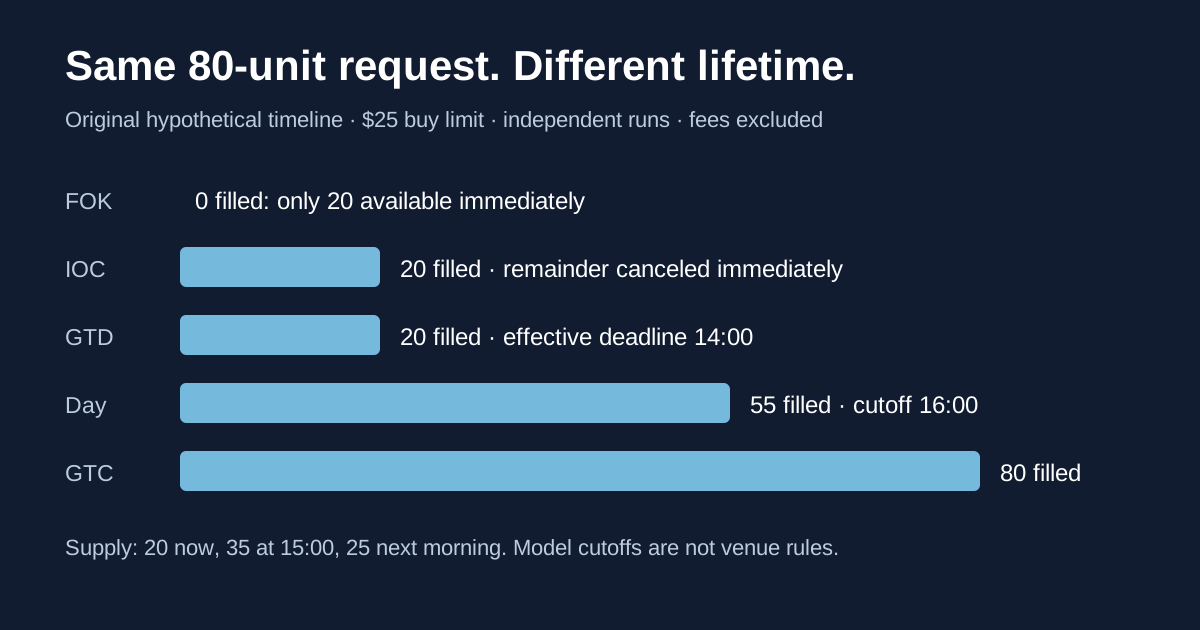
Imagine a fictional buy for 80 units with a $25 limit. For this simplified comparison, immediately executable supply is only 20 units at $24.90 at 10:00 on day one. Another 35 become executable at $25 at 15:00 that day, and 25 at $24.80 at 10:00 the next day.
Assume these are independent counterfactual runs: each policy encounters the same stipulated supply arrivals without other traders, queue effects, fees or rounding. The Day cutoff is stipulated as 16:00 on day one; the GTD effective cutoff is 14:00 that day. GTC remains eligible through the next morning. Partial fills are permitted except for FOK. These are model inputs, not actual venue cutoffs or predictions.
| Policy | Immediate fill | Later day-one fill | Next-day fill | Total filled | Unfilled result at model end |
|---|---|---|---|---|---|
| IOC | 20 | 0 | 0 | 20 | 60 canceled immediately |
| FOK | 0 | 0 | 0 | 0 | Entire 80 canceled |
| GTD, effective 14:00 | 20 | 0 | 0 | 20 | 60 expired at the deadline |
| Day, cutoff 16:00 | 20 | 35 | 0 | 55 | 25 expired at the cutoff |
| GTC through next morning | 20 | 35 | 25 | 80 | Fully filled |
IOC and GTD finish with the same 20-unit fill here, but their behavior differs. IOC cancels 60 immediately; GTD leaves 60 eligible until 14:00. If eligible supply arrived at noon, GTD could encounter it while the canceled IOC remainder could not. Matching end totals do not establish matching instructions.
The modeled costs before excluded charges are 20 ×$24.90 =$498 for IOC and GTD; $498 +35 ×$25 =$1,373 for Day; and $1,373 +25 ×$24.80 =$1,993 for GTC. FOK spends zero because it never fills in this model.
GTC’s weighted average is $1,993 ÷80 =$24.9125. Its larger filled quantity does not prove it is the best instruction. The model does not specify future value, risk preferences or whether the original decision remains valid tomorrow. A decision that requires no overnight open order has a different constraint from one that allows waiting.
Time in force is an instruction; order status is an observation
“GTC” describes requested behavior. “Accepted,” “partially filled,” “canceled” or “rejected” describes what a system reports happened. A ticket can carry a valid lifetime while being rejected for another reason. A canceled order can also have earlier executions; the status alone does not tell you the filled quantity.
Keep the requested instruction, order identifier, timestamped fills, remaining quantity and current state together. A connection timeout is missing information, not proof of zero execution. Our replacement-quantity example shows why that distinction matters when an order has partially filled.
How the terminology maps to prediction markets
Polymarket’s current documentation, checked November 9, 2026, uses GTC and GTD for limit-order lifetimes, and FOK and FAK for immediate execution policies. FAK fills available liquidity and cancels the remainder. Its terminology and SDK parameters should be read directly rather than inferred from a stock broker’s menu.
The documentation also distinguishes an accepted live order from a matched or delayed response. Delayed acceptance is not itself a completed position. Confirm actual fills instead of treating a time-in-force label or acknowledgement as execution evidence.
For Polymarket-specific examples and request units, see our limit-order guide and simulator. A continuously accessible interface does not make a stock market’s regular-session cutoff applicable, or guarantee that a particular event market remains open indefinitely.
Read the ticket in this order
- Identify the actual instrument, side and amount units.
- Read the price bound or trigger condition.
- Read how long the unfilled amount may remain eligible.
- Check whether partial execution is allowed and whether the whole size must execute immediately.
- Confirm the eligible sessions, explicit expiration and supported combinations.
- After submission, reconcile actual state and executions before changing the request.
For a separate view of filled-price benchmarks, see price improvement and comparing broker execution. For evaluating execution against the original decision rather than only the average fill price, read implementation shortfall. Use event research to assess the underlying outcome separately from the mechanics of submitting an order.