
On this page
Regulatory cases against wash trading show why reported activity must be separated from independent trading interest. Three useful records are the CFTC’s 2021 Coinbase settlement, the SEC’s 2025 final-judgment announcement concerning Suyun Gu, and the Justice Department’s 2024 HYDRO sentencing announcement.
This guide compares those dated official records, explains what each outcome establishes, and provides an original volume-reconciliation example. It is a selected case study, not a complete enforcement database or a claim about the latest appellate status of each matter. Sources checked November 9, 2026.
What is wash trading in crypto and other markets?
At a high level, wash trading creates apparent trading activity without the genuine change in economic ownership or independent interest that an observer might infer. The applicable legal test depends on the product, conduct and jurisdiction. A chart alone cannot establish those elements.
The Gu final judgment, for example, addresses transactions without a change in beneficial ownership and specified coordinated orders in its injunction concerning misleading activity. That document concerns securities law in that case; it is not a universal rule for every digital asset or event contract.
Three cases at a glance
| Official record | Outcome described | Question for a researcher |
|---|---|---|
| Coinbase / CFTC, March 19, 2021 | Settled administrative order; $6.5 million civil penalty | What did the reported transactions represent? |
| Suyun Gu / SEC, July 21, 2025 | Announcement of a July 9 final judgment following summary judgment | Were supposedly separate accounts independently controlled? |
| HYDRO / DOJ, June 25, 2024 | Criminal sentencing announcement following plea and trial outcomes | Are executed trades being confused with displayed orders? |
1. Coinbase: reporting findings and employee wash trading
The CFTC’s March 19, 2021 release describes a settled order requiring Coinbase to pay $6.5 million. It distinguishes reporting involving two automated programs that sometimes matched each other from a former employee’s intentional Litecoin/Bitcoin wash trading in August–September 2016.
The release says the automated programs had independent purposes, yet their matching transactions entered reported data. Separately, it describes the employee’s conduct as creating misleading Litecoin activity and finds Coinbase vicariously liable. These are different findings within one administrative matter; the release does not describe a criminal conviction.
Research lesson: a data feed can faithfully transmit a recorded trade while leaving a reader with an inaccurate impression of independent demand. Investigate how the underlying transactions entered the dataset.
2. Suyun Gu: liquidity rebates and a final judgment
The SEC’s July 21, 2025 release reports that the court found Gu had executed more than 11,000 wash trades involving approximately three million options contracts between controlled accounts. It describes a scheme involving liquidity rebates, a September 2024 summary judgment and a July 9, 2025 final judgment.
The linked judgment orders $621,703 in disgorgement, $134,663 in prejudgment interest and a $621,703 civil penalty. Those components total $1,378,069. Calling the entire total a “fine” would obscure the different categories. The civil judgment is also distinct from a criminal sentence.
Research lesson: account count is not a reliable substitute for independent participant count. Likewise, incentive receipts do not establish that the underlying activity reflected genuine independent demand.
3. HYDRO: executed wash trades and spoof orders
The DOJ’s June 25, 2024 announcement reports sentences of two years and 11 months for Shane Hampton and three years and nine months for Michael Kane. It distinguishes Hampton’s jury conviction from Kane’s guilty plea.
DOJ describes approximately $7 million in executed wash trades and more than $300 million in spoof trades placed through a bot. Its account concerns manipulative activity involving HYDRO. The two dollar figures should not be combined into an estimate of executed wash-trading volume: placed orders and executed trades measure different things.
Research lesson: label each statistic by its event type. An order-book display, a submitted order, a cancellation, a completed execution and a net position are separate records.
Original example: 1,000 units traded, unchanged group inventory
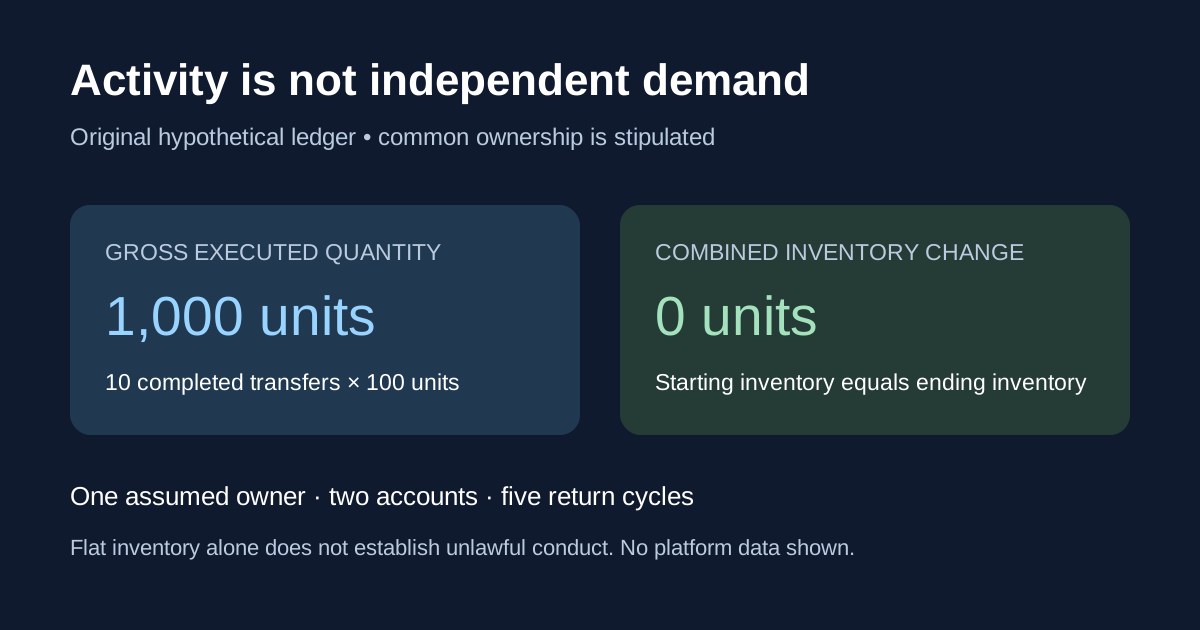
Consider two fictional accounts under one economic owner. Account A starts with 100 units and B with zero. For a simplified accounting illustration, 100 units move from A to B and then back to A, repeated five times. Count each completed transfer once as 100 units of executed quantity.
| Measurement | Result |
|---|---|
| Completed transfers | 2 per cycle ×5 cycles =10 |
| Gross executed quantity | 10 ×100 =1,000 units |
| Ending A inventory | 100 units |
| Ending B inventory | 0 units |
| Combined inventory change | 0 units |
The gross activity is ten times the starting inventory even though the assumed economic owner finishes with the same inventory. This is an invented reconciliation example, not a finding about any platform or an estimate of real wash trading. Prices, fees and cash flows are deliberately excluded; no profit is calculated.
Unchanged inventory by itself does not prove unlawful conduct. Independent traders can trade repeatedly and finish flat. In this example, common ownership is stipulated; a public dataset may not reveal that fact. Establishing control, purpose and the relevant legal elements requires evidence beyond the arithmetic.
How to read a wash-trading case without overstating it
- Record the document and date. Distinguish a regulator’s announcement from a complaint, order or judgment.
- Use the document’s procedural status. An allegation, settlement, court finding, guilty plea and jury conviction are different statements.
- Preserve the measurement unit. Orders placed are not executions; contract quantity is not dollars; gross volume is not net ownership change.
- Separate monetary categories. Penalties, disgorgement and interest should remain identifiable.
- State what the dataset cannot show. Public trades may lack beneficial ownership and account-control information.
- Avoid transferring conclusions to another venue. An established case concerning one product does not prove misconduct elsewhere.
Why this matters for prediction-market research
For Kalshi or Polymarket research, volume can be one descriptive measure, but it does not establish unique trader count, independent conviction or executable depth. The cases above are not allegations about either platform.
Use our open-interest versus volume guide to distinguish activity from outstanding positions. The adverse-selection guide addresses a different information problem: who chooses to fill a quote. Informed trading and wash trading should not be treated as synonyms.
When evaluating a market, compare timestamps, actual executable quotes, contract rules and the event evidence available through market news. High activity alone is insufficient support for an investment thesis or a misconduct accusation.