
On this page
CME event contracts let traders take a position on a defined event through a broker offering the product. CME lists the contracts; the broker provides the customer account and trading workflow. Start with the exact product specification and your broker's available market, fees and access requirements.
This guide answers the “CME event contracts” search intent using sources checked October 6, 2026. It distinguishes the current prediction-markets overview from older event-contract announcements, rather than assuming one contract size applies to every product.
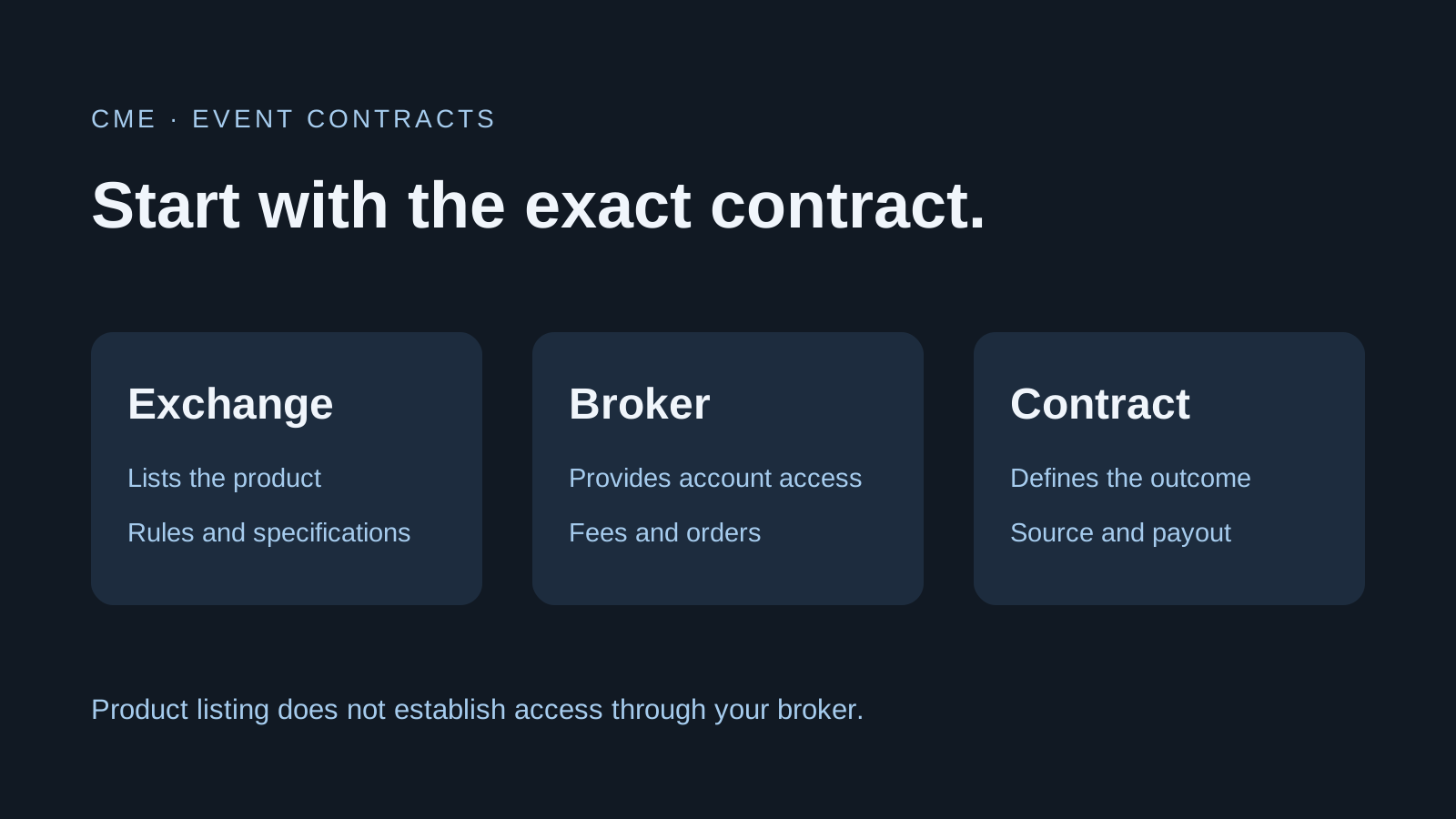
Exchange, broker and contract have different roles
| Layer | What to check |
|---|---|
| Exchange | Contract listing, specification and governing rules |
| Broker | Account eligibility, available products, fees and order workflow |
| Exact contract | Event, side, source, deadline and settlement conditions |
CME's current prediction-markets page directs traders to participating brokers. It describes prices from 1¢ to 99¢ and a standard $1 winning payout or $0 losing payout. Those prices reflect market expectations, not a guarantee of the event's probability.
A market listed by an exchange is not proof that your broker offers it to your account. Check the actual order screen and terms before treating a product directory as access confirmation.
Read the current specification
CME publishes an event-contract specification summary and notes that the rulebooks control discrepancies. The summary identifies each product's event, source, settlement value, trading termination and contingencies.
For example, its club-soccer single-game specification asks about winning in regulation and includes a delayed-event contingency with a seven-day window and fair-market liquidation afterward. That exception matters: the headline binary description does not tell you how every cancellation or delay will resolve.
For your contract, record its exact identifier and copy the relevant specification. Read the meaning of “in regulation,” “above” or “at least” before interpreting a result. Preserve the source, observation period and time zone with your notes.
Calculate proceeds and profit separately
Consider an independent hypothetical: 100 contracts purchased at 43¢, plus $2 in assumed total costs. You spend $45. If these contracts settle under standard $1/$0 conditions, a win returns $100 and produces $55 net profit; a loss returns $0 and costs $45.
| Scenario | Proceeds | Result after $45 cost |
|---|---|---|
| Standard win | $100 | +$55 |
| Standard loss | $0 | −$45 |
This example is not CME's or any broker's fee schedule. Replace its assumed costs with the actual preview and fills. If the contract specifies a nonstandard settlement, use that payout in the calculation instead.
Explore the arithmetic in the expected-value calculator. Use an independent probability estimate when evaluating expected returns; a profitable winning scenario alone says nothing about how often you will win.
Why older pages mention $20
CME's 2022 launch announcement described $20-sized contracts linked to futures markets. The current prediction-markets overview describes a $1 payout. Date, product family and exact specification matter when comparing these pages.
Do not copy a contract multiplier from an older tutorial into a new trade. Verify the amount per contract in the actual product, then apply it consistently to price, quantity, fees and settlement proceeds.
Compare venues using exact conditions
A CME-listed market and a Kalshi or Polymarket market with similar titles can use different sources, deadlines or cancellation treatment. Pair their complete rules before comparing prices. The contract-equivalence worksheet shows how a small threshold difference can break an assumed hedge.
Inspect available size as well as price. The slippage calculator illustrates how larger orders can fill across multiple price levels. Its default depth is hypothetical and does not retrieve CME quotes.
A checklist before relying on a quote
- Confirm the broker actually offers the exact product to your account.
- Save its current specification and identify any exceptional settlement treatment.
- Check the buying or selling price for your intended size.
- Include all applicable costs in the payout calculation.
- Separate a displayed quote from completed fills and a settled payout.
Alphascope's market research supports investigation. Check product availability and execution details with the underlying venue and broker.