
On this page
Kalshi liquidity rewards compensate qualifying resting orders in selected incentive programs. They are separate from a contract's settlement payout and from your trading profit. Start with the exact market's program details, not the total pool shown for a broader event.
This guide targets the liquidity-incentive workflow. Signup promotions, trading-volume incentives and designated liquidity-provider arrangements have different terms. Sources checked October 6, 2026: Kalshi's liquidity incentive guide and where to find rewards.
Find the exact market's program
Open Menu → Rewards or Kalshi's incentives page. Check the market's Rewards badge for its pool, time period, Target Size and Discount Factor. Event-level totals can combine multiple markets. Live earnings estimates can change; paid rewards appear in reward history and Account → Activity → Credits.
| Number | How to use it |
|---|---|
| Program pool | A shared amount for the exact program |
| Live estimate | A provisional value with an observation time |
| Paid credit | The completed reward to reconcile with your records |
| Trading result | A separate calculation including fills and fees |
What changes your reward share?
Kalshi scores snapshots using qualifying order size and distance from a reference price. Scores are normalized against other qualifying orders. Target Size and Discount Factor affect qualification and weighting; raw order quantity alone does not determine your final share. Snapshots require sufficient two-sided depth and an open market.
Placing a larger order can increase exposure if it fills. It does not prove that your score share rises proportionally, because the rest of the book can change. Record the program parameters and your order history rather than treating an isolated quote as a payment forecast.
A reward-pool calculation
The documented formula multiplies your final score share by the pool and the fraction of snapshots that qualify. It rounds down to cents, with a $1 minimum payment for an individual program. Try assumptions in the liquidity rewards scenario calculator.
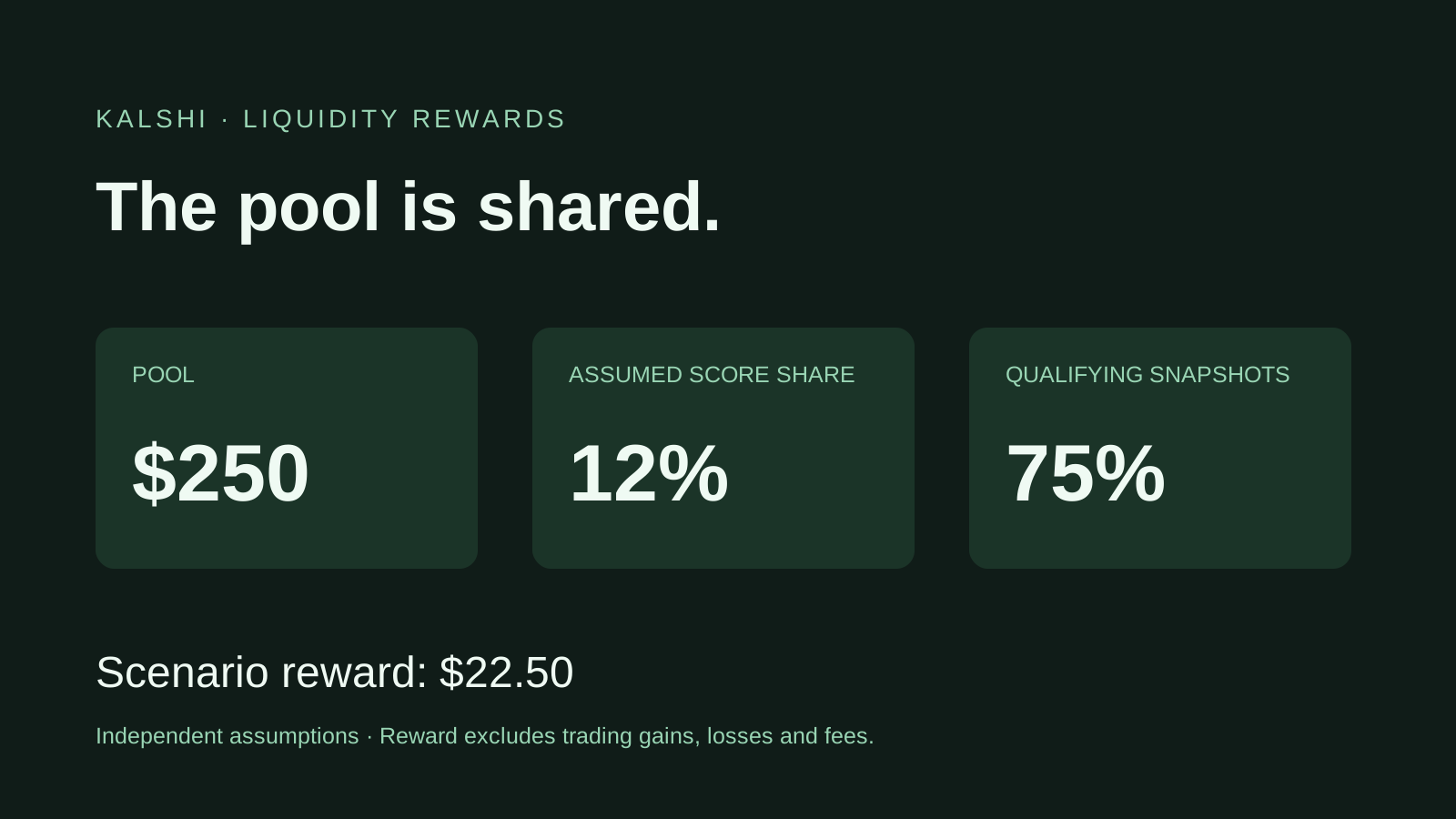
For an independent example, assume a $250 pool, a 12% final score share and 75% qualifying snapshots. The arithmetic is $250 × 0.12 × 0.75 = $22.50. A 6% share produces $11.25 under the same assumptions. Neither figure forecasts your earnings; the actual share must come from the program's scoring.
The calculator accepts a final share as an assumption. It does not derive scores from your account or order book, verify your eligibility or reconstruct a program's snapshots.
Compare the reward with the complete trading result
Imagine the $22.50 reward example accompanies $30 of trading losses and $2 of fees. The combined result is −$9.50. Calling the reward “income” without tracking inventory losses hides this outcome.
Keep three separate ledger columns: trading gains or losses, fees and paid incentives. Add them only after checking that each entry covers the same period and is counted once. Open positions also require a separate valuation; their displayed value is not a completed sale.
Use the Kalshi order-book guide to understand resting orders, the fee guide for costs and the portfolio guide for balance labels.
Why a reward total can still show zero
Kalshi says paid totals do not show pending rewards. Final processing follows the program's end and timing varies. An order may also fail qualification, and a final amount below the minimum is not paid. A live order indicator is guidance, not a final record.
Before asking about a missing credit, collect the exact market, program period, estimate timestamp and relevant order history. Compare the final paid-credit record rather than assuming the disappearance of an active listing means the credit has arrived.
Check eligibility and governing terms
Read the current program notices before participating. The official incentive guide limits eligibility and says Kalshi can change or end the program. This article and its calculator do not establish that your account or orders qualify.
Use Alphascope's research tools to investigate underlying events. Keep reward assumptions separate from your forecast of the event and from your decision about taking a position.