
On this page
Limitless is a prediction-market platform on Base where users trade shares in defined event outcomes. Its official documentation describes USDC-backed outcome pairs, order-book markets, automated-market-maker pools and REST/WebSocket developer interfaces.
This independent documentation review was checked November 21, 2026. Use limitless.exchange and the official documentation for the actual product. We did not connect a wallet, trade, test withdrawals or audit its contracts. The calculations below are original examples with supplied prices and explicit assumptions.
What is the Limitless prediction market?
The introduction describes outcome shares priced in USDC, with a Yes/No pair collateralized by 1.00 USDC. The normal binary outcome pays 1.00 to a winning share and zero to a losing share. Its exchange includes short-duration price markets and other event categories.
A contract about an asset’s price is an outcome claim, not ownership of the underlying asset. A displayed 0.60 share price is a market price for that claim; it is not proof that the forecast is correct, that all desired size can fill there or that an eventual sale is guaranteed.
Is Limitless available to US traders?
The Terms of Service, dated September 15, 2026 as served during review, list the United States among jurisdictions unavailable for trading. They separately list broader access restrictions and other eligibility requirements. Read the complete current terms for the relevant location and product.
A public quote or accessible documentation page does not establish permission to trade. Do not assume that Base-wallet compatibility, an API response or eligibility on another prediction platform removes these restrictions.
Identify the market type before comparing fees
The official fee guide distinguishes AMM pools, custom user-created pools, legacy order-book venues and new trading venues. It describes legacy buy fees in outcome tokens and legacy sell fees in USDC. New-venue taker fees are paid in USDC on both sides; resting makers are not charged trading fees.
That distinction changes the ledger. A charge deducted in shares changes the quantity remaining, while a USDC charge changes cash outlay or proceeds. A single unqualified headline rate cannot describe all products. Confirm the exact venue, current fee settings and any applicable profile cap.
Original example using the documented new-venue standard rate
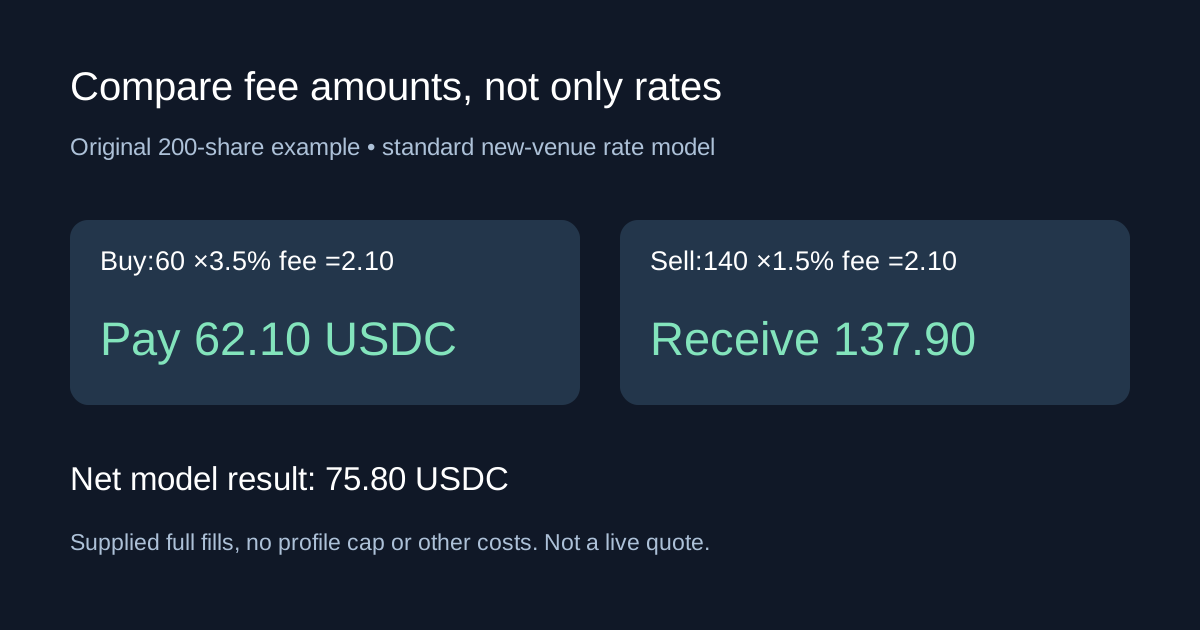
The current guide describes the standard new-venue taker rate as 5% of one minus the share price, applied to the trade’s USDC value. The following is unrounded model arithmetic using that documented standard, not a live order quote or a reproduction of production rounding.
Assume the same 200 shares are bought at 0.30 and later sold at 0.70, with full execution at both prices. Assume a standard-rate new venue, no profile cap, no quantity changes and no other charges or transfers.
| Ledger component | Buy | Sell |
|---|---|---|
| Quantity | 200 shares | 200 shares |
| Price | 0.30 | 0.70 |
| USDC trade value | 200 ×0.30 =60.00 | 200 ×0.70 =140.00 |
| Model fee rate | 5% ×0.70 =3.5% | 5% ×0.30 =1.5% |
| Model fee amount | 60 ×3.5% =2.10 | 140 ×1.5% =2.10 |
| Cash movement | Pay 62.10 | Receive 137.90 |
Gross price profit is 200 ×(0.70 −0.30) =80.00. The two model fees total 4.20, leaving 137.90 −62.10 =75.80. Under these specific inputs, different percentage rates produce equal fee amounts because the notional also changes.
The supplied fills are assumptions, not evidence that a real participant could execute this round trip. Spread, changing depth, latency and any omitted costs can change the result. Applying this USDC ledger to a legacy buy charged in outcome shares would be the wrong asset treatment.
Download the original fee ledger and market-research worksheet. Read current execution records before using a model as an account reconciliation.
Resolution and redemption are separate states
The resolution reference directs readers to market-specific sources and rules. It describes Pyth, Chainlink TWAP, sports data, manual and other resolution paths. It also distinguishes an API showing a market resolved from an onchain payout being ready to redeem.
Do not replace the specified rule with a convenient chart’s last tick. In an original fictional example, a three-observation equal-weight average of 100, 102 and 104 is 102. A final-tick value of 104 answers a different question. This teaching average is not a reproduction of a live feed’s windowing or sampling.
For an actual short-duration market, record the designated feed, baseline, averaging window, comparison operator, tolerance and deadline. Two markets with similar titles can use different source or timing rules and therefore produce different valid outcomes.
A 50–50 resolution is not necessarily a refund
The resolution reference explicitly permits 50–50 outcomes where the particular market’s criteria allow them. It says each share then redeems for 0.50 USDC, regardless of outcome side, rather than returning the amount paid. Do not generalize that special outcome to every market.
Construct a separate fictional holding: 100 shares bought at 0.66, ignoring all fees and other activity. Entry outlay is 66.00. If the contract validly resolves 50–50 under its rules, payout is 100 ×0.50 =50.00, for a net −16.00 before costs.
A refund of the 66.00 outlay would produce a different cash result. Preserve the actual resolution classification and any applicable refund policy rather than treating every cancelled, ambiguous or disputed event as the same ledger operation.
Limitless prediction-market API: where to begin
The current API reference lists https://api.limitless.exchange as the REST base. Public market browsing and order-book data are available without authentication; authenticated operations use scoped tokens and HMAC signing. It separately documents order management, portfolio data and real-time streams.
For read-only research, begin with exact market identification and relevant public data, not trading credentials. The reference describes venue-specific exchange/adapter information and outcome token IDs. Those are instrument data, not reusable defaults for another market.
Store the environment, exact market identity, outcome side, quote asset, observation time, venue and rule text alongside a price. An HTTP success does not establish completeness, execution quality, trading access or a successful redemption.
Recurring market aliases can point at a different round
Limitless’s official site reference explains that recurring series can have a stable URL pointing to the current instance, while past instances retain their own permanent URLs. That is useful for browsing, but it makes the distinction between “this series” and “this exact round” important for research.
Imagine collecting a price from a fictional hourly alias at 13:50 and reading the same alias again at 14:10. If it now resolves to a new round, combining the first price with the second round’s result would create a mismatched record. This is a constructed data-quality scenario, not an observed Limitless API failure.
Freeze the exact instance identity and interval when saving a forecast. A convenient recurring URL alone is weaker evidence than the specific contract, observation time and resolution condition.
How to compare Limitless with other prediction platforms
Compare the same outcome, timing, settlement units and intended size. Then identify actual access restrictions, market type, fee asset and execution path. A lower nominal price on a differently defined contract is not necessarily a cheaper version of the same payoff.
Our Polymarket alternatives guide separates cash event contracts, crypto-native venues, play-money practice and scored forecasting. The Opinion Trade overview examines another venue’s minimum-fee model. Neither venue’s rules should be copied into a Limitless calculation.
A Limitless research checklist
- Confirm the official product and current eligibility terms.
- Identify the exact market instance and outcome.
- Read the source, interval, cutoff and special-resolution conditions.
- Determine AMM/custom/legacy/new-venue fee treatment.
- Keep fees charged in shares separate from cash charges.
- Preserve actual size, depth and execution records.
- Distinguish resolution status, redemption readiness and any refund.
- Evaluate forecast quality separately from realized cash results.
Alphascope’s market-linked research adds event context. This source-based review and its calculations do not independently establish contract security, solvency, live liquidity or profitable trading.