
On this page
Myriad Markets is a blockchain-based prediction platform with both automated-market-maker (AMM) and order-book markets. Start at myriad.markets. The mechanism matters: a quote, a resting order and a filled position are different records.
This independent documentation review was checked November 21, 2026. It includes original worked examples, not a wallet, withdrawal or execution test. Current access terms, the exact market rules and the order preview remain essential checks.
What is the Myriad prediction market?
The official introduction describes outcome shares that can trade before resolution. In an ordinary resolved winning/losing outcome, winning shares pay $1 and losing shares pay zero. Prices express market expectations, not verified probabilities or guaranteed opportunities.
Buying an event share about a cryptocurrency does not buy the cryptocurrency. Likewise, an event about a sports result is defined by its contract rules, not by whichever scoreboard a researcher happens to inspect.
Myriad AMM vs order book
The AMM documentation describes dynamically changing prices, market-specific buy fees from 0% to 2%, and an additional $0.0085 transaction charge in the Myriad application. Check the actual market’s displayed fees; do not apply that range to every product.
The order-book guide describes offchain matching and onchain settlement. Resting makers are fee-free under the documented model; immediately executing takers pay a price-dependent fee. A limit order can take liquidity, so “limit” alone does not establish maker treatment.
| Research question | AMM record | Order-book record |
|---|---|---|
| What determines execution? | Current pool quote for the requested size | Available opposing orders and execution instructions |
| What should be preserved? | Input, output, fee and quote time | Levels, size, limits, fills and timestamps |
| What can be misleading? | Extrapolating a small quote to a large purchase | Assuming the best ask covers the entire desired size |
This table is a research framework, not a claim that either mechanism has better current liquidity. A useful comparison needs the same outcome, size and observation time.
Original depth example: the top ask is not the average price
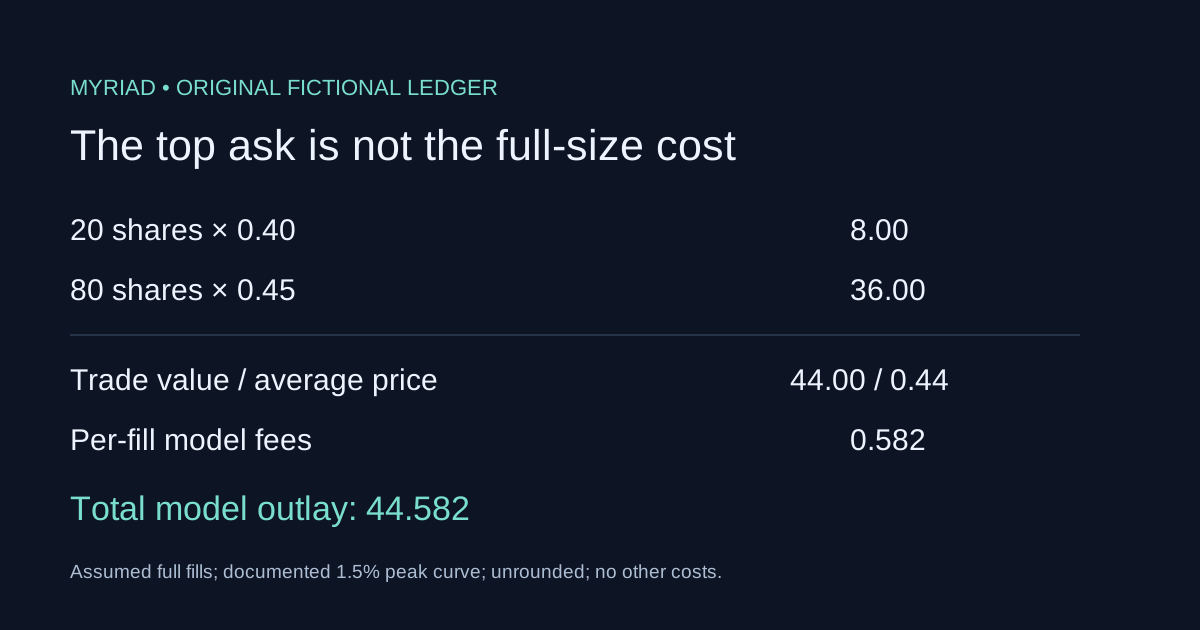
Construct a fictional order book with 20 shares offered at 0.40 and 80 shares at 0.45. Assume those offers remain available and there are no intervening trades. Buying 100 shares costs 20 ×0.40 +80 ×0.45 =44.00 before fees, giving an average price of 0.44.
Multiplying the top ask by the whole size produces 40.00, understating the model’s execution value by 4.00. This is a depth effect before any fee. It is not a live Myriad quote or an arbitrage signal.
Worked Myriad order-book fee example
The order-book reference currently gives a peak taker rate of 1.5% at price 0.50, decreasing linearly toward the extremes:
rate(p) =0.015 ×min(p, 1 −p) /0.5
Apply that documented curve to the invented fills above. Assume taker execution, no rebates or other charges, and use unrounded arithmetic rather than claiming production precision.
| Fill | Trade value | Model rate | Model fee |
|---|---|---|---|
| 20 shares at 0.40 | 8.00 | 1.20% | 0.096 |
| 80 shares at 0.45 | 36.00 | 1.35% | 0.486 |
| Total | 44.00 | Per-fill calculation | 0.582 |
Total modeled outlay is 44.582. If all 100 shares subsequently receive the ordinary 1.00 winning payout, the model’s result is 100 −44.582 =55.418. A zero payout produces −44.582. Neither outcome is a forecast.
Calculating the curve only at the average price 0.44 gives 44 ×1.32% =0.5808, which differs from the per-fill total by 0.0012. The example shows why preserving fills matters for a nonlinear fee amount. Actual rounding, grouping and applicable market configuration require execution records.
Download the original fill ledger and market-research worksheet. The worksheet contains the assumptions and a separate cancellation example; it contains no credentials or trading instructions.
FOK, FAK and a partial-fill scenario
The order-book guide describes the application’s market-order flow as Fill Or Kill (FOK), while the API and CLI also support Fill And Kill (FAK). FOK requires the full order; FAK can execute an available portion and cancel the remainder.
Now change the fictional instruction: request 100 shares but limit execution to 0.42. Only the 20 shares at 0.40 qualify; the 80 shares at 0.45 do not. Under a supplied FOK model, the order cannot fill fully and executes zero shares. Under a supplied FAK model, it fills 20 and cancels the remaining 80.
That is a different scenario from the earlier 100-share purchase, where both levels were eligible. Do not combine the 44.582 full-fill outlay with a position that only contains 20 shares. A rejected order is also different from a completed trade followed by a cancellation of the market itself.
Resolution, cancellation and perpetual sentiment
The trading reference says market rules govern resolution and the Myriad team manages it. Its cancellation language uses the market value of the open position at cancellation, which can create a gain or loss. It separately describes perpetual sentiment markets that never resolve.
In an original cancellation model, buy 100 shares at 0.60 for 60.00, excluding every fee. Stipulate a valid cancellation valuation of 0.35 per share and no other account activity. The claim is 35.00 and the result is −25.00. This is a teaching example, not a specific historical cancellation or a reproduction of a contract’s valuation algorithm.
Returning the original 60.00 purchase cost would be a different policy. An ordinary 1/0 event payout would also be different. Record the actual state and rule instead of labeling every nonstandard outcome “refund.”
A perpetual sentiment price also needs a different research objective: without an eventual event-resolution label, a conventional resolved-event accuracy calculation cannot simply be copied across. Price movement, forecast scoring and realized cash results measure different things.
Myriad API research: preserve units and identity
The current API reference covers AMM and order-book interfaces, market rules, books, trades and real-time updates. It distinguishes pre-fee price from priceAfterFees and documents token-smallest-unit strings for amounts and fee values.
For a data record, save the market and outcome IDs, chain, asset, decimals, mechanism, state, source rule and observation time. Keep raw integer strings alongside a correctly scaled display value. A missing decimal conversion can turn an otherwise valid number into the wrong economic quantity.
Suppose a fictional six-decimal token amount is stored as 44582000. Its scaled amount is 44.582, not 44,582,000. Six decimals are an explicit teaching input, not a universal assumption about every Myriad asset.
Use the current authentication reference for any integration. This review made no authenticated requests, signed orders, installed CLI software or tested live API completeness. A market-data response alone would not prove trading eligibility or successful settlement.
Myriad vs Polymarket and other alternatives
Compare an identical event predicate, source, time interval and payout unit before comparing price. Then account for the intended size, mechanism, execution instruction and actual fees. Similar titles do not establish interchangeable contracts.
Our Polymarket alternatives guide compares different product purposes. The Limitless guide and Opinion Trade guide examine their own documented fee and settlement models. Their formulas should not be imported into a Myriad ledger.
For event context, use Alphascope’s market-linked research. Keep the question you are forecasting separate from the mechanics of the venue where its shares trade.
Before using a Myriad quote in research
- Confirm the official product, current terms and your eligibility.
- Identify the exact outcome and authoritative resolution rule.
- Distinguish AMM, order-book and perpetual sentiment products.
- Record size, time, units and the full available quote or depth.
- Separate maker/taker status from order-type labels.
- Preserve each actual fill and its fee treatment.
- Keep cancellation valuation separate from purchase-cost refunds.
- Evaluate accuracy separately from trading profit.