
On this page
Predict.fun is a prediction-market platform on BNB Chain where users buy and sell outcome shares. The official product is predict.fun; this guide concerns that platform, not Pump.fun or unrelated prediction games.
Documentation checked November 21, 2026. This independent review explains its fee basis, yield accounting and settlement workflow with original examples. We did not fund an account, connect a wallet, trade, claim yield or test withdrawals.
What is Predict.fun?
The official quickstart describes tradable shares tied to future events. A price expresses the market’s view of an outcome; it does not establish an accurate forecast or a guaranteed return.
Separate three questions: What does the event contract pay? What does acquiring or selling it cost? What additional cash flows, if any, are actually attributable to the position? Mixing these questions makes comparisons unreliable.
Can US users trade on Predict.fun?
The Terms of Service, dated November 18, 2025 as served during this review, restrict trading for persons in the United States and several other jurisdictions. They distinguish permitted content access from restricted technology features and prohibit bypassing restrictions with VPNs.
Read the complete current terms for your location and circumstances. An accessible price page or compatible wallet does not establish trading eligibility. This source review is not an individual access determination.
Predict.fun fees: identify the denominator
The fee reference describes fee-free makers and variable taker fees. It provides this raw-fee formula:
raw fee =base fee rate ×min(price, 1 −price) ×shares
It separately defines the effective percentage as raw fee divided by trade value. These are different quantities. Its example base rate is 2%; an eligible 10% discount multiplies the resulting fee by 0.9. Check actual market and account settings instead of assuming the discount applies.
Original example: equal raw fees, different effective percentages
Construct two independent hypothetical taker purchases of 250 shares, one priced at 0.20 and the other at 0.80. Use the documented 2% base, no discount, no other charges and unrounded arithmetic. These are sensitivity scenarios, not simultaneous executable opportunities or a recommended pair trade.
| Model component | Price 0.20 | Price 0.80 |
|---|---|---|
| Quantity | 250 | 250 |
| Trade value | 50.00 | 200.00 |
| Cheaper outcome price | 0.20 | 0.20 |
| Raw fee | 0.02 ×0.20 ×250 =1.00 | 0.02 ×0.20 ×250 =1.00 |
| Fee / trade value | 1 /50 =2% | 1 /200 =0.5% |
| Outlay including model fee | 51.00 | 201.00 |
The raw fee is symmetric around 0.50 for the same share quantity, but the percentage of purchase value is not. Applying a flat 2% to the 200.00 trade value would produce 4.00, overstating this model’s fee by 3.00.
If the stipulated 10% discount applies, each raw fee becomes 1.00 ×0.9 =0.90. At price 0.80, that is 0.90 /200 =0.45% of trade value. A ten-percent fee discount does not remove ten percentage points from the share price.
This ledger does not reproduce production rounding, partial-fill grouping or blockchain costs. Preserve execution records for reconciliation. The displayed quote, number of shares received and final fee should be checked independently.
How Predict.fun yield works
The yield documentation describes USDT collateral earning through Venus Protocol, with account attribution based on onchain position snapshots and weekly distribution. It states there is no fixed rate and a 10% management fee applies to generated yield.
The same reference warns that a liquidity crunch can delay claims on yield-bearing markets and that deployment can be paused. Its historical timing discussion is not a guaranteed withdrawal deadline. Yield eligibility, accrual, distribution and ability to claim are separate facts.
Yield does not make an incorrect prediction profitable
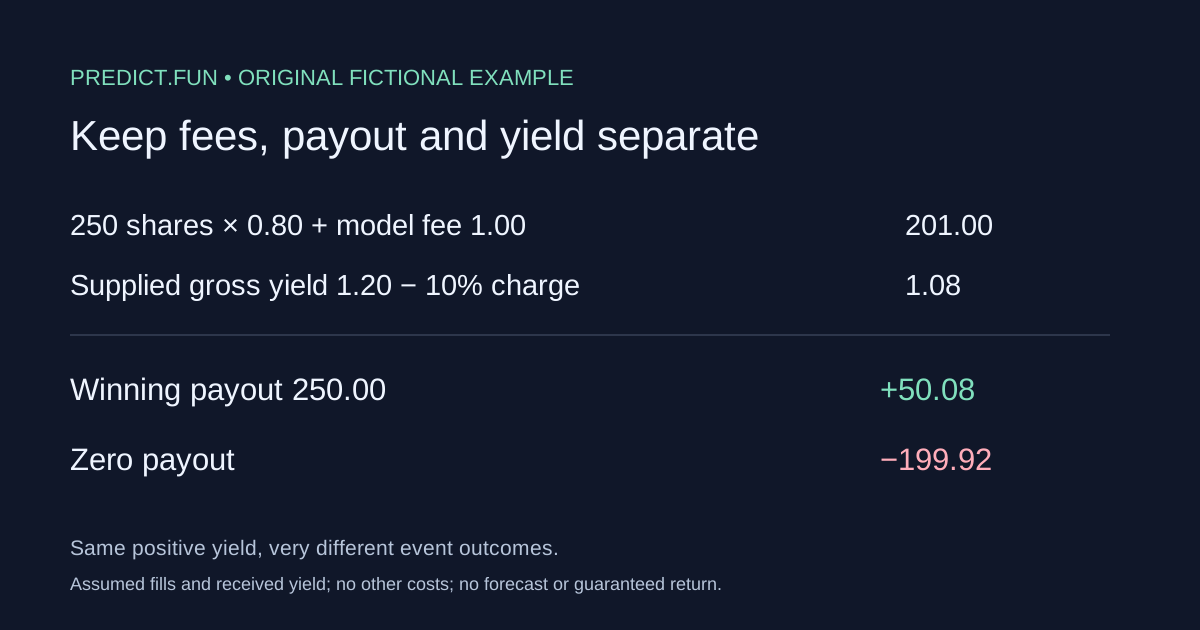
Continue only the fictional 250-share purchase at 0.80, with the undiscounted 1.00 model trading fee. Total outlay is 201.00. Now stipulate that this particular holding has separately been attributed 1.20 of gross yield. This is a supplied amount, not a forecast APR or a reconstruction of Predict’s snapshot allocation.
Applying the documented 10% management fee to that supplied yield gives 1.20 ×10% =0.12 management cost and 1.08 net yield. It does not charge 10% of the 200.00 purchase value.
| Original cash ledger | Winning payout scenario | Zero-payout scenario |
|---|---|---|
| Outlay including trading fee | −201.00 | −201.00 |
| Stipulated ordinary event payout | 250.00 | 0.00 |
| Stipulated net yield actually received | 1.08 | 1.08 |
| Combined result | 50.08 | −199.92 |
The same positive yield amount coexists with a substantial loss if the outcome pays zero. Receiving interest does not guarantee capital preservation. If yield is not received, do not record it as cash available merely because a model estimated it.
For an account ledger, record the trading fee and yield management fee once each. If a distribution already reports net yield, subtracting the management fee again would double-count it. Keep accrued, claimable and received amounts in separate fields.
Download the original fee, yield and settlement worksheet. All prices and gross-yield amounts in the example are explicit assumptions.
Limit orders, estimates and actual fills
The FAQ describes limit prices and order expiry. It also warns market orders can encounter invalid orders and produce fewer shares than estimated. That makes the final execution quantity important.
Suppose a fictional preview estimates 250 shares but the confirmed position contains 240. Under a supplied 1.00-per-winning-share payoff, the payout quantity is 240, not 250. Reusing the earlier 250-share ledger without updating every corresponding outlay, fee and yield input would give a misleading result.
An open order is not the same as a held position. A cancelled unfilled order is not a resolved event. Save order identifiers, fill quantities and execution times separately from the market’s closing and resolution timestamps.
How does Predict.fun resolve markets?
The resolution guide says new markets since March 2026 use UMA’s Optimistic Oracle. It describes bonded proposals, a challenge window, another proposal round after a dispute, and escalation to a UMA vote after a second dispute.
The guide estimates roughly two hours for undisputed resolution, with disputed cases taking longer. Treat that as a described workflow, not a fixed availability promise. Check the actual market’s rules, oracle request and current state.
Distinguish the event becoming knowable, a proposal being posted, a challenge period ending, a payout becoming claimable and assets actually reaching the account. A headline announcing the event does not prove that every later step has completed.
Predict.fun developer documentation
The official developer portal is the starting point for integrations. Preserve the exact market, outcome, chain, collateral asset, timestamps and relevant rules when collecting data. Use the current reference for authentication and supported operations.
A read-only research pipeline should distinguish price observations from executable quotes and completed fills. Store raw source values and units so that a later calculation can be traced back to the observation. This review did not test a live API integration or order-signing flow.
Comparing Predict.fun with other prediction markets
A useful comparison starts with the exact event, payout unit, timing, eligibility and intended size. It then accounts for spread, applicable fees and settlement mechanics. A yield badge alone cannot establish the cheapest executable contract.
Read our Polymarket alternatives guide for product distinctions, the Myriad guide for another AMM/order-book model, and the Limitless guide for different venue and payout rules. Keep each venue’s formula attached to its own product.
Alphascope’s market-linked research adds event context. For a reproducible analysis, keep forecast accuracy, event payout, execution costs and yield distributions in separate records.