
On this page
OPINION is a prediction-market platform at opinion.trade, with an exchange interface, outcome markets and developer documentation. Its documented design combines an order book, market-specific resolution rules and a taker-fee schedule. This independent overview examines what those documents establish and what still needs checking on the actual market or account.
Reviewed November 21, 2026. Start with the official domain and documentation. This article concerns OPINION/Opinion Labs, not every similarly named “opinion trading” site. We did not connect a wallet, place orders, test withdrawals or validate production fee charging.
What is the Opinion prediction market?
OPINION’s documentation presents a prediction exchange focused on trading real-world outcomes, including economic topics. Its product description discusses AI-supported resolution and an onchain infrastructure stack. Those are documented product descriptions, not independent proof of forecast accuracy, liquidity or operational safety.
A review should separate the market question, tradable outcome, available order book and final resolution. A compelling topic or a recent headline does not establish that a contract’s definitions match the event you want to study.
Can US users trade on Opinion?
The linked Terms of Use, dated October 19, 2025 as served during this review, include the United States among restricted jurisdictions for platform access and trading. They also list other restrictions and prohibit using VPNs to circumvent them. Read the current complete terms rather than treating this paragraph as a full eligibility list.
The same terms distinguish informational content from the platform’s technology features. Viewing a page or public documentation does not establish permission to trade. We make no claim that a US reader can participate or that another venue’s eligibility carries over.
Order-book prices are different from executable size
The official order-book guide discusses bids, asks, spreads and partial fills. A limit order specifies a price constraint; it can remain unfilled or fill in parts. A limit instruction that immediately crosses existing liquidity should not be assumed to earn maker treatment merely because it is called a limit order.
For an original fictional book, suppose 20 shares are offered at 0.60 and 80 at 0.64. A hypothetical 100-share purchase consuming both levels costs 20 ×0.60 +80 ×0.64 =63.20 before fees. Its average price is 63.20 ÷100 =0.632, not 0.60.
These are invented quotes, not an observed Opinion order book. The example shows why a screenshot’s best price does not establish the price available for an entire intended size. Read our notional-value guide for the quantity-versus-outlay distinction.
Opinion Trade fees: maker, taker and the minimum
The official fee guide describes taker charges and maker-free trading, with a probability-shaped curve, market coefficient and multiplicative discounts. It specifies a 0.25 settlement-unit minimum fee, a 5-unit minimum order and settlement-asset denomination. Matching gas is covered, while some other actions can incur user-paid gas.
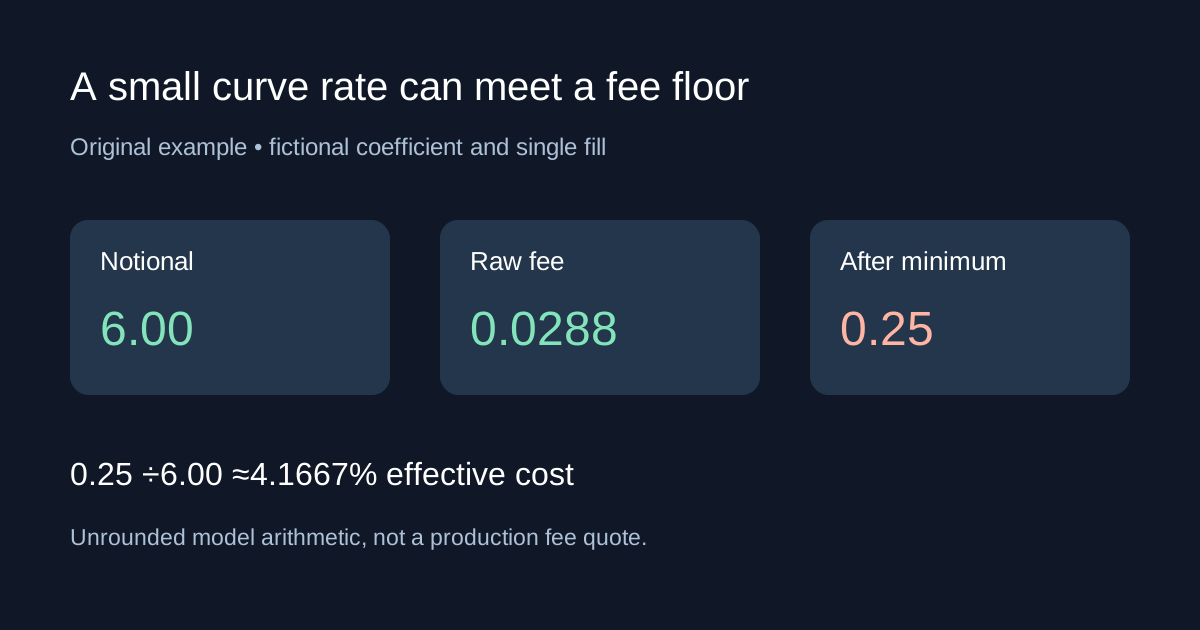
The minimum matters: a curve rate and the effective cost as a percentage of a small trade are different figures. The page’s formula applies a floor after calculating the discounted notional-based charge. Its stated fee assessment is per matched fill. Confirm current preview, rounding and actual fill records before estimating a real order.
Original fee example: the floor can dominate
Build an unrounded teaching model using a supplied market coefficient of 0.02, price 0.60 and no discounts. These are hypothetical inputs, not a current market configuration. The curve rate is 0.02 ×0.60 ×(1 −0.60) =0.0048, or 0.48%.
For one modeled taker fill, compute notional as quantity times price, multiply it by the curve rate and compare the result with the stated 0.25 floor. Actual precision and fill grouping are not reproduced by this model.
| Fictional single fill | Notional | Raw curve charge | Charge after floor | Charge ÷ notional |
|---|---|---|---|---|
| 10 shares at 0.60 | 6.00 | 0.0288 | 0.25 | 4.1667% approximately |
| 100 shares at 0.60 | 60.00 | 0.288 | 0.288 | 0.48% |
| 500 shares at 0.60 | 300.00 | 1.44 | 1.44 | 0.48% |
The first row’s 4.1667% is not a new headline curve rate. It is the effective ratio produced by applying a fixed minimum to a small hypothetical fill. A small raw rate therefore does not prove a small percentage cost after a minimum is imposed.
Now apply an assumed 50% discount to the curve component only. For the 100-share row, the raw charge falls from 0.288 to 0.144, but the floor raises the model result to 0.25. The final charge drops by 0.038, about 13.19%, rather than 50%.
For 500 shares, the discounted raw amount is 0.72, above the floor, so this model retains the full 50% reduction. Do not extrapolate a nominal discount to every ticket size. The coefficient, discounts, minimums and actual execution records all matter.
Download the original fee/book calculations and research fields. The worksheet is not an order preview, a fee quote or a tested comparison of venue execution.
How does Opinion resolve markets?
The resolution page directs readers to each market’s specified method and identifies Opinion AI as the primary current mechanism for most markets. That short description does not prove that every market uses an identical rule or that an AI-derived result is guaranteed correct.
The terms separately discuss designated sources, disputes and possible cancellation where resolution is impossible. Preserve the actual market rule, source, time zone and cutoff. A title alone is insufficient evidence of the payoff condition.
For an original predicate comparison, “above 5 at 17:00” and “at least 5 at 17:00” differ when the final observed value is exactly 5. Matching two market titles without reading that distinction could create a false cross-platform comparison. The example is invented and does not describe a current listed market.
Does Opinion have an API?
Yes. The current OpenAPI overview documents market discovery, prices, price history, books and quote tokens. It says its listed public-data endpoints do not require an API key, while other endpoints require authentication. It distinguishes this data interface from the CLOB SDK used for trading operations.
That current text differs from older snippets that describe all access as requiring an application. Check the live reference for the actual endpoint rather than copying a cached setup assumption. We read documentation for this review; we did not test an authenticated API or create credentials.
For a reproducible research record, save the exact market and outcome identifiers, quote-token identity, retrieval time, bid/ask depth and rules. Do not combine records solely by similar titles. A readable API response does not establish that an intended order is eligible or executable.
How to compare Opinion with Polymarket or Kalshi
Start with the task rather than declaring one universal winner. A read-only macro researcher, an eligible trader and a developer have different needs. Compare the same event definition, observation time, outcome side and intended size.
| Comparison field | Evidence to collect | What not to assume |
|---|---|---|
| Access | Current product-specific terms and account eligibility | One crypto venue’s rules apply to all |
| Event | Exact source, cutoff and predicate | Similar titles mean identical payouts |
| Execution | Side, depth, size and fill records | The best displayed price covers the whole ticket |
| Costs | Actual maker/taker treatment, minimums and other charges | A headline percentage is the complete cost |
| Data | Endpoint version, identifiers and freshness | Successful retrieval proves trading access |
For other venue workflows, our Polymarket API guide and Kalshi API guide provide separate starting points. Their hosts, credentials, fee rules and identifiers should not be reused as Opinion defaults.
For a broader comparison by objective, see Polymarket alternatives for trading, practice and forecasting.
What this Opinion review establishes
This is a source-based overview with original calculations. It establishes what the cited pages said during review and explains how supplied fee and book inputs affect arithmetic. It does not independently audit contracts, verify solvency, measure live liquidity, demonstrate withdrawals or certify forecast accuracy.
Use Alphascope’s market-linked research for event context, then preserve venue-specific rules and evidence alongside any price comparison. An accurate calculation is useful only when its inputs describe the contract and execution being evaluated.