
On this page
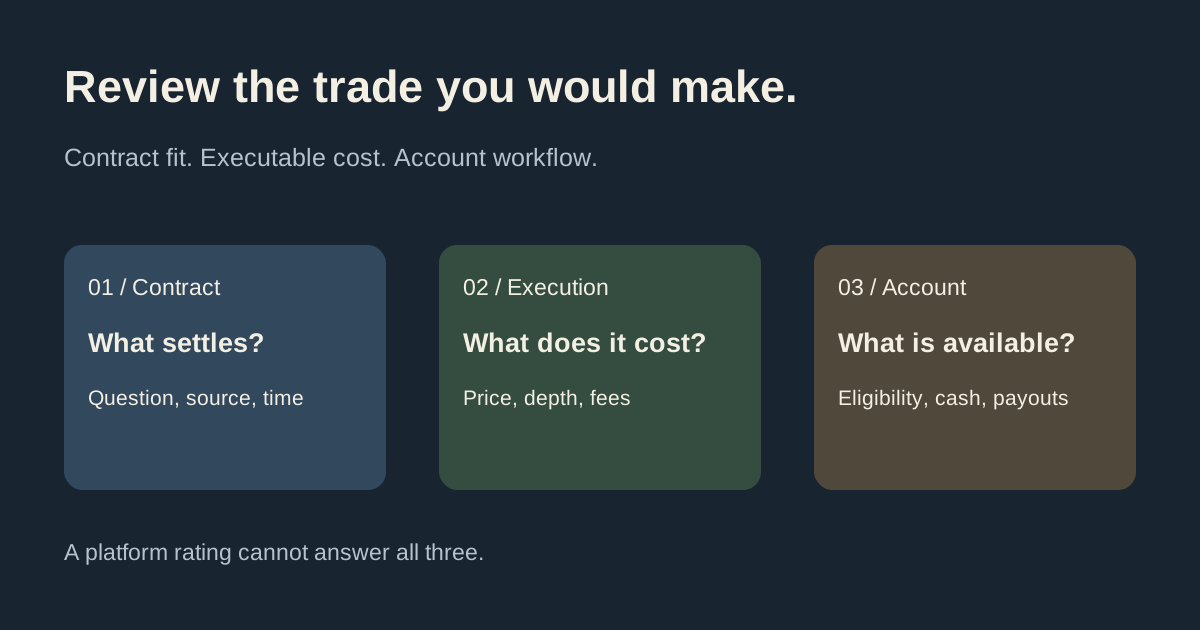
Evaluate Kalshi against the exact contracts, trading costs and account services you need. Its official help describes bank and card payouts, signed-in support and profit-and-loss records. These are useful features to investigate, but their existence does not establish that every account has the same access, that an exit will fill or that you will make money.
Reviewed October 6, 2026. This is a documentation-based product review, not an authenticated deposit, trade or withdrawal test. We link the sources behind factual statements and separate them from our assessment. We do not assign a customer star rating or claim to have surveyed users.
Kalshi review: the practical assessment
Kalshi is worth investigating when you want to research and trade a specific event contract and can verify that the product, location and account requirements fit your situation. The useful question is whether its executable market and account workflow meet your needs at an acceptable cost.
Our assessment favors checking concrete workflows over awarding points for a platform's reputation. A documented bank payout option can be useful if you have an eligible US account. It cannot substitute for checking available cash, a deposit hold or the receiving institution's processing.
| Area | Useful feature to investigate | Limit or condition to check |
|---|---|---|
| Account funding and payouts | Documented bank and debit-card withdrawal routes | Account eligibility, holds, supported destinations and method-specific timing |
| Support | Signed-in messenger with an email fallback | Response times vary; no universal resolution deadline |
| Performance records | Documents tab with P&L statements after trades | Full history matters more than a winning-ticket screenshot |
| Trading and exits | Inspect the selected contract's order book and rules | A displayed price does not establish depth or a fill at your intended size |
| Incentives | Published liquidity-program terms for qualifying activity | Rewards have eligibility and scoring conditions; they are separate from trading profit |
Trading costs: compare the whole transaction
Read the current venue fee schedule and the order quote for the precise market and order type. A review that says “no hidden fees” without identifying the trade, payment method and date is not enough to estimate your own costs.
Spread, execution price, quantity filled and fees answer different questions. A limit controls your acceptable price; it does not guarantee that the quantity you want will trade. Use the order-book guide to inspect bids, asks and resting size, and the slippage calculator for an educational depth scenario.
For a fictional binary contract, 80 winning contracts purchased at 55¢ cost $44 and pay $80 at $1 each. That leaves $36 before fees. If total fees in this fictional example are $2, net profit is $34. If the position instead settles to $0, the loss is $46 including those assumed fees. The $80 payout is not an $80 profit, and the assumed $2 is not a quoted Kalshi fee.
Before comparing venues, match the underlying question, settlement source, time window and tie rule. Then compare executable prices for the same intended size. An attractive headline price is not enough to establish which venue gives you the better completed trade.
Withdrawals: what the official methods say
The bank-withdrawal page lists no venue fee, limits bank payouts to US users and describes typical arrival within a few business days. Recent deposits can have a hold. That is a method description, not a promise that every individual payout takes the same time.
The debit-card page lists no venue fee and typical arrival within hours, while noting issuer differences, personalized daily limits, unsupported destinations and processor reviews. A normal payout estimate and a review period are different clocks.
The security-holds page points to the account withdrawal screen for deposit availability and excludes funds in open positions from available withdrawals. Do not interpret a portfolio screenshot as proof that its total can be sent to a bank.
Read the withdrawal guide for method and account distinctions, or the deposit guide for a funding issue. This review does not measure successful-payout rates or establish a typical customer experience from selected posts.
Customer support: messenger, fallback and response scope
Kalshi's official contact instructions prefer the messenger while signed in, with an email fallback if it cannot be reached. They say response times vary and phone-call/text support is unavailable. Avoid relying on an older review that says support is email-only or guarantees a 24–48-hour response.
For an issue report, preserve the exact status, time, account type and order or transfer reference. Distinguish an acknowledgement from a resolved issue. Our support guide includes a concise template and the current routes.
Kalshi app review: test the tasks that matter to you
Interface quality is partly personal and can change with releases. Rather than calling the app universally intuitive or fast, check whether you can find the exact contract, read its settlement rule, interpret the order quote, locate a position and retrieve your account documents. Include the device and app version when assessing a problem.
The trading-history guide describes profit-and-loss statements in the documents tab after trades. Compare the complete period's record with fees and remaining exposure. A screenshot of one result cannot establish your overall return.
Use the demo-account guide to explore documented practice and API environments. Mock funds are not live money, and success in a test environment does not prove live eligibility or execution.
Rewards belong in a separate ledger
Kalshi's liquidity-program documentation describes eligible resting orders, scoring and program conditions. Check the particular market's active terms. A headline pool is not your personal award and can change.
For a fictional period with $18 of paid rewards, $25 of trading losses and $3 of fees, the combined result is a $10 loss. Keep rewards, trading gains/losses and fees separate before adding them. Use the liquidity-rewards guide for the program workflow.
How to use customer reviews without inventing a consensus
Reviews can identify questions you should investigate. Look for a dated experience, the relevant method or contract, the observed state and a later outcome. Do not combine a complaint thread, a handful of positive screenshots and an app-store score into a new “overall rating” without a defined dataset and method.
Our Reddit community guide links to bounded discussion examples and explains their limits. A selected set of posts cannot establish the frequency of delays, the quality of support for most users or the profitability of a strategy.
Compare Kalshi with your actual alternatives
Use the Kalshi-versus-Polymarket comparison to distinguish platforms and access requirements. Compare the exact contract and account services you would use; avoid treating Polymarket US and the international platform as one interchangeable account.
Before funding, record the contract you want, product/location eligibility, quoted trade cost, likely exit depth, payout method and support route. If a required detail is unclear, resolve it using the current venue documentation or account support. Alphascope's prediction-market research can help investigate the underlying event; the venue's contract and order quote govern the actual trade.