
On this page
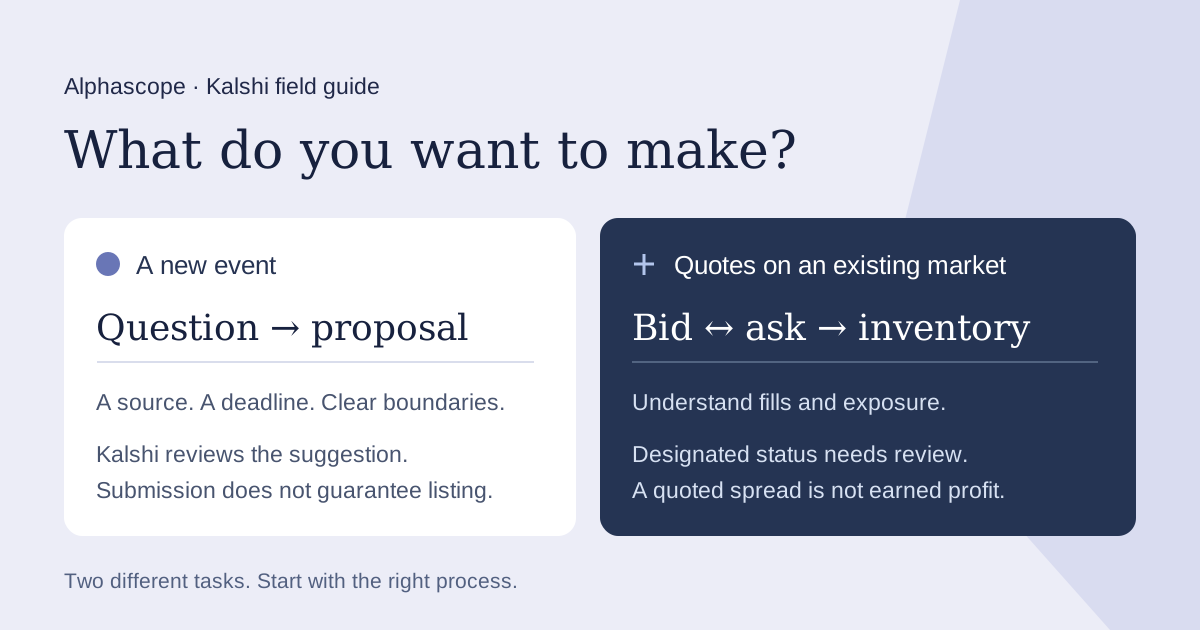
To suggest a new market on Kalshi, use the submission link in its official market-suggestion guide. Kalshi reviews ideas for regulatory compliance, resistance to manipulation, and user interest. A suggestion does not guarantee a listing. If you mean quoting buy and sell prices on an existing contract, that is market making—a different activity.
This guide was checked against Kalshi's documentation on October 12, 2026. Use the proposal worksheet below to clarify your idea before sending it through the official process. The worksheet is an Alphascope drafting aid; it does not create a contract or submit anything to Kalshi.
Create a new event or make markets?
| Your goal | What to do | What it does not establish |
|---|---|---|
| Propose an event that is not listed | Draft the question and use Kalshi's official suggestion process | Approval, a launch date, or permission to define the exchange's final rules |
| Understand quoting on an existing contract | Study bids, asks, fills, and inventory risk | Designated market-maker status |
| Join the designated market-maker program | Review the program's eligibility and ongoing obligations | Automatic approval or guaranteed returns |
A new market needs a resolvable event. A market maker needs a way to manage exposure when quotes fill. Choosing the right task first avoids spending time on a trading strategy when your actual goal is to get a new question considered.
Draft a question someone else can resolve
The following is our editorial checklist, not an official application requirement. Aim for a proposal that another reader can interpret without asking what you meant.
- Name the event. Replace a subjective phrase such as “a successful launch” with an observable action or published measurement.
- State the threshold. Specify whether “at least” includes the boundary. Include units, location, and the measurement period.
- Identify a public source. Link to the proposed report, record, or announcement and explain which field would determine the outcome.
- Separate the event deadline from publication. The event may end before its result becomes public. State dates and time zones clearly.
- List ambiguous cases. Consider a delayed report, correction, cancellation, or disagreement between sources. Flag unresolved cases for review.
- Explain why people would care. Describe the audience and uncertainty rather than promising trading volume or profits.
Prediction-market prices help summarize uncertainty, but a price cannot repair an unclear settlement question. Read our Kalshi settlement guide to understand why the final contract rules matter.
A fictional proposal: make the boundary explicit
Suppose a fictional Riverton library publishes a monthly visitor report. “Will the library have a busy November?” leaves “busy” undefined. A clearer draft might be:
Will Riverton Library report at least 10,000 visits for November 2026 in its monthly visitor report?
This is an invented example, not a listed or approved market. The library and report are fictional. Before submitting a real version, replace them with a verifiable institution and source.
- Boundary: 9,999 visits falls below the proposed threshold; 10,000 meets it.
- Measurement: Visits and unique visitors are different counts. Choose the report's actual field.
- Timing: Define when the report is expected and how long a delayed publication could leave the result unknown.
- Revisions: Ask whether an initial or corrected report should count. Do not quietly change the definition after seeing the number.
The useful part of the exercise is discovering unanswered questions. A crisp headline with a missing source or undefined fallback still needs work.
Use the market-proposal worksheet
Download the blank proposal worksheet and fill in the question, source, dates, edge cases, and audience. It contains no account information and asks for no credentials. Keep private personal or payment details out of an event proposal.
Then return to the official market-suggestion guide and follow its current submission link. Keep a copy of your draft. Kalshi decides whether to list the event and what final rules to use; this guide supplies no approval timeline.
How the Kalshi market-maker program differs
Kalshi's designated market-maker guide describes a review of financial resources, experience, and reputation. Approved participants undertake ongoing two-sided liquidity obligations. Reduced fees or adjusted position limits are conditional benefits, and trading can lose money.
Its Liquidity Provider Program separately describes a Market Maker Agreement and auctions for designated providers in incentivized series. A reward depends on meeting the period's requirements. Reading the page or placing an ordinary limit order does not prove admission.
As a fictional illustration, buying 100 contracts at 45¢ and later selling all 100 at 47¢ produces a $2 price difference before fees. If only the buy fills, the matching sale has not happened: you still hold the position. A quoted spread is therefore not a completed profit.
Explore partial fills with the Kalshi limit-order simulator. For the separate resting-order reward workflow, read our Kalshi liquidity-rewards guide. Alphascope provides research context; review any application or order on Kalshi itself.