
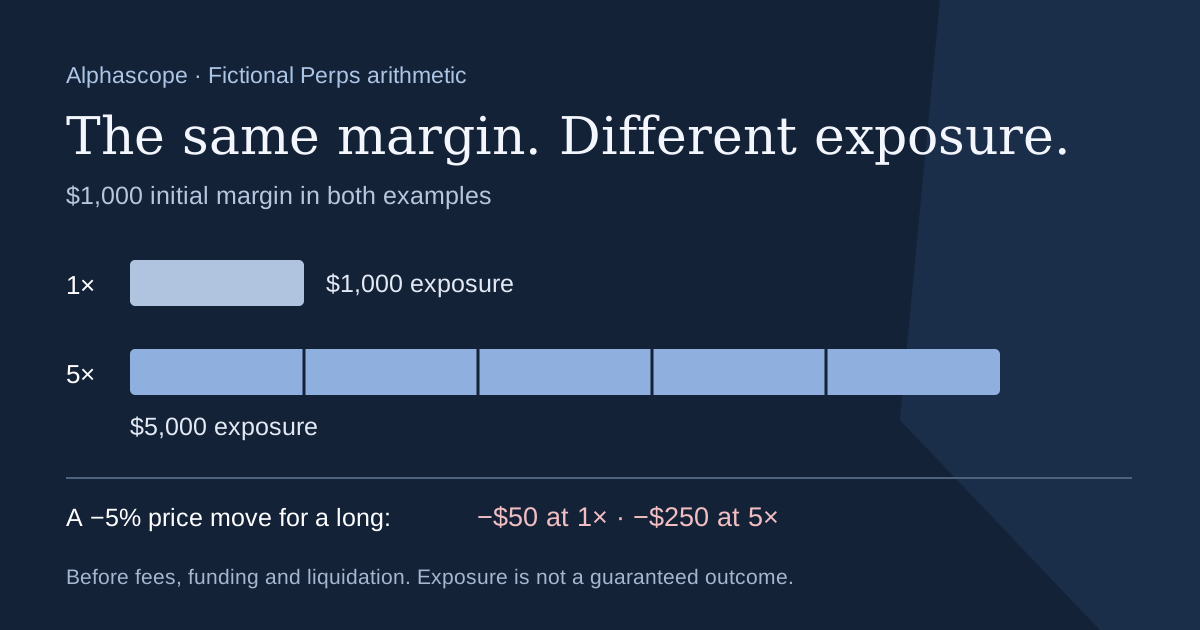
Same price move. Different exposure.
A fictional linear Perps scenario, not a venue quote. Compare notional exposure and price gains or losses. Fees and funding are your assumptions; no account or order is connected.
- Modeled notional exposure
- $5,000.00
- Price-only P&L
- -$250.00
- Net modeled P&L
- -$250.00
- Net return on initial margin
- -25%
Exposure = margin × leverage. Price-only P&L = exposure × price change × direction. Net P&L subtracts entered fees and net funding cost.
| Leverage | Exposure | Net P&L | Return |
|---|---|---|---|
| 1× | $1,000.00 | -$50.00 | -5% |
| 3× | $3,000.00 | -$150.00 | -15% |
| 6× | $6,000.00 | -$300.00 | -30% |
No maintenance-margin threshold, mark-price path, liquidation execution, slippage or account eligibility is modeled. The 1×–6× choices are lesson inputs, not a guarantee that a contract or account offers each setting.
On this page
Kalshi offers leveraged perpetual futures, or Perps, separately from its Predictions product. The official Perps overview describes up to 6× leverage for its Bitcoin contract. Check the specific contract and your account's available settings; this is not a promise that every Kalshi market supports leverage. Sources reviewed October 12, 2026.
The calculator above is an independent lesson in exposure and price-change arithmetic. It does not quote Kalshi's margin requirement, predict liquidation, or recommend a position. Start with its fictional defaults, then compare the same movement at different leverage levels.
Kalshi Predictions and Perps are different products
| Question | Predictions event contract | Perpetual futures |
|---|---|---|
| What determines the result? | A contract's defined Yes/No event and settlement rules | Price movement in an underlying asset |
| What does the clock mean? | An event deadline and settlement process | No fixed contract expiration; funding can apply while held |
| What should I check? | Contract terms, purchase cost, fees and available depth | Contract specifications, margin, leverage, liquidation and funding |
The official overview distinguishes these instruments. Do not interpret a cheap event contract as a margined Bitcoin position. Our order-book guide explains event-contract execution, while the stop-loss guide separates Perps controls from Predictions auto sell.
How leverage changes the same price move
In a simplified linear scenario, notional exposure = initial margin × leverage. Price-only profit or loss equals that exposure multiplied by the underlying's percentage move, with the sign reversed for a short position.
For an original fictional example, assume $1,000 initial margin and 5× exposure. The notional is $5,000. A 5% fall gives a long position a $250 price loss, or 25% of the initial margin. The same movement gives a short a $250 price gain before costs. These are arithmetic comparisons, not executable quotes.
At 1×, the same $1,000 margin and 5% movement changes the price result by $50. At 6×, it changes it by $300. Larger exposure magnifies both directions. It does not improve the underlying forecast.
Add an assumed $10 of trading fees and $5 of funding received to the 5× long example: −$250 − $10 − (−$5) = −$255. The net return on the assumed $1,000 margin is −25.5%. The calculator treats positive funding as paid and negative funding as received; it does not fetch a live rate.
Initial margin is not the liquidation threshold
Kalshi's margin guide distinguishes collateral to open a position, the maintenance threshold to keep it open, and variation margin from changing profit or loss. It says isolated margin is the app's currently available mode. The general Perps overview also discusses cross margin; do not infer app availability from that general description.
Dividing 100% by leverage gives a simplified movement that consumes the initial margin before costs. It is not an exact liquidation distance. Maintenance requirements, mark prices, fees, funding, and the position's path affect a real account. That is why this calculator does not display a liquidation price.
Use the account's position details and current governing terms for the applicable requirement. Kalshi's liquidation guide describes closure when equity falls below maintenance margin. A remaining positive amount in simplified arithmetic does not establish that a real position is still open.
Costs and interruptions change the result
The Perps risk guide describes funding every eight hours, sharp price moves, liquidation and operational disruptions. Funding can accumulate while a position is held. During unscheduled outages, orders may not be executable.
The margin guide also warns that exceptional losses can exceed posted margin and describes financial safeguards. Do not treat the lesson's initial margin as a guaranteed loss cap. A stop-loss instruction and clearinghouse safeguards serve different purposes; neither makes the modeled result an assured trade outcome.
Who can access Kalshi Perps?
The access guide says US-based KYC-verified users can apply for a separate margin account. It describes a questionnaire, review and a mandatory educational tutorial after approval. Access is not automatic, and an application can be declined. This guide does not apply for an account or evaluate your eligibility.
Read the product before interpreting the number
- Identify the instrument. An event-contract price and an asset's notional exposure are different numbers.
- Record the basis. State whether a return is measured against initial margin, purchase cost or notional exposure.
- Separate assumed costs from actual charges. Reconcile fees and funding for the same period, counting each once.
- Check the live account record. A model does not tell you whether the venue filled, closed or liquidated a position.
Use Alphascope to research events and forecasts. For ordinary event-contract price and payout math, use the profit calculator. Keep that workflow distinct from the Perps scenario above.